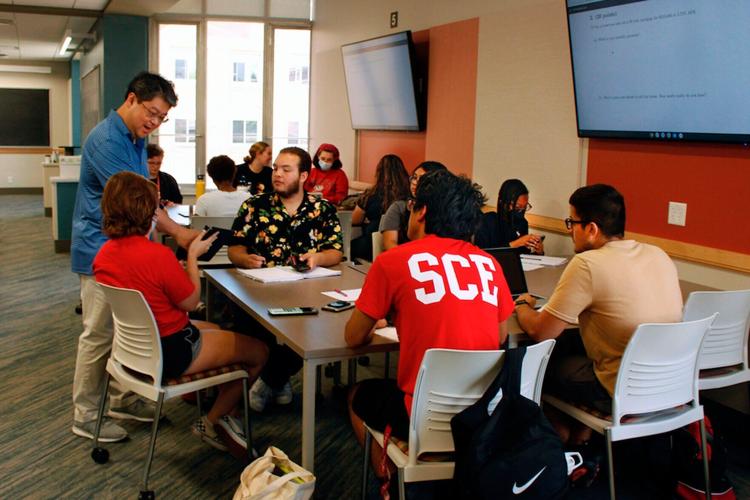
Angel Hope listens in a math class as part of an intense six-week summer bridge program for students of color and first-generation students at UW-Madison.
The COVID-19 pandemic shutdown created financial pressures, particularly for Division I programs with lost revenue from the cancellation of the NCAA men's basketball tournament and uncertainty about whether football — which largely funds schools' abilities to offer Olympic and lower-profile sports programs — would go forward at all.
Instructor Oh Hoon Kwon, left, speaks to UW-Madison students participating in an intense six-week summer bridge program. Hundreds of thousands of recent graduates are heading to college this fall after spending more than half their high school careers dealing with the upheaval of a pandemic.
kAm“p7E6C E9:D[ x 567:?:E6=J 766= AC6A2C65 7@C 4@==686[” 96 D2:5] “x7 x 5:5?’E 92G6 E9:D[ x H@F=5 36 :? 2 G6CJ 325 A=246]”k^Am
Higher education reporter Kelly Meyerhofer shares her favorite stories of 2021
After a bruising year brimming with horrific headlines, the first story I wrote in 2021 was filled with optimism for the year ahead: UW-Madison received its first COVID-19 vaccines.
COVID-19 complicated the transition for all freshmen last year, but especially for students who started their college careers from home. For one family, those complications were multiplied by four.
Angel Hope listens in a math class as part of an intense six-week summer bridge program for students of color and first-generation students at UW-Madison.
Instructor Oh Hoon Kwon, left, speaks to UW-Madison students participating in an intense six-week summer bridge program. Hundreds of thousands of recent graduates are heading to college this fall after spending more than half their high school careers dealing with the upheaval of a pandemic.