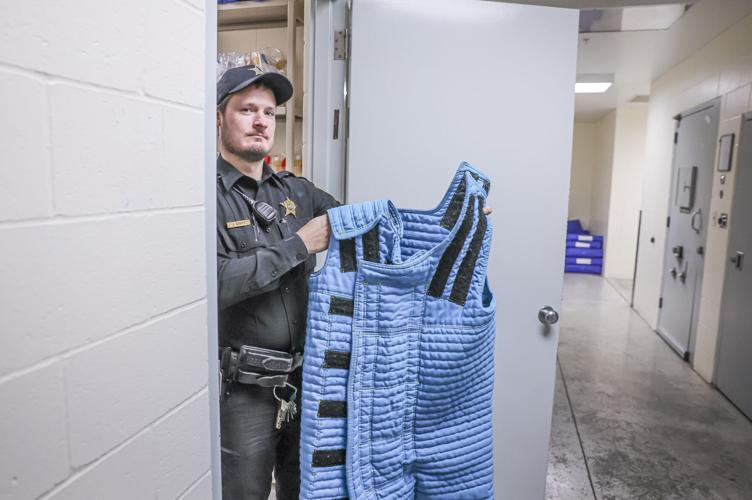
Despite repeated warnings from medical professionals, staff at the Sangamon County Jail placed 27-year-old Tiffany Rusher — who had a long, documented history of suicide attempts and self-harm — in an isolated cell for nearly four months, a lawsuit and jail records show.
In March 2017, she was found dead with “a strip of hand towel wrapped tightly around her neck.,” according to a lawsuit filed by her family.
Doctors had advised jail staff that Rusher should not be held in solitary confinement, noting her dozens of prior attempts to harm herself and her high risk for suicide.
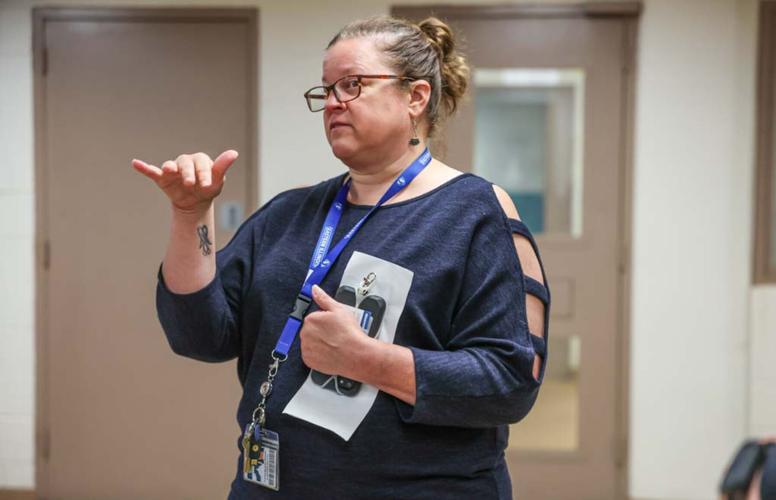
Jackie Mathias, director of inmate services and behavioral health at McLean County Jail, discusses jail programs.
As anxiety and isolation take a toll on employee mental health, here's how managers improve workplace culture
As more Americans become aware of the importance of mental health, work-life balance has become a priority for many working individuals. This makes sense, considering Americans working a traditional 40-hour workweek spend nearly 2,000 hours at work annually.
Technological advances like smartphones, email, and work-messaging platforms have allowed for near-constant contact between bosses and employees. At the same time, the rise of remote work and working with colleagues across time zones has blurred the line between working and nonworking hours.
In 2022, the Surgeon General issued guidance on workplace mental health, noting the relationship between work and well-being. Workplace stress, exacerbated by working long hours or in a toxic work environment, can have long-term effects on employees and their employers.
A 2024 American Psychological Association survey found that 2 in 3 workers reported experiencing signs of burnout in the previous month, such as reduced interest or effort at work, low energy levels, lack of motivation, or feelings of loneliness or isolation.
Economic factors such as stagnant wages and rising prices can also affect one's mental health. An October 2024 survey of 5,000 working adults showed financial insecurity had become a significant factor in decreased productivity, with a quarter of workers identifying finances as their greatest source of stress.
WorkTango examined data from the APA and health technology firm TELUS Health to see how employees feel about the culture surrounding mental health at work and how it's changed since 2020.
PeopleImages.com - Yuri A // Shutterstock
Workers' mental health stabilizes but still needs improvement
Overall, workers' mental health has improved since the COVID-19 pandemic upended the way people do their jobs and how they feel about them, according to the TELUS Mental Health Index, or MHI. The index measures the emotional well-being of employed adults on a scale of 0 to 100, with 80-100 being the optimal score.
Workers' mental health was at its lowest level in April 2020, when TELUS launched the index. By fall 2024, things had improved slightly but plateaued at 70.6. For the past three years, anxiety and isolation have continued to strain workers' mental health, with scores staying persistently low compared to other health measures, such as work productivity, depression, and financial risk.
Still, the latest data shows that fewer workers fell into the high-risk mental health group in October 2024 than in April 2020, when 1 in 4 workers were in that risk category. The type of job one has can play a role; managers have better mental health scores than laborers or those working in the service industry.
This can create a gap in understanding between employers and employees regarding workplace mental health and well-being, as well as a fear of speaking out. While workers are generally satisfied with their jobs—with 9 in 10 saying they're proud of their work, according to the APA—3 in 5 reported that their work environment is not as mentally healthy as their employer thinks. More importantly, 2 in 5 believe disclosing a mental health condition to their employer would negatively impact them.
WorkTango
How employers and employees can work to improve mental health at work
Creating a psychologically safe work environment, or a space where employees can voice their opinions without fear of reprisal, is vital for employers and employees. According to the APA, trust in the workplace fosters teamwork and helps creativity and innovation to flourish, which increases overall performance. Encouraging well-being in the workplace can also reduce the risk of chronic illness or stress, which can affect productivity.
The Surgeon General's 2022 report suggests five essentials for improving workplace culture: protecting workers from harm by prioritizing safety and security, creating an inclusive community that fosters belonging and trusted relationships, providing work-life balance with autonomy and flexibility, ensuring that people feel like they matter in the workplace, and allowing growth opportunities for their careers.
On an individual level, one strategy employees can use to reduce the likelihood of burnout and protect their mental health is to set boundaries to protect their time and energy. This could look like taking breaks for lunch, not checking work emails outside work hours, or discussing appropriate workloads.
There is no doubt that creating a work environment that prioritizes employee mental health and actively works to reduce the risk of burnout has wide-ranging benefits for both employers and employees. It fosters productivity, job satisfaction, and overall well-being while delivering measurable bottom-line results.
Story editing by Natasja Sheriff Wells. Copy editing by Paris Close. Photo selection by Clarese Moller.
This story originally appeared on WorkTango and was produced and distributed in partnership with Stacker Studio.
Theera Disayarat // Shutterstock
+5
Cassidy
Contact Drew Zimmerman at 309-820-3276. Follow Drew on Twitter: @DZimmermanLee
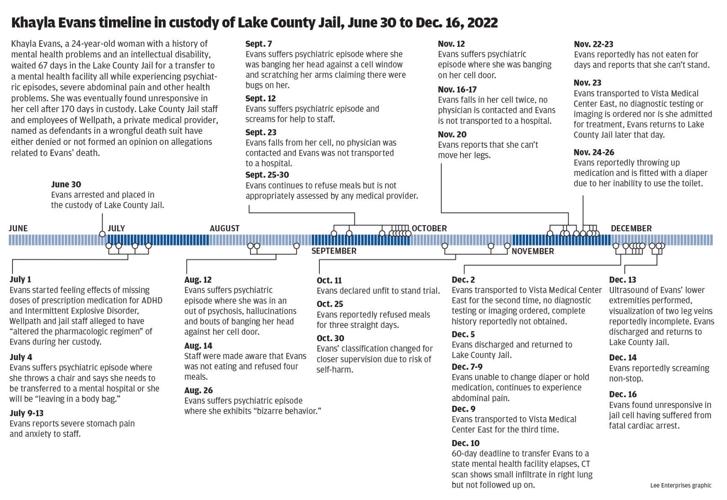
Khayla Evans’ timeline in custody of Lake County Jail from June 30 to Dec. 16, 2022
June 30: Evans arrested and placed in the custody of Lake County Jail.
July 1: Evans started feeling effects of missing doses of prescription medication for ADHD and Intermittent Explosive Disorder, Wellpath and jail staff alleged to have “altered the pharmacologic regimen” of Evans during her custody.
July 4: Evans suffers psychiatric episode where she throws a chair and says she needs to be transferred to a mental hospital or she will be “leaving in a body bag.”
July 9-13: Evans reports severe stomach pain and anxiety to staff.
Aug. 12: Evans suffers psychiatric episode where she was in an out of psychosis, hallucinations and bouts of banging her head against her cell door.
Aug. 14: Staff were made aware that Evans was not eating and refused four meals.
Aug. 26: Evans suffers psychiatric episode where she exhibits “bizarre behavior.”
Sept. 7: Evans suffers psychiatric episode where she was banging her head against a cell window and scratching her arms claiming there were bugs on her.
Sept. 12: Evans suffers psychiatric episode and screams for help to staff.
Sept. 23: Evans falls from her cell, no physician was contacted and Evans was not transported to a hospital.
Sept. 25-30: Evans continues to refuse meals but is not appropriately assessed by any medical provider.
Oct. 11: Evans declared unfit to stand trial.
Oct. 25: Evans reportedly refused meals for three straight days.
Oct. 30: Evans’ classification changed for closer supervision due to risk of self-harm.
Nov. 12: Evans suffers psychiatric episode where she was banging on her cell door.
Nov. 16-17: Evans falls in her cell twice, no physician is contact and Evans is not transported to a hospital.
Nov. 20: Evans reports that she can’t move her legs.
Nov. 22-23: Evans reportedly has not eaten for days and reports that she can’t stand.
Nov. 23: Evans transported to Vista Medical Center East, no diagnostic testing or imaging is ordered nor is she admitted for treatment, Evans returns to Lake County Jail later that day.
Nov. 24-26: Evans reportedly throwing up medication and is fitted with a diaper due to her inability to use the toilet.
Dec. 2: Evans transported to Vista Medical Center East for the second time, no diagnostic testing or imaging ordered, complete history reportedly not obtained.
Dec. 5: Evans discharged and returned to Lake County Jail.
Dec. 7-9: Evans unable to change diaper or hold medication, continues to experience abdominal pain.
Dec. 9: Evans transported to Vista Medical Center East for the third time.
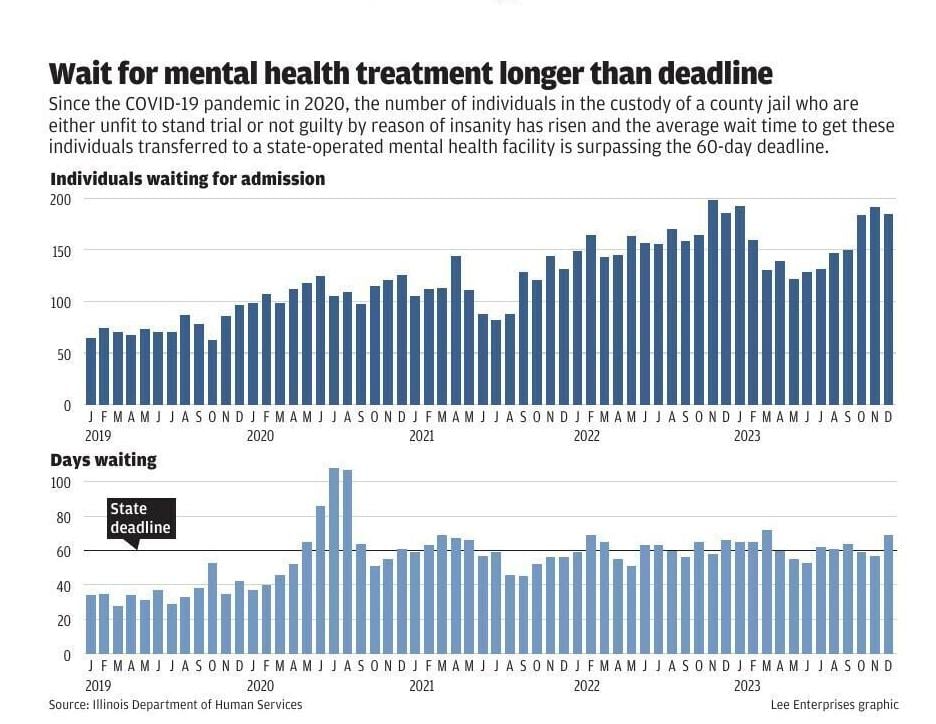
Dec. 10: 60-day deadline to transfer Evans to a state mental health facility elapses, CT scan shows small infiltrate in right lung but not followed up on.
Dec. 13: Ultrasound of Evans’ lower extremities performed, visualization of two leg veins reportedly incomplete. Evans discharged and returns to Lake County Jail
Dec. 14: Evans reportedly screaming non-stop.
Dec. 16: Evans found unresponsive in jail cell having suffered from fatal cardiac arrest.