


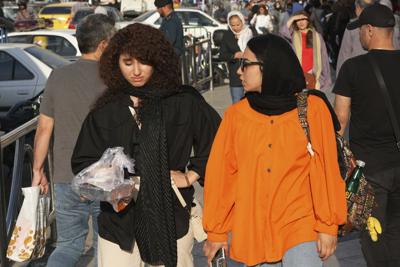
TEHRAN, Iran — Billboards across Iran's capital proclaim that women should wear their mandatory headscarves to honor their mothers. But perhaps for the first time since the chaotic days following Iran’s 1979 Islamic Revolution, more women — both young and old — choose not to do so.
People are also reading…

A woman walks around Tajrish commercial district without wearing her mandatory Islamic headscarf April 29 in northern Tehran, Iran.
A look at the top historical sites in Iran
1. Naqsh-e Jahan Square

From TripAdvisor: Also known as Isfahan Royal Square, a huge open area built in the 17th century is adorned by impressive mosques, fountains and bazaar.
2. Shushtar Historical Hydraulic System

From Fars Travel Company, which offers tours of the site: "Inscribed on UNESCO World Heritage list in 2009 as a ‘masterpiece of creative genius’, the Shushtar Historical Hydraulic System in southwest Iran is a destination for history buffs, nature lovers and travelers who eyewitness how the prehistoric yet homogeneous hydraulic system works."
3. Imam Reza Holy Shrine

Muslim Pilgrims visit the mausoleum of Imam Reza, the 8th Shiite Muslim's Imam and grandson of the Prophet Mohammad in Mashhad, 900 km (540 miles) in northeastern of Tehran, Iran Monday, Aug. 11, 2008. Today the holy shrine and its museum hold one of the most extensive cultural and artistic treasuries of Iran, in particular manuscript books and paintings. Several important theological schools are associated with the shrine of the Eighth Imam. There are also over 20 million pilgrims who visit the shrine every year.
4. The Tabatabaei House

From the Tabatabaei House website: "The Tabatabaei house is the bride of the houses of Iran. Its flawless architecture and superbly beautiful appearance have brought it a reputation for it. The Tabatabaei House as a Tourist Attraction is one of the most valuable houses in Iran, which can be seen in that the elements of Iranian architecture and is a masterpiece of Kashan's architecture."
5. Jameh Mosque of Yazd

The Jameh mosque was built in the 12th century mosque. The entrance, shown here on right, is decorated entirely in tile work.
6. Qavam House

The Qavam House was built in the late 1800s for the Qavam family. Today it's a museum and is open to the public.
It's also known as Narenjestan e Ghavam.
7. Vakil Bazaar

From Fars Travel Company: "Bazaar-E-Vakil of Shiraz is one of the most famous historical and traditional bazaars of Iran. This bazaar had been built with the order of Karim Khan Zand (Iranian King) at about 200 years ago. (It is thought that the market originally was established by the Buwayhids in the 11th century AD, and was completed mainly by the Atabaks of Fars, and only was renamed after Karim Khan Zand in the 18th century.)"
8. Eram Garden

The historic Persian garden is a World Heritage Site and protected by Iran's Cultural Heritage Organization. It's open to the public as part of the Shiraz Botanical Garden.
9. Chehel Sotoun

From IranReview.org: "The name, 'Forty Columns,' was inspired by the twenty slender wooden columns supporting the entrance pavilion, which, when reflected in the waters of the fountain, are said to appear to be forty."
10. Kandovan

Kandovan is an ancient city built into the side of foothills near Mount Sahand. About 600 people still live there.
It's similar to the more well known cliff city of Cappadocia in Turkey.




.jpg)


