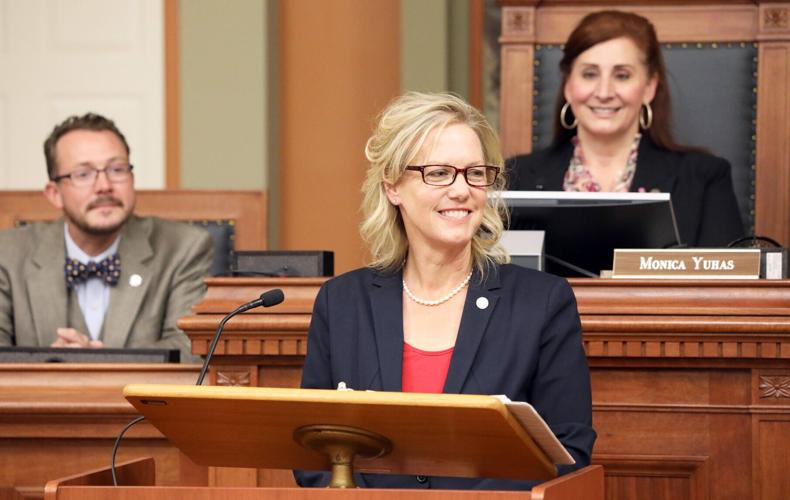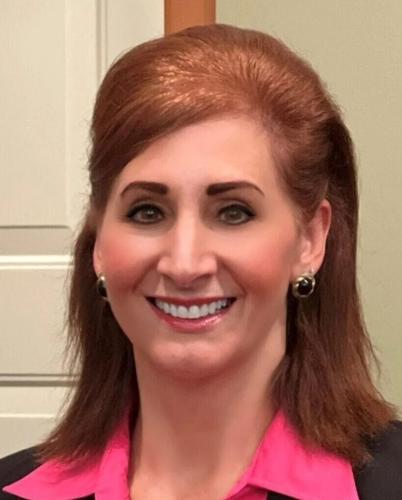

A Kenosha County Board supervisor who currently chairs the board has announced she will not seek office to the District 17 post she has held the last eight years.
People are also reading…
Kenosha County Executive Samantha Kerkman delivers her administration’s proposed 2026 budget to the County Board Tuesday night, Oct. 7, 2025.…
2022 Midterm Election results in Kenosha County
WATCH NOW: Amanda Nedweski wins Wisconsin Assembly District 61 seat
Republican candidate Amanda Nedweski won the race for Wisconsin Assembly District 61 Tuesday, taking the seat formerly held by current County Executive Samantha Kerkman.
Nedweski, of Pleasant Prairie, a county board supervisor for Kenosha County District 16, received 17,538 votes while political newcomer Max Winkels of Burlington received 9,848 votes. Nedweski received 64% of the vote, Winkels 35.94%.
Vocabulary of voting: A glossary guide to the 2022 midterms
Advance voting
The term “advance voting” is preferred in states where voters have several options to vote before Election Day. It can mean a few different things: mail-in ballots, absentee ballots and early, in-person voting.
Absentee ballots
Voters who can’t go to the polls on Election Day itself often vote absentee, getting a ballot — either by mail or in-person — and casting it ahead of time. Twenty-seven states and the District of Columbia offer “no-excuse” absentee voting. This means that any voter can request and cast an absentee or mail ballot without providing a reason.
AP VoteCast
First used in 2018, AP VoteCast is a survey of the American electorate conducted by NORC at the University of Chicago for Fox News and The Associated Press. VoteCast is not an exit poll.
Canvassing the vote
After votes are cast, officials check lists of voters against the number of ballots cast and research any discrepancies, which often are due to clerical errors or mistakes.
Certification
Votes also have to go through the certification process at the local and then state levels, either involving a board composed of statewide officials such as the secretary of state and governor, or solely the secretary of state. Hawaii is the only state where certification is overseen by a nonpartisan chief election official appointed by a bipartisan commission. In 45 states, the local boards that handle election certification are either party-controlled or commissions where the members are elected on a partisan basis, according to research by the advocacy group Election Reformers Network.
Early returns
As votes are cast and counted across the country, they are tabulated and reported, before races themselves are called. Early returns often do not provide an accurate reflection of the ultimate outcome, especially in states that take days or weeks to count votes cast in advance and provisional ballots.
Exit polls
In the U.S., exit polling is a survey of voters conducted by the National Election Pool — a network of broadcasters — using a methodology based on in-person interviews at polling places.
"Late earlies"
Some advance ballots don't get turned in or received until Election Day. These “late earlies,” as they're known in states like Arizona, can often lead to vote counts taking several days to complete in some places, although the state does permit both ballot processing and counting prior to poll close.
Mail voting
Eight of the states that offer no-excuse absentee voting automatically mail a ballot to every eligible voter, without necessitating a request or application. That doesn’t mean that there aren’t in-person polling locations, too, but most people in these places vote by mail.
Majority & plurality
A majority is more than half the votes cast; a plurality is the largest number of votes, but less than a majority. In states like Georgia, where a candidate needs a majority to win, runoff elections may be necessary to determine who ultimately wins a contest.
Overvote and undervote
An overvote is when a voter selects too many candidates in a given race. Conversely, an undervote means that a voter hasn’t made a selection for each office on the ballot, leaving some blank.
Poll monitors/poll watchers/citizen observers
The terms poll monitors, poll watchers and citizen observers are interchangeable, and they can be partisan or nonpartisan. Nonpartisan poll watchers are trained to monitor polling places and local elections offices that tally the votes, looking for irregularities or ways to improve the system. Partisan poll watchers are those who favor particular parties, candidates or ballot propositions and monitor voting places and local election offices to ensure fairness to their candidates or causes. Since the 2020 election, a handful of states passed laws limiting the restrictions that local election officials can place on poll watchers, giving them greater access to ballot counting and processing.
Poll workers
Distinct from poll monitors or observers, poll workers are the people — many times volunteers — manning voting locations on Election Day.
Provisional ballots
Called “challenge” or “affidavit” ballots in some states, provisional ballots are required by the federal Help America Vote Act of 2002 to ensure that voters' choices aren't discounted due to administrative error. Voters are given a provisional ballot when there is some uncertainty about their eligibility, like a name not appearing on voter rolls. In most places, provisional ballots are kept separate from other ballots until after the election, when an election board decides if the voter was indeed eligible, and therefore whether the vote should be counted.
Race call
AP calls winners of elections in the United States based on an analysis of the vote count, polling research and other data. An AP race call is not a projection; AP only makes race calls when it is determined that a trailing candidate has no path to overtake a leading candidate.
Ranked choice voting
In this electoral system, voters rank their choice of candidate by ordered preference, with those rankings used to determine a winner in the event no candidate wins a majority of ballots on which they appear as voters’ first preference. If a candidate wins over 50% in the first round, it’s over. If not, round two starts with the candidate who got the fewest votes in the first round being eliminated. If the eliminated candidate was your vote then your next choice gets your vote in this round.
Only a handful of states use ranked-choice voting now, but its use is being debated in other places.
Spoilt ballot/ballot spoiling
A ballot is considered spoiled when officials have deemed it invalid, for reasons deliberate or not, and therefore not to be included in vote totals. In some places, like Wisconsin, the rarely used practice of ballot spoiling has been challenged in court, in circumstances when a voter submits an absentee ballot, then voids the original ballot and votes again.
Supermajority
A requirement that a proposal or candidate gain a level of support that exceeds the threshold of a standard 50% plus 1 majority.
Too early to call
Races in which the vote count is active and ongoing and a winner is not yet clear are “too early to call.” That includes races in which the vote count may take several days.
Too close to call
Races in which the vote count has reached its primary conclusion – all outstanding ballots save provisional and late-arriving absentee ballots have been counted – without a clear winner are “too close to call.” AP formally declares a race “too close to call” via our election reporting system and in our news report.
WATCH NOW: Majority of Kenosha County voters favor Wisconsin becoming sanctuary state for gun owners
Kenosha County voters Tuesday night told their state legislators by a close margin that they favored Wisconsin becoming a sanctuary for gun owners.
By a vote of 32,362 to 30,126, or 51.79% to 48.21%, respectively, a majority of county residents sided with an advisory referendum with its basis in the Second Amendment to the U.S. Constitution, which guarantees the right to keep and bear arms.
Rebecca Matoska-Mentink wins fifth term for Kenosha County clerk of courts
Rebecca Matoska-Mentink won a fifth term as Kenosha County Clerk of Courts Tuesday night.
Matoska-Mentink, a Democrat, defeated County Supervisor Zach Rodriguez, a Republican. Matoska-Mentink won 52.9% of the vote (34,322) and Rodriguez won 47.01% (30,500), according to unofficial results.
Kenosha Clerk of Courts Rebecca Matoska-Mentik, right, hugs her grandson Lucas Matoska, 2, as her son, Tony Matoska, looks on after winning her election on Tuesday, Nov. 8, 2022.
City of Kenosha votes overwhelmingly in support for legalizing and taxing marijuana in non-binding referendum
City of Kenosha residents voted overwhelmingly Tuesday in a non-binding referendum in support of legalized, taxed and regulated marijuana.
Residents voted 71.93% (23,952) to 28.07% (9,347), according to unofficial results. The following question appeared on city ballots: “Should marijuana be legalized for adult use, taxed, and regulated like alcohol?”
US President Joe Biden on Thursday pardoned thousands of Americans convicted of marijuana possession in a major new step towards destigmatizing the drug -- and fulfilling a promise to his supporters a month before midterm elections.
WATCH NOW: U.S. Rep. Bryan Steil wins re-election, visits Kenosha County on election night
U.S. Rep. Bryan Steil, R-Janesville, won a third term in U.S. House of Representatives Tuesday night.
Steil, who attended an election night watch party at Parkway Chateau, 12304 75th St., in Kenosha while returns were being counted, expressed his appreciation to the public for supporting him for another term.
U.S. Rep. Bryan Steil, R-Janesville, speaks at the Parkway Chateau as Kenosha County Executive Samantha Kerkman looks on after he won reelection on Tuesday.