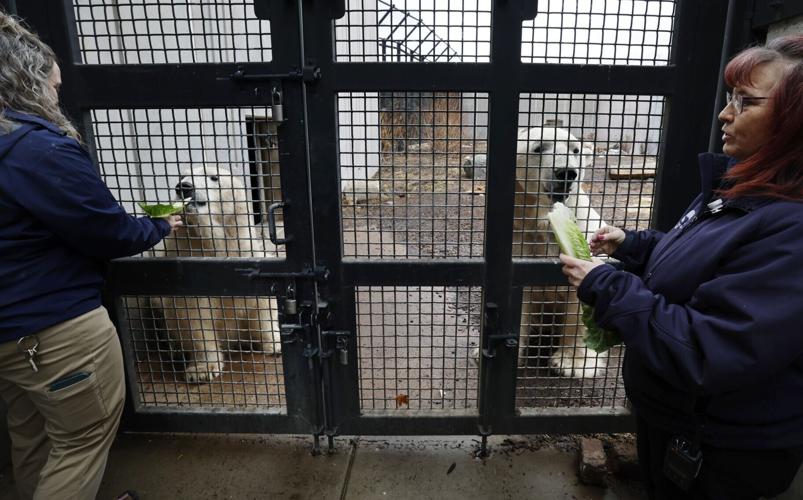

The emotion of the moment caught me a bit off guard.
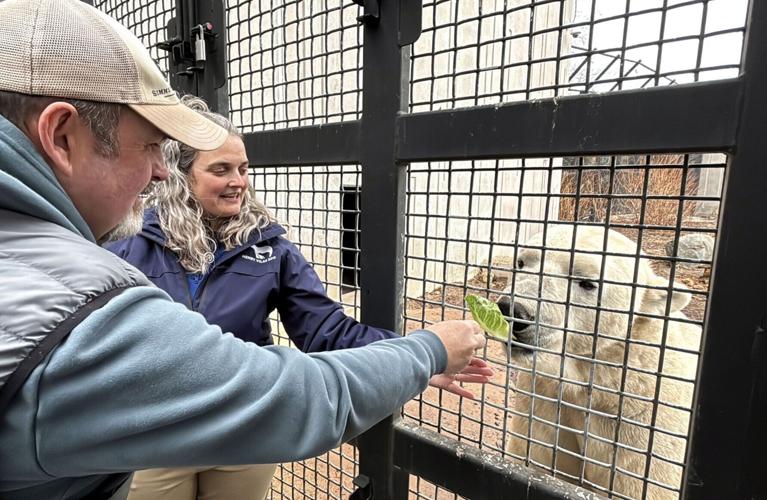
An 1,100-pound polar bear named Siku had just consumed a leaf of fresh romaine lettuce I had poked through a steel-mesh fence. As I backed away, I became choked up.
Maybe it was realizing the unique opportunity that had just occurred: feeding one of only 35 polar bears housed in zoos or aquariums in the U.S.

Wisconsin State Journal reporter Barry Adams feeds a leaf of romaine lettuce to 1,100-pound Siku during a behind-the-scenes tour of the polar bear exhibit at Vilas Zoo. Polar bear are fed fish, beef, apples, carrots and sweet potatoes but enjoy romaine lettuce as a snack.
Or maybe it was the relief of knowing that the thin but sturdy fence at Henry Vilas Zoo kept me from being the main course for an animal with paws the size of dinner plates.
In the wild, polar bears in the Arctic hunt ringed and bearded seals, which have thick blubber. Let’s just say Siku would not have been disappointed with my BMI.

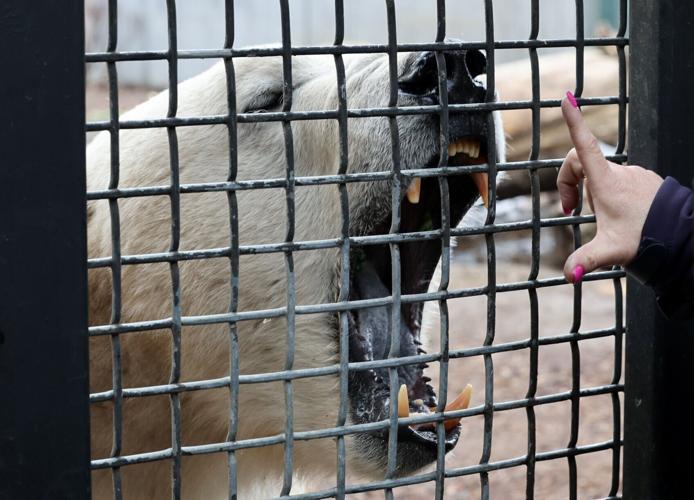
Johanna Soto, zoo manager, uses a hand signal to get Siku to open his mouth. The training allows for zoo staff to inspect teeth and other parts of the mouth without having to anesthetize the animals.
It was mid-February during a behind-the-scenes tour of the Arctic Passage, and Nora and Siku were in love. It would be the first of several visits to one of the country’s only free zoos for photographer Amber Arnold and me to begin our reporting on the incredible journey of Nora, who lives at the zoo with the 16-year-old Siku and the 27-year-old female Berit.
People are also reading…
Nora was born at the Columbus Zoo and Aquarium in Ohio in November 2015, abandoned by her mother and hand-raised by zoo keepers. Ten years and 600 pounds later, she's here in Madison, where her keepers are hoping she’ll bear a cub or cubs fathered by Siku.
Johanna Soto, the zoo manager, and Kristin Myers, a lead keeper at Henry Vilas Zoo, led us through a gantlet of hallways, steel gates and finally a steel door. We turned a corner into an outdoor area out of view from the public, and there, on the other side of the fence, were Nora and Siku, a combined 1,700 pounds of polar bear.

Led zookeeper Kristen Myers, left, feeds lettuce to Nora while zoo manager Johanna Soto treats Siku at the Henry Vilas Zoo.
Armed with heads of romaine lettuce, Soto and Myers began peeling off leaves and pushing the lettuce through the square holes of the mesh, mindful not to allow their fingers into the holes.
Siku and Nora would have likely preferred seal blubber, salmon or sweet potatoes, but eagerly took the leafy offerings from Soto and Myers.
“Romaine lettuce is not a typical item that bears like to eat but in zoos we have found that polar bears really seem to enjoy romaine lettuce,” Meyers said. “It’s really a great treat because it’s basically zero calories. They can have as much as they like.”
So I simply asked, kind of in a hushed tone if Arnold and I could give it a try. Remarkably, Soto and Myers obliged.
Arnold went first. With Myers acting as a guide, Arnold reached out her right-hand and led with the butt end of a piece of lettuce. Siku, whose nose was just a few inches from the fence, leaned in and pulled the lettuce through the opening. The lettuce disappeared in just a few seconds, leaving Arnold with a huge smile.
Myers handed me a piece of lettuce, I poked it through the fence, and Siku took the offering.
It reminded me of a dog when you tell it to “take it nice.” It was that gentle.

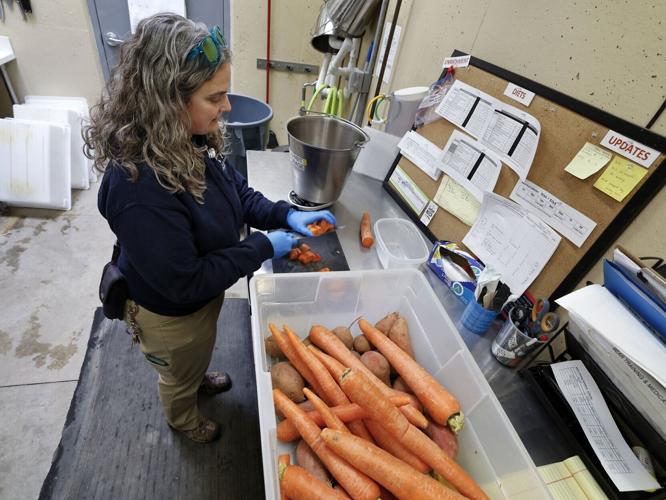
Lead zookeeper Kristen Myers chops up carrots in the Arctic Passage kitchen.
Attitude different when food is 'real'
A month later, however, Siku and Nora gave us an audible reminder of their potential ferociousness. We were in a different back area of Arctic Passage, and it was feeding time. Berit was in his own enclosure with Siku and Nora sharing another. The plan was for Myers and lead zookeeper Ben Meendering to coax Siku into one enclosure and Nora into another.
Only they knew it was feeding time. Bellies were hungry, and tempers were short. With a bucket of fish and vegetables, Meendering led Siku to another area so Myers could begin feeding Nora. Meendering then led Siku back toward Nora with the hopes that Siku would enter a neighboring holding area where he could be fed.
The plan worked, but during the process, Siku got a little too close to Nora and her food. She belted out a roar that sounded something like King Kong. The roar echoed through the enclosed feeding area.
Moments later, Myers asked Nora to stand, her front paws resting on the mesh fence.
“Your paws are so dirty. I can’t even see your paw pads, ma’am. How did you get so dirty,” Myers said in between Nora’s short bursts of growls. “She’s just a talkative girl.”
Nora, who likes to swim in the pool and then roll in the dirt, is significantly smaller than Siku, something brought home when Meendering led Siku to stand in the neighboring enclosure. This time, the enticement was with lard and capelin, a fish that looks like a large sardine.
“It gets really fun when they get the big fish,” Meendering said. “You should see them eat big salmon.”
Career highlight
The up-close encounters with polar bears rank among my most memorable moments in a more than 40-year career in journalism. I’ve interviewed astronauts, governors, the CEOs of some of the state’s largest companies and, earlier in my career, heralded athletes like Robin Yount, Brett Favre and most of the players and coaches of the 1994 Wisconsin Badgers’ Rose Bowl Team.
But feeding a polar bear may top all of those. The exception would be the 45-minute phone conversation in 2016 with Jim Lovell, the Milwaukee native and UW-Madison graduate who was the mission commander on Apollo 13.
Nora and Siku could pull off their own miraculous mission.

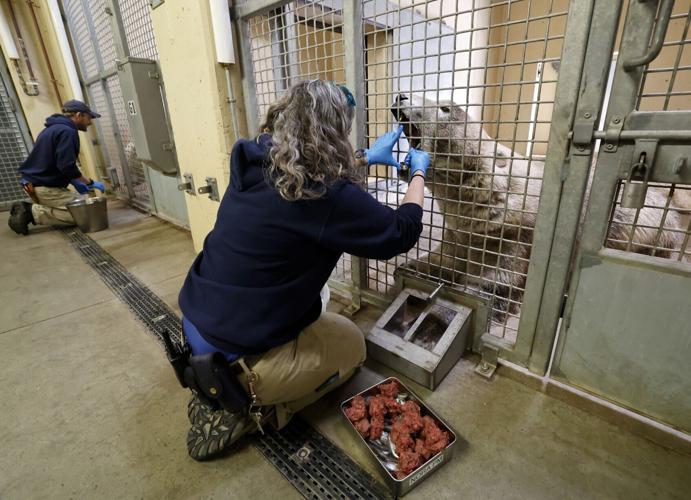
Zookeeper Kristen Myers, right, feeds Nora while zookeeper Ben Meendering feeds Siku during a training session. Nora was being fed ground beef and fish and is being trained to put a paw into the steel box on the floor. That will allow zoo staff to do blood draws without using anesthesia.
The pair mated in mid-February, but we won’t know until November or December if she was actually pregnant, the odds of which are between 10% and 12%. Nora may exhibit denning behavior in October, but it won’t be known whether she’s pregnant until she gives birth.
So for now, we wait in anticipation and try not to think of the disappointment, for what could be a historic moment in the 115-year history of Henry Vilas Zoo.
“It’s really low odds, but we really want it to happen,” Myers said. “But we have to wait.”
Barry Adams covers regional news for the Wisconsin State Journal. Send him ideas for On Wisconsin at 608-252-6148 or by email at badams@madison.com.