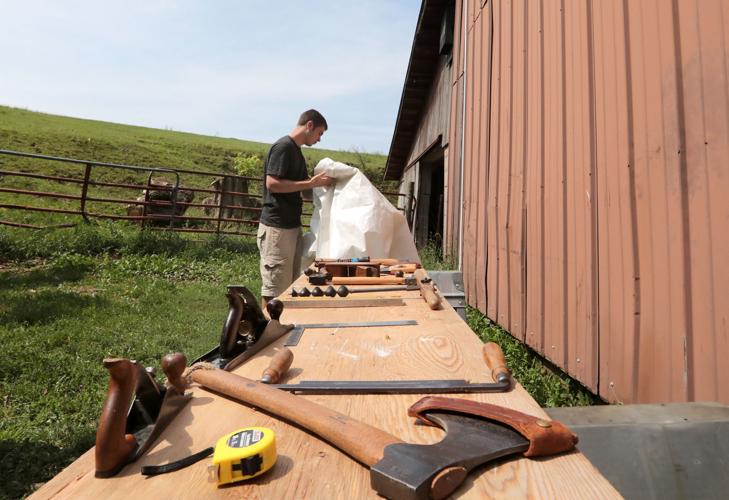


Hand tools employed in the reconstruction of the Aslak Lie House include a broad axe, hand plane, left, and a draw knife that has two handles.
People are also reading…

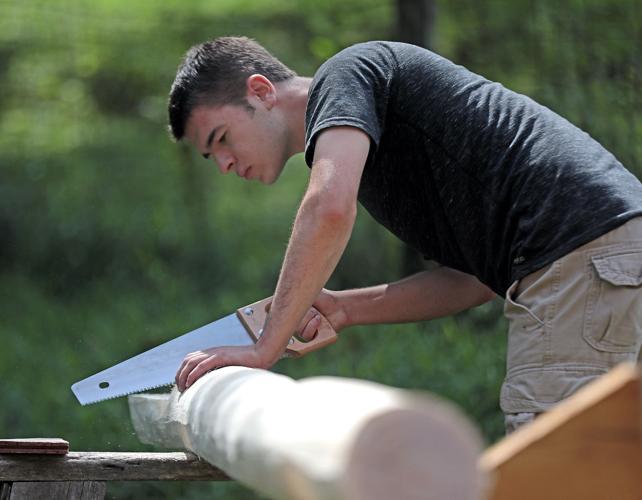
Cade Restle, 20, a Madison West graduate, uses a hand saw to hone a log that will become part of the roof rafters for the reconstructed Aslak Lie House at Folklore Village. It may be several years before the project is completed as workers are not using power tools.

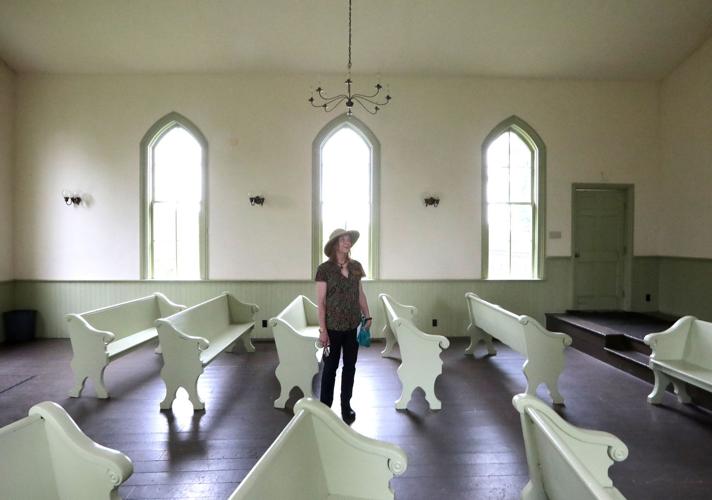
Terri Van Orman, executive director of Folklore Village near Ridgeway, walks through the sanctuary of an 1882 chapel that was moved to the cultural arts center when Highway 18-151 was expanded.

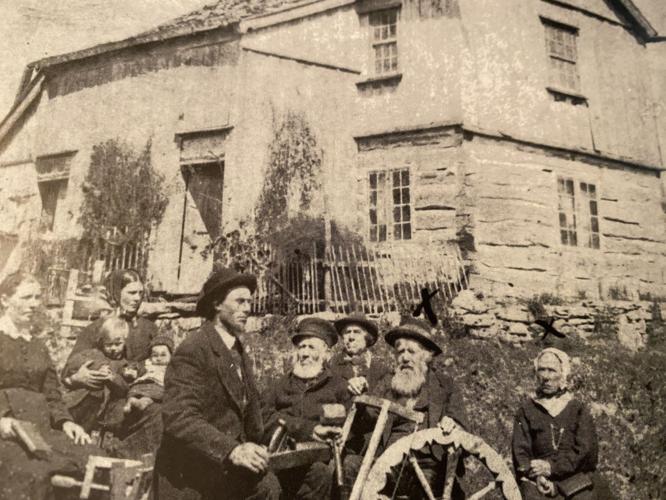
Aslak Olsen Lie, second from right, built this house over the course of about six years in Klevenville, northeast of Mount Horeb. The photo was taken in 1875 by Andrew Dahl.

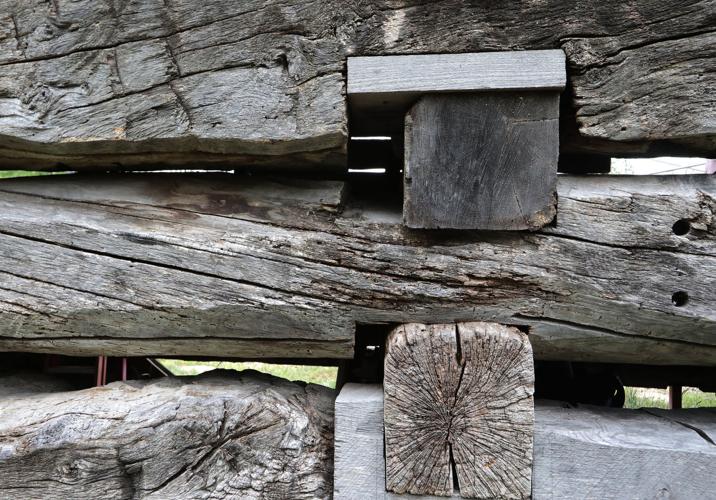
Original hand-hewed timbers are meshed with replacement logs harvested from nearby Iowa County farms to help rebuild the Aslak Lie cabin. Lie had built two log homes in Norway out of pine, but when he came to Wisconsin in 1848 was forced to use white oak, a much harder and more difficult wood with which to build.

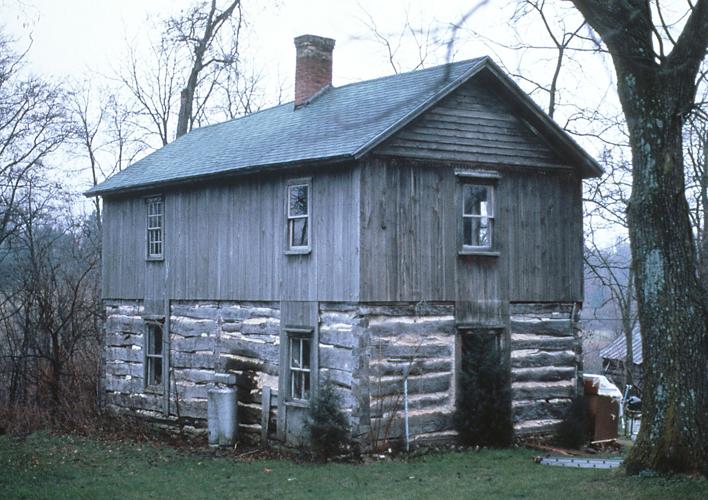
This undated photo from the Wisconsin Historical Society shows Aslak Olsen Lie's house as it stood in rural Dane County for more than 100 years. The first floor was built in 1848 and 1849, and the second floor added in 1854. It was taken apart in 2003 after being acquired by Folklore Village.

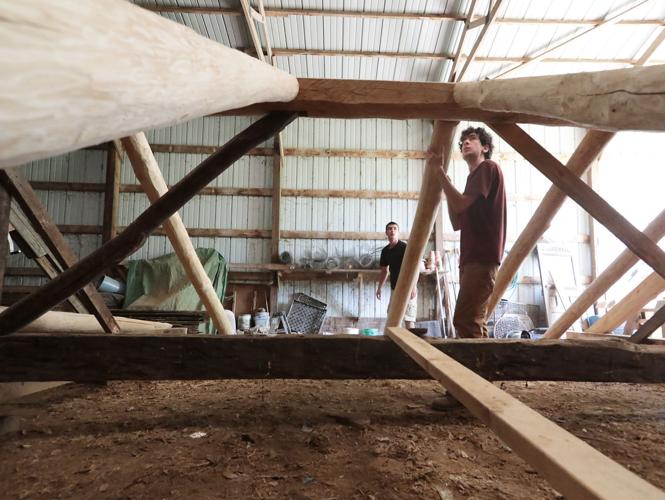
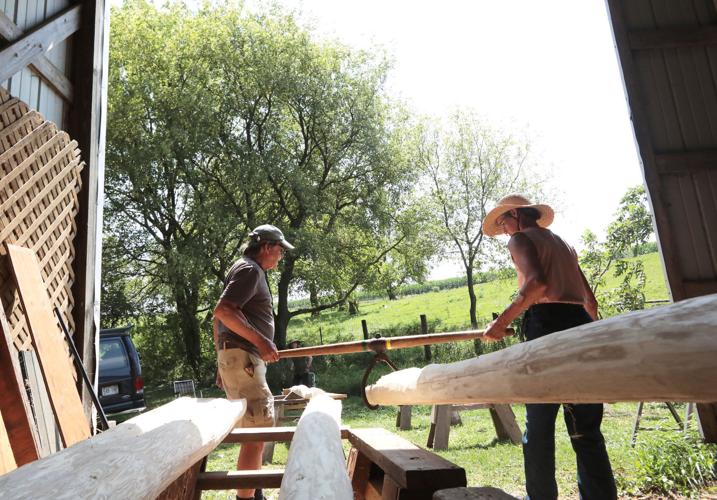
Cade Restle, back left, and Will Kanel position a hand-hewed log into the roof structure of the Aslak Lie House. The interns have been working this summer in a barn about five miles south of Folklore Village to create the trusses, which will be numbered for easy reassembly onto the cabin.

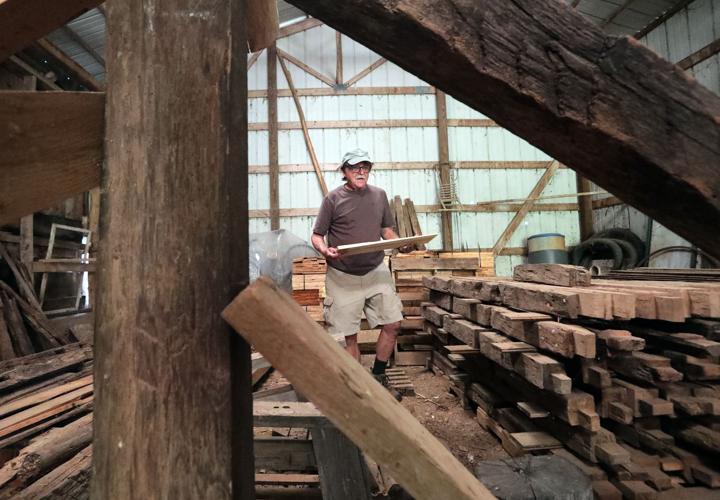
Nels Diller, left, helps carry a log out of a barn south of Folklore Village. Diller spent nearly 40 years as a carpenter and since 2014 has volunteered to help rebuild an 1840s-era cabin.

Nels Diller works among the timbers of the Aslak Lie House, which is being restored and reconstructed as part of a future permanent element of Folklore Village near Ridgeway.
Photos: The multi-year reconstruction of an 1848 cabin for Folklore Village
Folklore Village
Nels Diller, left, helps carry a log out of a barn south of Folklore Village. Diller spent nearly 40 years as a carpenter and since 2014 has volunteered to help rebuild an 1840s-era cabin.
Folklore Village

Will Kanel uses a hand saw to hone a log which will become part of the roof rafters for the reconstructed Aslak Lie House at Folklore Village in Ridgeway.
Folklore Village
This undated photo from the Wisconsin Historical Society shows Aslak Olsen Lie's house as it stood in rural Dane County for more than 100 years. The first floor was built in 1848 and 1849, and the second floor added in 1854. It was taken apart in 2003 after being acquired by Folklore Village.
Folklore Village

Terri Van Orman, executive director of Folklore Village in Ridgeway, walks past the Aslak Lie House, an 1840’s-era timber cabin being reconstructed on the grounds of the cultural preservation site.
Folklore Village
Nels Diller works among the timbers of the Aslak Lie House, which is being restored and reconstructed as part of a future permanent element of Folklore Village near Ridgeway.
Folklore Village
Original hand-hewed timbers are meshed with replacement logs harvested from nearby Iowa County farms to help rebuild the Aslak Lie cabin. Lie had built two log homes in Norway out of pine, but when he came to Wisconsin in 1848 was forced to use white oak, a much harder and more difficult wood with which to build.
Folklore Cabin Village

Terri Van Orman, executive director of Folklore Village in Ridgeway, approaches an 1880’s-era church on the grounds of the cultural preservation site.
Folklore Village

Cabinetry featuring Norwegian rosemaling designs hint at the history of a former schoolhouse on the grounds of Folklore Village.
Folklore Village

Cade Restle uses a hand tool to hone a log into the roof structure of Folklore Village’s Aslak Lie House in Ridgeway.
Folklore Village
Cade Restle, back left, and Will Kanel position a hand-hewed log into the roof structure of the Aslak Lie House. The interns have been working this summer in a barn about five miles south of Folklore Village to create the trusses, which will be numbered for easy reassembly onto the cabin.
Folklore Village
Terri Van Orman, executive director of Folklore Village near Ridgeway, walks through the sanctuary of an 1882 chapel that was moved to the cultural arts center when Highway 18-151 was expanded.
Folklore Village

Hand tools employed in the reconstruction of the Aslak Lie House share a table at the site of the timber frame building’s reconstruction project near Folklore Village in Ridgeway.
Folklore Village

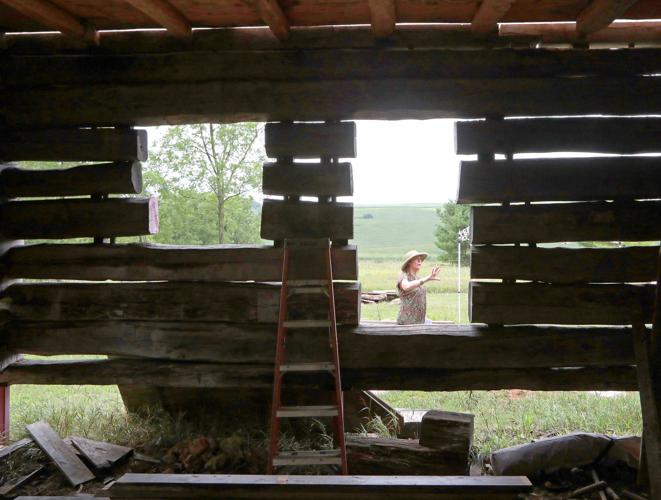
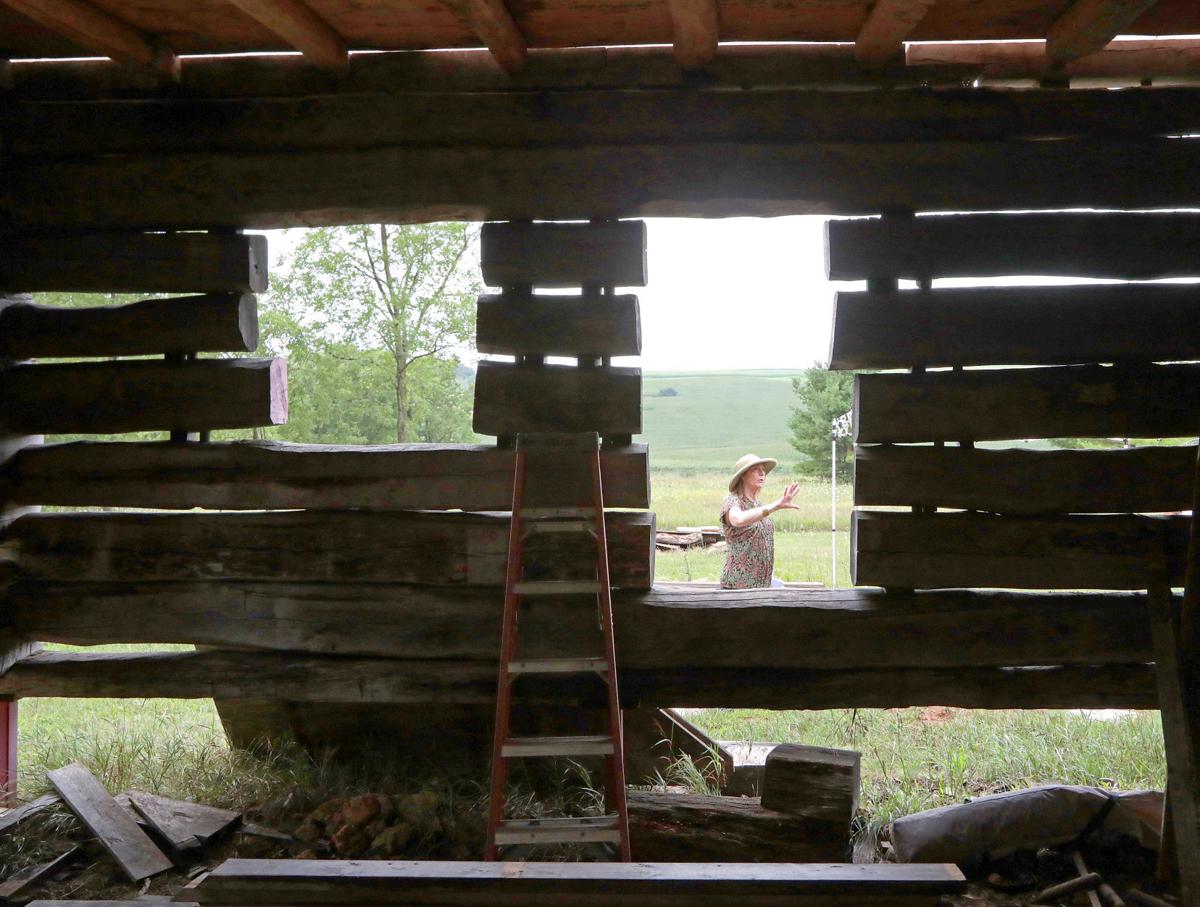
Terri Van Orman, executive director of Folklore Village near Ridgeway, is seen through a window of the Aslak Lie House, an 1840s-era timber cabin being reconstructed on the grounds of the cultural preservation site. The cabin was built near the hamlet of Klevenville, northeast of Mount Horeb, but taken apart in 2003. Work to rebuild the log house has been ongoing since 2014.
Folklore Village
Cade Restle, 20, a Madison West graduate, uses a hand saw to hone a log that will become part of the roof rafters for the reconstructed Aslak Lie House at Folklore Village. It may be several years before the project is completed as workers are not using power tools.
Folklore Village

An undated photo of the Aslak Lie House, courtesy of the Wisconsin Historical Society.
Folklore Village
Hand tools employed in the reconstruction of the Aslak Lie House include a broad axe, hand plane, left, and a draw knife that has two handles.
Folklore Village
Aslak Olsen Lie, second from right, built this house over the course of about six years in Klevenville, northeast of Mount Horeb. The photo was taken in 1875 by Andrew Dahl.
Folklore cabin

Marit Knutsdotter and Aslak Olsen Lie were married in Norway in 1826 but emigrated to Wisconsin in 1848 where for many years they lived in a two story log house northeast of Mount Horeb near the Miltary Ridge Trail. In 1878, the couple moved to their son's farm in Buffalo County. Knutsdotter died in 1881 and Lie in 1886. They are buried in the cemetery at Lyster Lutheran Church in the town of Urne near Nelson, in Buffalo County.
Barry Adams covers regional news for the Wisconsin State Journal. Send him ideas for On Wisconsin at 608-252-6148 or by email at badams@madison.com.