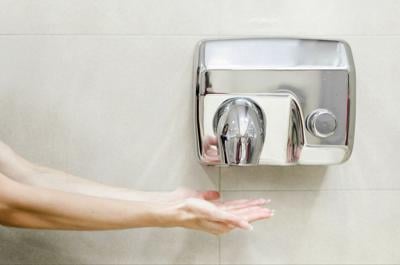


Photo provided by DepositPhotos
For about 15 years, the jet air dryer was the obvious upgrade. Faster than paper, cheaper over time, and easier to defend at a sustainability meeting. The pitch made sense, the buildings bought in, and most of us stopped thinking about it.
Then the research caught up.
Hospitals were the first to pull the units off the walls. Schools followed. Now restaurants and corporate offices are working through the same conversation, and it has nothing to do with aesthetics or budget. It has to do with what happens in the air around the dryer while it's running.
What the Studies Actually Found
A research team at the University of Westminster found that jet air dryers can disperse up to 1,300 times more viral particles than paper towels. It turns out that, while the high-velocity air does dry your hands, it also propels whatever bacteria and viruses are still on them across the room, sometimes more than 10 feet from the unit.
People are also reading…
A systematic review from the Mayo Clinic reached a similar conclusion. After weighing decades of hand-drying research, the verdict was that paper towels are the more hygienic option. Work cited in PubMed found roughly a 77% reduction in bacterial transfer from hands when people used paper towels instead of air dryers.
The CDC's handwashing guidance reinforces the point: how you dry your hands affects how many pathogens leave the sink with you.
Why Healthcare Acted First
Hospitals run on a different risk tolerance than the rest of us. When a single restroom sits between a surgical wing and an immunocompromised patient, any bump in airborne contamination is a problem. So when the Leeds data started circulating in infection-control circles, the response was straightforward. Pull the dryers. Restock the dispensers.
That decision has been working its way outward ever since, into pediatric clinics, dialysis centers, and long-term care facilities.
Restaurants and Schools Are Catching Up
Restaurants are next, and the motivation is partly regulatory and partly reputational. A norovirus outbreak traced back to a restroom is the kind of headline no operator wants on a Monday morning. Schools are weighing similar concerns, especially after the last few flu seasons reminded administrators how fast something airborne moves through a building full of kids.
Offices are slower to move, but they're moving. Facility managers already report spending an average of $800 to $1,200 per location annually on bulk paper towels. When a building swaps dryers back out for dispensers, that line item climbs, and procurement teams have started planning for it accordingly.
How the Story Flipped
For two decades, the dominant pitch was that paper towels were wasteful and dryers were the responsible choice. It leaned hard on landfill statistics and tree counts, and it worked. Building codes followed. Green certifications rewarded the swap.
What that pitch left out was the air itself. Nobody was measuring what happened in the four feet around a dryer while someone used it. Once researchers started looking, the picture shifted fast.
There's a cultural piece too. After the last few years, people pay attention to airborne anything in a way they didn't before. A loud machine that visibly blows air off wet hands into a shared room reads differently in 2026 than it did in 2015.
Why It Matters Beyond the Bathroom
This isn't really about hand drying. It's about how fast accepted wisdom can shift once independent research starts asking questions the original marketing never had to answer. The dryer was sold as the smarter option for years, and for most of that time nobody pushed back. The institutions with the most at stake are walking it back now, and the rest of the built environment tends to follow.
Sometimes the older answer holds up better than the upgrade.