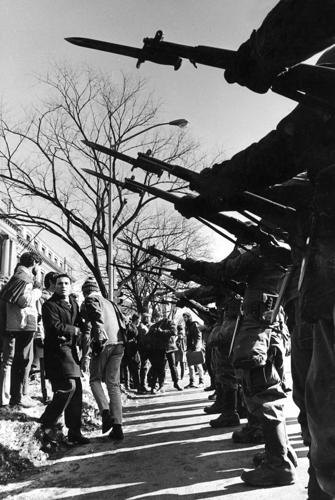
National guard members stand in formation with bayonets pointed at UW students, during a protest in February 1969.
State Journal archives
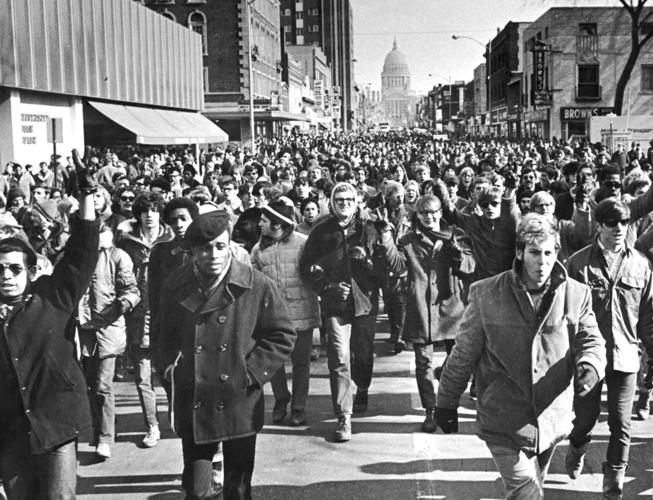
Protesters demanding march down State Street toward the UW-Madison campus on Feb. 14, 1969. The protest called for an education "relevant to black people," including formation of a Black Studies department and more black black faculty.
The dawn of the 1960s brought with it the promise of change. The country had elected a charismatic young president, John F. Kennedy, the first such candidate born in the 20th century.
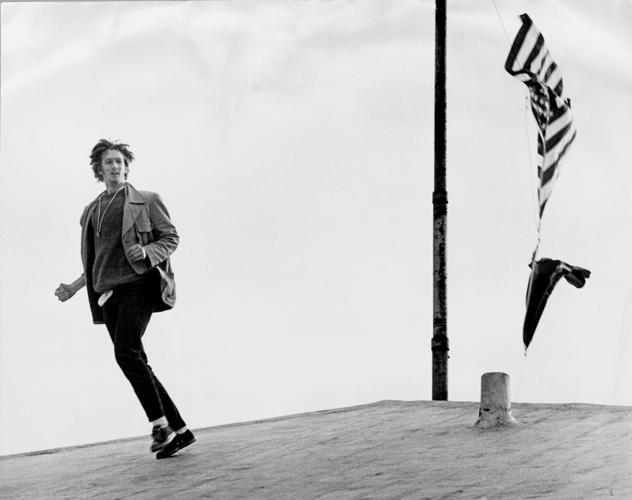
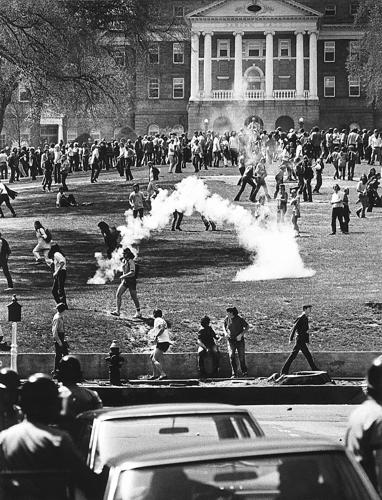
Tear gas explodes on Bascom Hill as police try to keep anti-war protesters from gathering in large groups in May, 1971. Each time the crowd pushed up Bascom Hill, they were repelled by tear gas and advancing lines of police. After each flurry, both sides relaxed for as much as a half an hour at a time, enjoying what was otherwise a sunny, pleasant day.
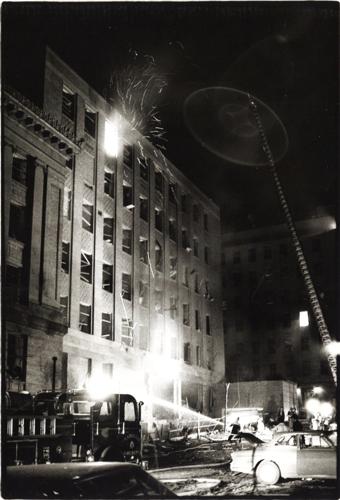
The Army Mathematics Research Center was the target when Sterling Hall was bombed just after 3 a.m. on Aug. 24, 1970. The bombing killed a young physics researcher named Robert Fassnacht, and has often been labeled the death of the peace movement.
The Army Mathematics Research Center was the target when Sterling Hall was bombed just after 3 a.m. on Aug. 24, 1970. The bombing killed a young physics researcher named Robert Fassnacht, and has often been labeled the death of the peace movement.
Protesters demanding march down State Street toward the UW-Madison campus on Feb. 14, 1969. The protest called for an education "relevant to black people," including formation of a Black Studies department and more black black faculty.
Tear gas explodes on Bascom Hill as police try to keep anti-war protesters from gathering in large groups in May, 1971. Each time the crowd pushed up Bascom Hill, they were repelled by tear gas and advancing lines of police. After each flurry, both sides relaxed for as much as a half an hour at a time, enjoying what was otherwise a sunny, pleasant day.