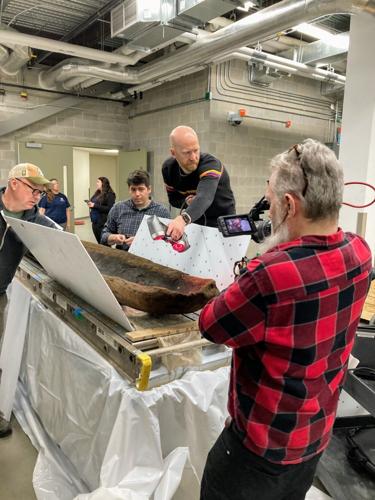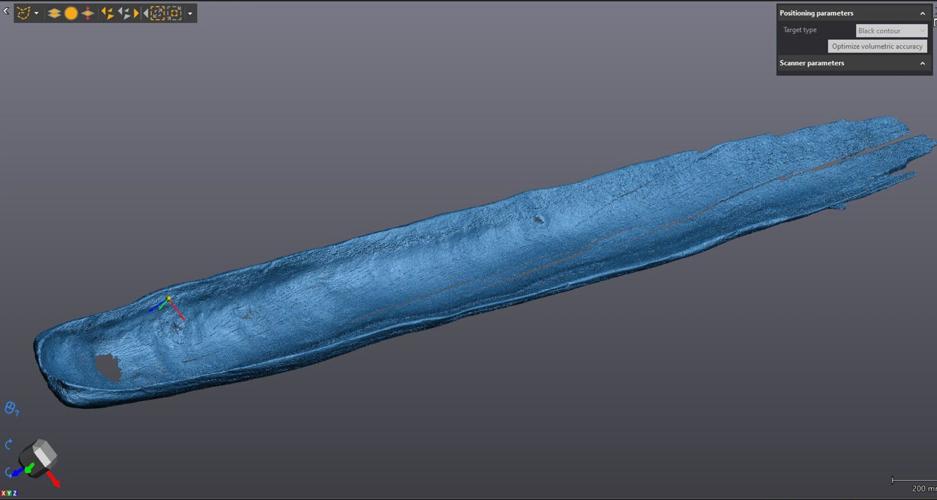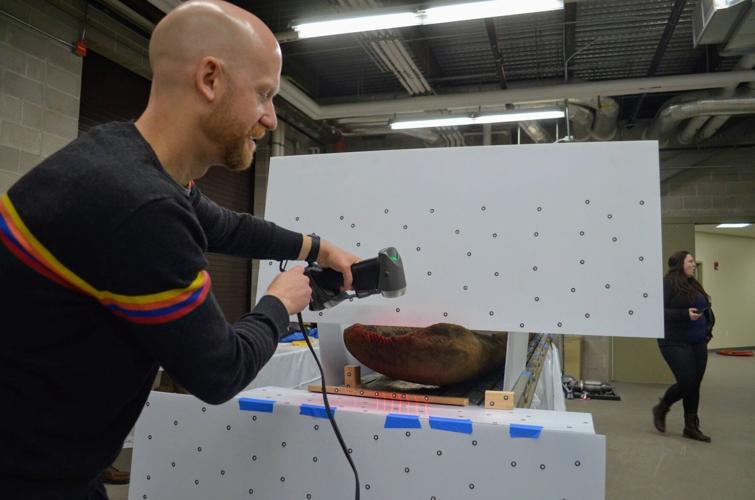


Lennon Rodgers, who directs the Grainger Engineering Design and Innovation Laboratory at UW-Madison, scans the dugout canoe to make 3-D images of the boat found in Lake Mendota.
People are also reading…

A series of scans on the canoe includes a hole, at left, in one end of the boat. The scans show more details than can be seen with the naked eye.

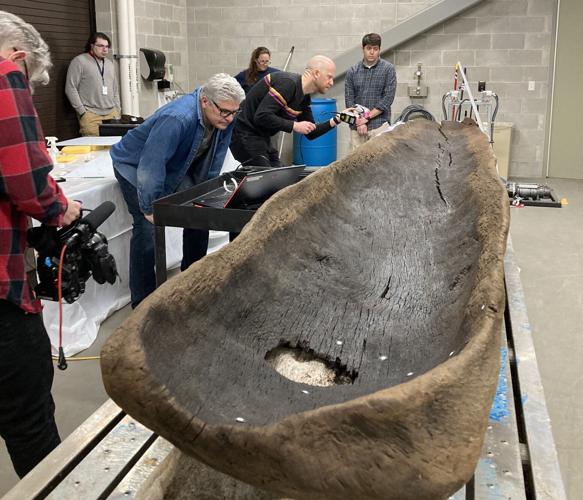
This 1,200-year-old dugout canoe found in June and pulled from Lake Mendota in early November was temporarily removed in March from a preservation tank so it could be scanned to make 3-D images of the historic watercraft.

The 1,200-year-old dugout canoe was raised from Lake Mendota in early November by the Wisconsin Historical Society. The canoe was discovered in June during a recreational dive and is the oldest intact boat ever recovered from Wisconsin waters. The canoe is undergoing preservation efforts over the next two years before it could be displayed in a museum.

Lennon Rodgers, who directs the Grainger Engineering Design and Innovation Laboratory at UW–Madison, uses a high-tech device to scan a 1,200-year-old dugout canoe that was pulled from Lake Mendota in early November.

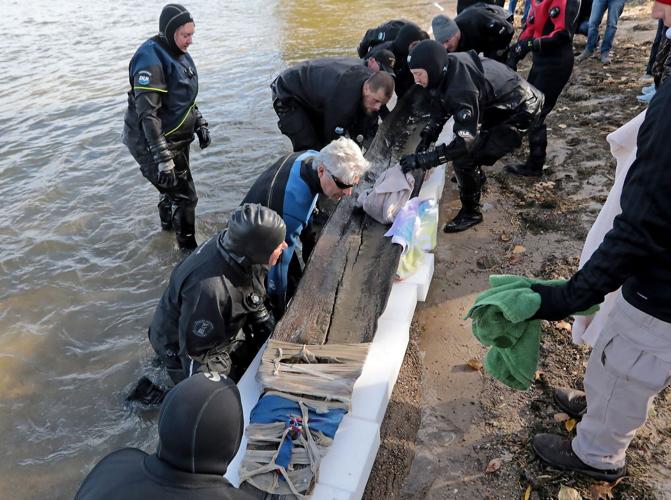
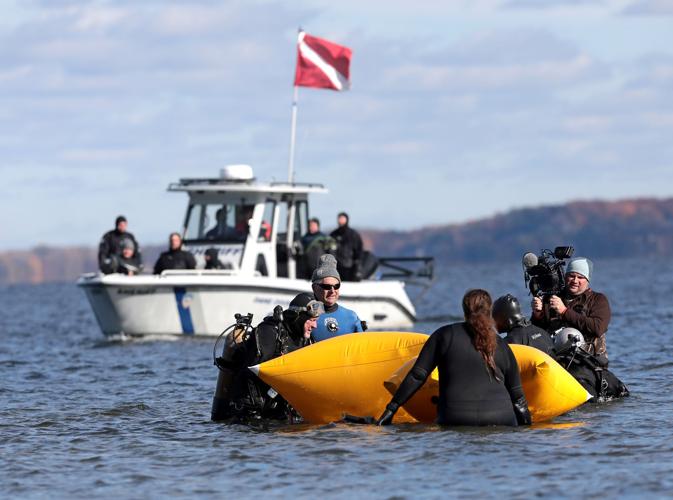
A dugout canoe crafted in A.D. 800 was towed in early November for most of its 1-mile trip to shore but guided by divers in shallow water for the final 100 yards or so to Spring Harbor Beach.
Photos: Dugout canoe recovered from Lake Mendota after 1,200 years
Dugout canoe

Randy Wallander, a volunteer diver from Manitowoc, unloads gear for the dive. Wallander specializes in bringing up sunken objects, usually in Lake Michigan.
Dugout canoe

Members of the dive team from the Dane County Sheriff's Office were among those who took part in Tuesday's dive near Shorewood Hills.
Dougout canoe

Divers prepare to remove a 1,200-year-old dugout canoe from Lake Mendota on Tuesday.
Dugout canoe

Dugout canoe

Divers converged on Lake Mendota Tuesday to recover a dugout canoe that hadn't been to the surface in 1,200 years.
Dugout canoe

Tamara Thomsen, a maritime archaeologist who discovered the Native American dugout canoe in June in Lake Mendota, celebrates the recovery Tuesday with Jim Skibo, Wisconsin's state archaeologist. The canoe was placed in an enclosed trailer for its trip from Spring Harbor Beach to the State Archive Preservation Facility on Madison's Near East Side.
Dugout canoe

Spectators watch as a 1,200-year-oid dugout canoe makes its way across Lake Mendota to Spring Harbor Beach.
Dugout canoe

A 1,200-year-old dugout canoe was raised from Lake Mendota Tuesday by the Wisconsin Historical Society. The canoe was discovered in June during a recreational dive and is the oldest intact boat ever recovered from Wisconsin waters. The canoe will undergo preservation efforts over the next two years before it can be displayed in a museum.
Dugout canoe

Spectators watch as a 1,200-year-oid dugout canoe crafted by members of the Native American Ho-Chunk tribe from Lake Mendota near Spring Harbor Beach in Madison, Wis., Tuesday, Nov. 2, 2021. JOHN HART, STATE JOURNAL
Dugout canoe

A dugout canoe crafted in A.D. 800 was towed for most of its 1-mile trip to shore but guided by divers in shallow water for the final 100 yards or so to Spring Harbor Beach.
Dugout canoe

Bystanders watch as yellow floats are used to bring a dugout canoe to Spring Harbor Beach. The 1-mile trip took nearly two hours.
Dugout canoe

Tamara Thomsen, a maritime archaeologist who discovered the Native American dugout canoe in June in Lake Mendota, celebrates the recovery Tuesday with Jim Skibo, Wisconsin's state archaeologist. The canoe was placed in an enclosed trailer for its trip from Spring Harbor Beach to the State Archive Preservation Facility on Madison's Near East Side.
Dugout canoe

A 1,200-year-old dugout canoe was raised from Lake Mendota Tuesday by the Wisconsin Historical Society. The canoe was discovered in June during a recreational dive and is the oldest intact boat ever recovered from Wisconsin waters. The canoe will undergo preservation efforts over the next two years before it can be displayed in a museum.
Dugout canoe

A dugout canoe crafted in A.D. 800 was towed for most of its 1-mile trip to shore but guided by divers in shallow water for the final 100 yards or so to Spring Harbor Beach.