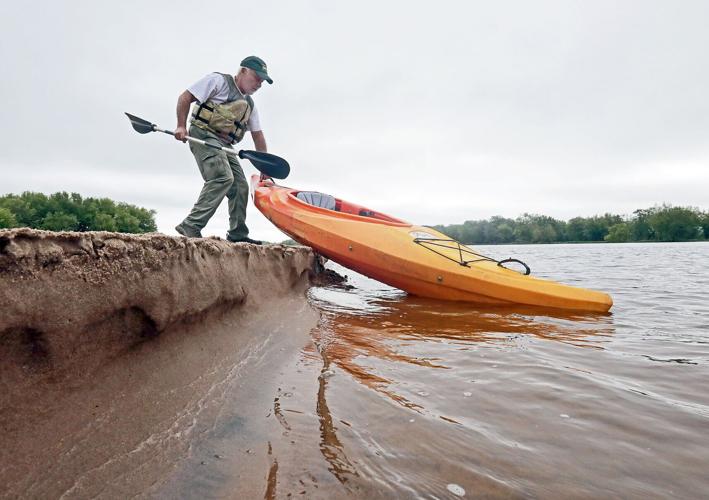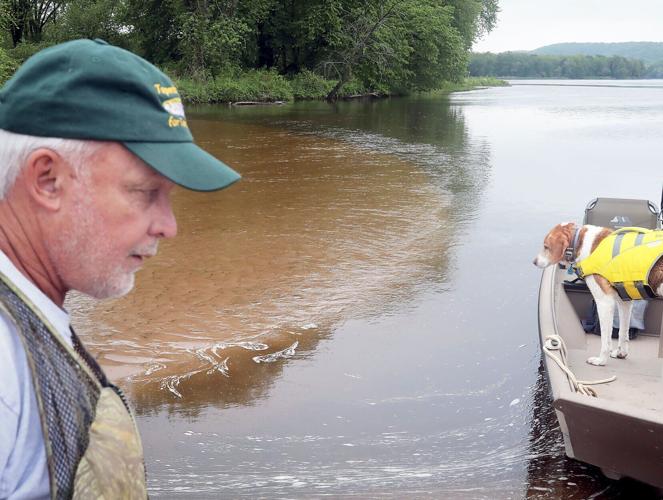


A sandbar in the Wisconsin River is covered by inches of water, left, but quickly drops off to deeper water. Timm Zumm, president of the Friends of the Lower Wisconsin Riverway, has been traversing the river for years and is often accompanied by his 12-year-old hound, Bowie, who also sports a life jacket.
People are also reading…

Timm Zumm, president of the Friends of the Lower Wisconsin Riverway, lowers his kayak Thursday off a sandbar and into the shallow water of the Wisconsin River west of Gotham. Zumm is adamant about users of the river wearing life jackets since its features include strong currents and sudden drop-offs.

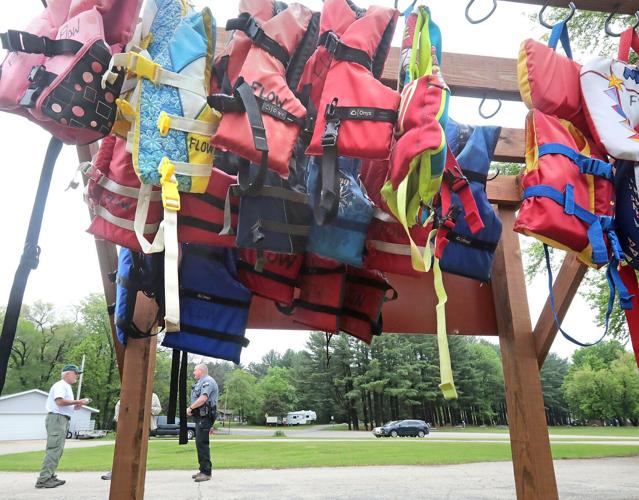
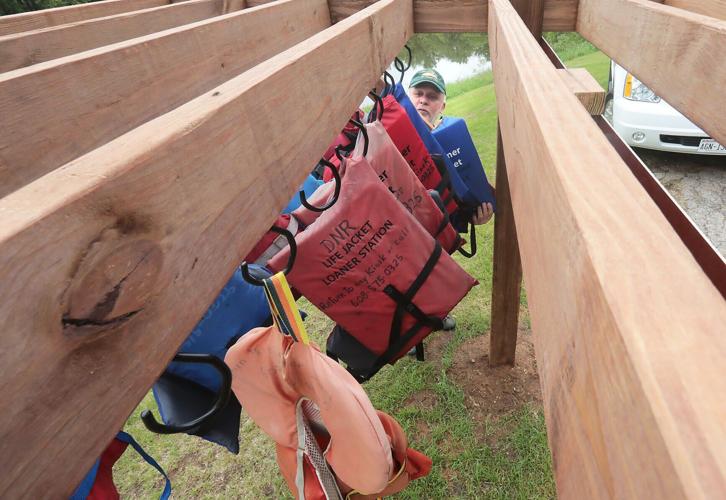
Life jackets offered free of charge to visitors to the Lower Wisconsin State Riverway share a new kiosk at the boat landing in Avoca. The kiosks — a collaboration among the Friends of the Lower Wisconsin Riverway, Department of Natural Resources and service organizations — can be found at more than a dozen landings along the 92-mile stretch of river between the Prairie du Sac Dam and the Mississippi River.

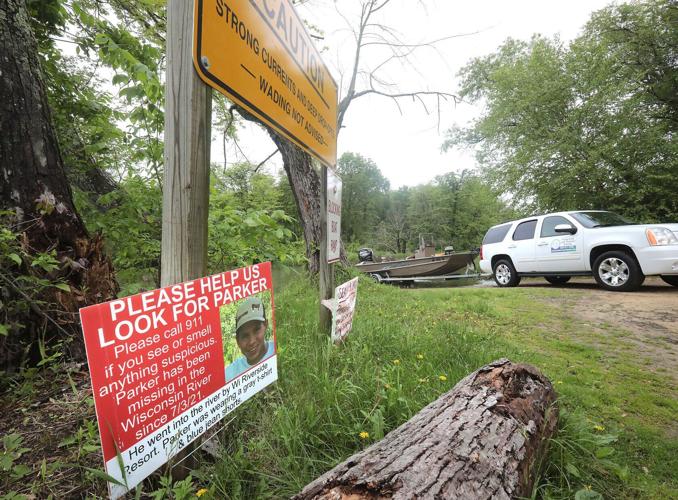
The top sign at the boat landing near Gotham alerts visitors to strong currents and deep drop-offs in the Wisconsin River. Another sign asks people to be on the lookout for the remains of Parker Kruse, who was thrown from a boat near Spring Green last July.

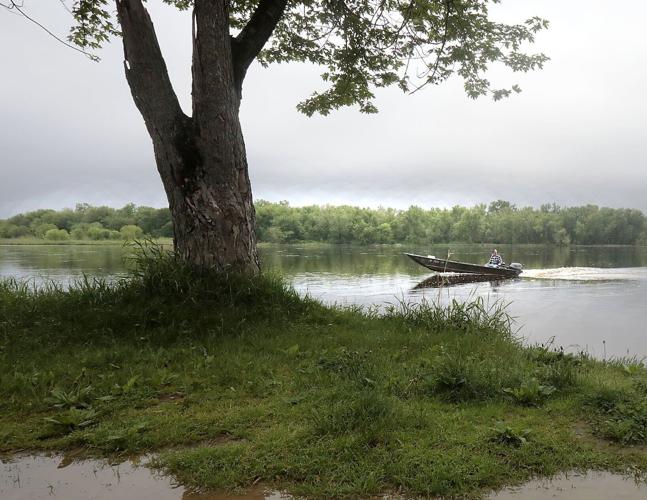
A boater departs from a Wisconsin River boat landing near Gotham.

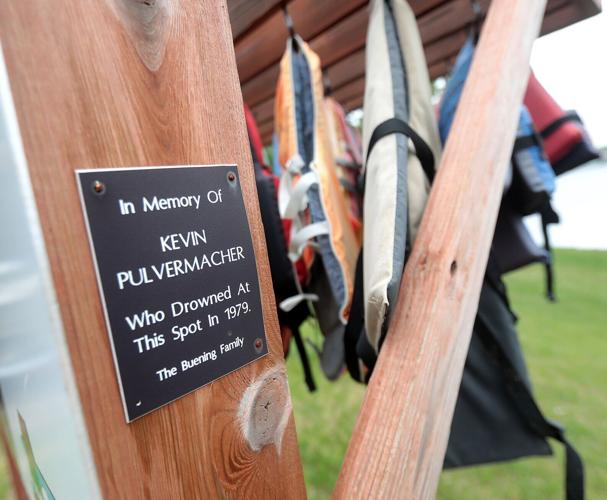
A marker on a life jacket kiosk in Muscoda memorializes Kevin Pulvermaker, who lost his life in the Wisconsin River in 1979.

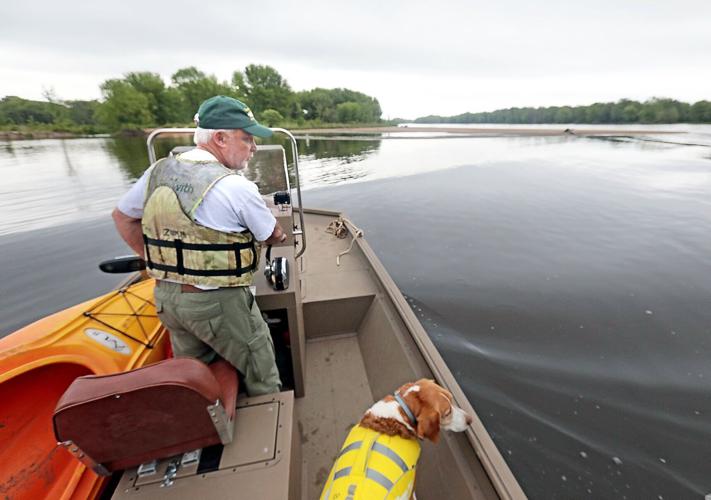
Timm Zumm guides his flat-bottom power boat on the Lower Wisconsin State Riverway on Thursday along with his dog, Bowie. Zumm's boat is equipped with a jet-drive motor which uses water instead of a prop for propulsion and allows the boat to navigate over sandbars submerged in just a few inches of water.

Timm Zumm, president of the Friends of the Lower Wisconsin Riverway, arranges life jackets on a kiosk recently installed at the boat landing in Avoca.
Photos: Lower Wisconsin Riverway
Lower Wisconsin Riverway

The 92-mile Lower Wisconsin Riverway is a prime destination for paddlers. Its diverse ecosystem has led the Riverway to be designated a Wetland of International Importance by the Ramsar Convention on Wetlands. Mark Cupp, left, executive director of the Lower Wisconsin State Riverway Board; Katie Beilfuss, center, outreach programs director of the Wisconsin Wetlands Association; and Mike Mossman, an ecologist with the Friends of the Lower Wisconsin Riverway, paddle a stretch of the river near Muscoda last week.
Lower Wisconsin Riverway

(From left) Mike Mossman, an ecologist with the Friends of the Lower Wisconsin Riverway, Katie Beilfuss, outreach programs director of the Wisconsin Wetlands Association, and Mark Cupp, executive director of the Lower Wisconsin State Riverway Board, canoe the Wisconsin River in Muscoda, Wis., Thursday, Sept. 3, 2020. The Lower Wisconsin Riverway is now recognized as a Wetland of International Importance by the United States and the Ramsar Convention on Wetlands. AMBER ARNOLD, STATE JOURNAL
Lower Wisconsin Riverway

Dan and Judy Torphy, of Pewaukee, take in the view as they look out toward the Wisconsin River during a visit to Muscoda last week. The river is a major draw for bird watchers, paddlers and anglers, and some stretches are just a 20-minute drive from Madison's Far West Side.
Lower Wisconsin Riverway

Timm Zumm, with the Friends of the Lower Wisconsin Riverway, drives his boat on the Wisconsin River in Muscoda, Wis., Thursday, Sept. 3, 2020. AMBER ARNOLD, STATE JOURNAL
Lower Wisconsin Riverway

Timm Zumm, with the Friends of the Lower Wisconsin Riverway, picks up litter at a sandbar on the Wisconsin River near Muscoda. The river can be heavily used by campers and day paddlers.
Lower Wisconsin Riverway

A bald eagle perched above the Wisconsin River near Muscoda. The Lower Wisconsin State Riverway draws more than 140 species of birds.
Lower Wisconsin Riverway

Sandbars are signature features of the Lower Wisconsin State Riverway and provide camping opportunities from Prairie du Sac to the Mississippi River. The sandbars are in constant change and appear above and below the water, depending on the ever-changing water levels. Taking a break from a day on the water are, from left, Mark Cupp of the Lower Wisconsin State Riverway Board, ecologist Mike Mossman and Timm Zumm, both with the Friends of the Lower Wisconsin Riverway, and Katie Beilfuss of the Wisconsin Wetlands Association.
Lower Wisconsin Riverway

Life vests are available at the boat launch in Muscoda, Wis., Thursday, Sept. 3, 2020. AMBER ARNOLD, STATE JOURNAL
Lower Wisconsin Riverway

Katie Beilfuss, outreach programs director of the Wisconsin Wetlands Association, left, and Mike Mossman, an ecologist with the Friends of the Lower Wisconsin Riverway, look for wildlife while canoeing the Wisconsin River in Muscoda, Wis., Thursday, Sept. 3, 2020. The Lower Wisconsin Riverway is now recognized as a Wetland of International Importance by the United States and the Ramsar Convention on Wetlands. AMBER ARNOLD, STATE JOURNAL
Lower Wisconsin Riverway

Timm Zumm, with the Friends of the Lower Wisconsin Riverway, drives his boat on the Wisconsin River in Muscoda, Wis., Thursday, Sept. 3, 2020. AMBER ARNOLD, STATE JOURNAL
Lower Wisconsin Riverway

Timm Zumm, with the Friends of the Lower Wisconsin Riverway, uses his phone to take a picture of a beaver dam at the Fish Trap Flowage west of Muscoda. The flowage is part of the rich diversity of the Lower Wisconsin State Riverway.
Lower Wisconsin Riverway

Mike Mossman, an ecologist with the Friends of the Lower Wisconsin Riverway, and Katie Beilfuss, left, with the Wisconsin Wetlands Association, talk about the diverse flora and fauna of the Riverway while visiting the Fish Trap Flowage, a backwater of the Wisconsin River west of Muscoda.
Lower Wisconsin Riverway

Joe Pye weed grows along the road, at right, at Fish Trap Flowage, as Mike Mossman, an ecologist with the Friends of the Lower Wisconsin Riverway, gives a tour of the area in Muscoda, Wis., Thursday, Sept. 3, 2020. AMBER ARNOLD, STATE JOURNAL
Lower Wisconsin Riverway

Timm Zumm, with the Friends of the Lower Wisconsin Riverway, left, and Mark Cupp, executive director of the Lower Wisconsin State Riverway Board, visit Blue River Sand Barrens State Natural Area in Muscoda, Wis., Thursday, Sept. 3, 2020. AMBER ARNOLD, STATE JOURNAL
Lower Wisconsin Riverway

Cardinal flower grows at Fish Trap Flowage in Muscoda, Wis., Thursday, Sept. 3, 2020. AMBER ARNOLD, STATE JOURNAL
Lower Wisconsin Riverway

Cactus at Blue River Sand Barrens State Natural Area near Muscoda.
Lower Wisconsin Riverway

Lichen at Blue River Sand Barrens State Natural Area in Muscoda, Wis., Thursday, Sept. 3, 2020. AMBER ARNOLD, STATE JOURNAL
Lower Wisconsin Riverway

Just yards from the backwaters of the Wisconsin River, the ecosystem changes to desert at the Blue River Sand Barrens State Natural Area, where prickly pear cactus can be found.
Lower Wisconsin Riverway

Katie Beilfuss, outreach programs director for the Wisconsin Wetlands Association, looks over the flora at Fish Trap Flowage near Muscoda. Her organization, along with land owners and citizens, helped achieve international recognition for the Lower Wisconsin State Riverway between Prairie du Sac and the Mississippi River.
Lower Wisconsin Riverway

Mike Mossman, an ecologist with the Friends of the Lower Wisconsin Riverway, points out an obedient plant at the Fish Trap Flowage near Muscoda. The Riverway is home to a diverse collection of flora and fauna.
Lower Wisconsin Riverway

Mike Mossman, an ecologist with the Friends of the Lower Wisconsin Riverway, shows off a map of the Riverway, now recognized as a Wetland of International Importance by the Ramsar Convention on Wetlands.
Lower Wisconsin Riverway

The Lower Wisconsin State Riverway Board office in downtown Muscoda. The board was created in 1989 to help administer laws designed to protect the scenic beauty of the 92-mile stretch of river from Prairie du Sac to the Mississippi River.
Wisconsin River

Timm Zumm, president of the Friends of the Lower Wisconsin Riverway, shows off some of the 98 species of fish that live in the river. Zumm worries that invasive carp could decimate native fish.
Wisconsin River

Timm Zumm, with his dog, Bowie, prepares to board his boat on the Lower Wisconsin River near Spring Green. Zumm, president of the Friends of the Lower Wisconsin Riverway, said he fell in love with the river in the 1980s.
Wisconsin River

Timm Zumm, president the Friends of the Lower Wisconsin Riverway, explores the river with his dog, Bowie, near Spring Green. A study has found more than half a dozen Wisconsin rivers, including the Lower Wisconsin, could become suitable habitat for invasive carp if climate change is not slowed.
Wisconsin River

Timm Zumm, president the Friends of the Lower Wisconsin Riverway, explores the waterway with his dog, Bowie, near Spring Green on Oct. 26, 2022.
Wisconsin River

Timm Zumm, president the Friends of the Lower Wisconsin Riverway, explores the river with his dog, Bowie, near Spring Green. A study has found more than half a dozen Wisconsin rivers, including the Lower Wisconsin, could become suitable habitat for invasive carp if climate change is not slowed.
Barry Adams covers regional news for the Wisconsin State Journal. Send him ideas for On Wisconsin at 608-252-6148 or by email at badams@madison.com.