
Social media accounts believed to belong to Madison school shooter Natalie Rupnow reflect a 15-year-old girl immersed in some of the darkest corners of the Internet, where spree shooters are glorified, gore videos are openly shared and white supremacist beliefs run rampant.
In clues gleaned from a variety of public forums, some of them since deleted, Rupnow would have had access to a reservoir of violent videos, posts and groups on platforms popular with other school shooters like Discord, Telegram and beyond.
School shootings stand alone among violent crimes in which perpetrators seek inspiration and fellow travelers online, according to Mary Ellen O’Toole, a former FBI agent who began profiling school shooters in the mid-1990s.
“Bank robbers don’t emulate other bank robbers,” O’Toole said. “You can be in touch with somebody around the world who shares your ideas, and that tends to normalize what you’re about to do.”
People are also reading…
Preliminary information already suggests that Rupnow was tapped into this online world.
Investigators at the Anti-Defamation League have concluded that Rupnow participated in “a very sparsely populated” chat on Telegram in which a Turkish neo-Nazi shared a racist manifesto before stabbing five people outside a mosque in August. Another poster shared a livestream of the attack in the same chat while others commented on it, including Rupnow, the ADL said.
At the time of that attack, the ADL downloaded the chat and later searched it for usernames associated with Rupnow.
ADL researchers also found a TikTok account that posted white supremacist and antisemitic memes that it said was geolocated to Rupnow’s house on Madison’s North Side.
“What we’re seeing more of is more of an international problem,” Carla Hill, a senior researcher with the ADL, said of these online groups. “Even if you start on the edge of it, it can pull these folks in, and they’re constantly telling each other where to go online. They teach each other and push them even further.”
On Tuesday, a 20-year-old California man admitted he had been messaging Rupnow about his own plans to attack a government building, according to an emergency protective order issued under that state’s gun red flag law. FBI agents saw the messages, according to the order.

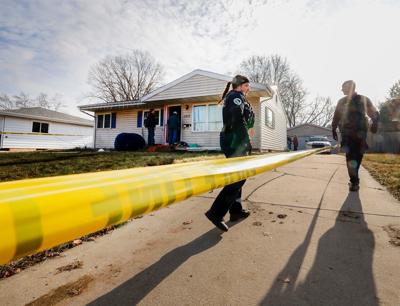
Madison police officers control the perimeter of Natalie Rupnow's residence on the North Side last week. A TikTok account posting white supremacist content was geolocated to the house.
Another clue for Rupnow’s beliefs came from her father’s Facebook page, which included a photo of the 15 year old skeet shooting while wearing a shirt for the band KMFDM. The band and it merchandise was a favorite of the shooters at Columbine High School in Littleton, Colorado, in 1999.
Madison police Chief Shon Barnes said authorities are still investigating Rupnow’s online writings and social media presence but said the motive behind the shooting was likely a “combination of factors.”
Warning signs
Of the dozens of school shooters before Rupnow, plans for violence often leak out on social media, making digital platforms a key warning sign for parents and authorities to help assess what kind of threat someone might pose.
A 2023 study of 44 mass shootings found that perpetrators who used social media tended to be younger, planned their attacks more, killed significantly more people and were more likely to be motivated by racism.
But these online warning signs can go unseen by parents and others who might be able to intervene, and are often posted on Discord and Telegram channels that can’t be accessed unless a user is a member of them.
Sometimes, parents don’t take their children’s online activity seriously or don’t want to bring unnecessary attention to their child, said Emilie Ney, director of professional development for the National Association of School Psychologists.
“They don’t think that their child is actually going to go and do this,” Ney said. “They may have a tendency to prefer to try to deal with it within the home, only to find that in some cases the problem is a little bit bigger than what can be dealt with within the home.”
Generally, parents should lay out ground rules for how their children access and use social media, Ney said. Responses to rule-breaking should be proportionate, and taking away access completely can make the problem worse.
How parents should respond depends on what harmful online behavior a child is doing, but parents should contact their child’s school for help if they become obsessive with online content about violence and guns, she said.
“This highlights the need for a school to have a well-developed threat assessment process, so when something like that is communicated the school is prepared to respond,” Ney said.
Threat assessments
Even though many shooters express their plans beforehand, law enforcement can sometimes miss the warning signs — or see them too late.
Prior to the 2018 school shooting in Parkland, Florida, the FBI didn’t investigate a tip warning about the shooter, which led to a $127.5 million lawsuit settlement with the victims’ families.
A shooter who killed four people and injured nine at a Georgia High School earlier this year had been previously interviewed by local law enforcement for making threats, but authorities didn’t have enough evidence to make an arrest, according to CBS News.
But formal threat assessment systems within schools have been recommended by federal authorities for decades and have a track record of resolving threats, said Dewey Cornell, a professor at the University of Virginia who helped pioneer threat assessment protocols for schools.
“Often a student is experiencing a problem or stress that the teams can address and thereby reduce the risk of violence,” Cornell said.
About 80% of reported threats are not serious, Cornell said. About 5% of threats require a safety plan and only 1% lead to an arrest.
“We have conducted extensive research showing that school-based threat assessment teams can safely and effectively resolve student threats, steering between the errors or over-reaction and under-reactions, and providing students with support and counseling to help students and prevent violence,” he said. “The process is fair and equitable, keeps most students in school and avoids criminalization or excessive punishment of students.”
In Wisconsin, the Department of Justice’s Office of School Safety has trained more than 8,000 people in behavioral threat assessments, including at least one staff member at Abundant Life, said state School Safety Director Trish Kilpin.
Those trainings have included an online violence prevention module the office created that lays out for viewers what the warning behaviors look like.
But Kilpin emphasized how many shooters don’t make overt, direct threats beforehand, meaning a “public health approach” is needed to bring together educators, mental health professional and law enforcement to identify and support students.
“They have some warning behaviors, deepening desperation and despair,” Kilpin said. “They are deteriorating. They are unraveling. We can’t limit our behavioral threat assessment management intervention to only when a student makes a threat. We have to look at it more broadly.”