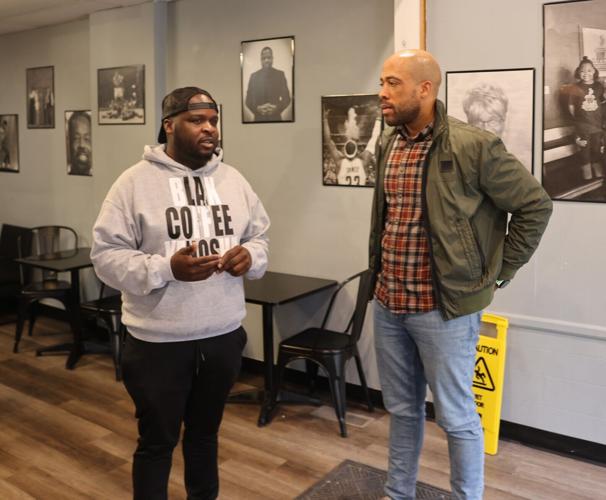


Affordable housing and small business issues took the spotlight during recent visits of state lawmakers to Kenosha.
People are also reading…

Former Lt. Gov. Mandela Barnes visited Blak Coffee, a Downtown Kenosha business owned by DeShaun Foster, during a visit to discuss small business.
Capitol secrets: 10 little-known facts about the Wisconsin statehouse
1. Familiar face

No one has a better vantage point of Madison and beyond.
Perched atop the state Capitol, the 15-foot, 5-inch gold-gilded, bronze statue known simply as "Wisconsin" extends her right arm to the east in a gesture that recalls the state motto: "Forward."
That may explain why she is frequently confused with the copper statue that is named "Forward," installed near the east entrance of the Capitol in 1895, moved in 1909 to the North Hamilton Street approach and then relocated indoors to the Wisconsin Historical Society in 1995 after conservators discovered she was deteriorating. A bronze replica of "Forward" was installed in 1996 at the top of State Street.
Created by Daniel Chester French at a temporary studio on the cliffs of the Housatonic River in Massachusetts, the statue Wisconsin was cast in 1913 and 1914 at a foundry in Brooklyn, New York.
Standing 284 feet above ground and weighing more than 3 tons, she stands unflinching to the whims of the weather outside — and the political gusts that blow inside — the Capitol.
Her left hand holds a globe on top of which stands an eagle, while a badger, the state animal, rests atop her helmet in a nod to the state's lead mining industry that was flourishing at the time of statehood in 1848.
Wisconsin was placed atop the Capitol's lantern in 1914 — not entirely without incident. "In its perilous journey upward the statue was brushed against one or two projections and the gilt was scratched," the Wisconsin State Journal reported in a story noting efforts shortly afterward to touch up her gold leaf.
She was restored with new gilding in 1932, 1957 and in 1990, when she received a $52,000 coat of 23-karat gold leaf. In 2000, workers touched up claw marks left by peregrine falcons on her head and arm.
An appealing sight anytime, the newly shimmering apparition held a special appeal for former Gov. Tommy Thompson after her last full recoat in 1990. Just days before the project was completed, Thompson, needing to burn off pent up energy on Election Day, climbed the scaffolding and is believed to be the first governor to touch the outside of the statue.
2. A well-traveled badger

Replicas of badgers are prolific throughout the state Capitol.
They can be found in sculptures, on door handles, murals and on the head of "Wisconsin," the statue atop the Capitol.
And why not? The feisty, burrowing mammal that is in the same family as the weasel, wolverine and otter symbolizes the lead miners who came to southwestern Wisconsin in the early 1800s and dug crude homes into the hillsides.
Bucky Badger may travel the world for football, basketball and other events. But a 1,200-pound bronze badger outside the governor's office has had quite a journey, too.
The badger, cast in 1899 from melted down Spanish cannons captured in Cuba during the Spanish-American War, is the work of Milwaukee artist Paul Kupper as part of a gift to the USS Wisconsin battleship. The badger rode on the bridge of the ship from 1901 when it was commissioned until the outbreak of World War I, when it was removed from the ship.
For more than 60 years, the badger was in a garden at the U.S. Naval Academy in Annapolis, Maryland. It was returned to Wisconsin in 1988 to be part of a Wisconsin Historical Society exhibit timed to coincide with the recommissioning of the second USS Wisconsin. The badger was moved to the Capitol in 1989 after the exhibit closed, and now its nose is rubbed daily by tourists and passersby for good luck.
3. April Fool's Day prank and a rumor 50 years later

There was a time when news and photographs couldn't immediately be had with a smartphone or computer.
So when readers of The Capital Times received their copy of the paper on April 1, 1933, many were likely shocked to see a front page image of the state Capitol with its dome collapsed from "a series of mighty blasts," the paper reported.
"A Capital Times cameraman arrived just in time to snap this unusual and sensational photograph of the mass of granite and steel as it fell," it reported.
Of course, it was an April Fool's Day hoax and explained later in an article.
In July 1981, a more real concern made the rounds of the Capitol news corps, but in the end turned out to be of little concern.
The Associated Press quashed a rumor that the dome of the Capitol could collapse. It started with reports of rusted girders and an off-hand remark by a legislator, who joked that he never walks in the rotunda for fear that engineers were wrong in their assessment that the building was fine.
That led several reporters to contact the head of the State Bureau of Facilities Management, who said the "girders" were actually just a reinforcing bar, among thousands inside the dome. A crack in the granite under the "Wisconsin" statue had caused a leak that rusted one of the bars, which was replaced.
4. Only God is perfect

The state Capitol is one of the grandest buildings not only in Wisconsin but throughout the nation.
It's also not perfect, but you'll need to look closely to find the imperfection.
When the construction was completed 100 years ago, stone masons left one tiny job unfinished because, historians say, of a tradition that says "only God is perfect."
The flaw can be found on an exterior window finial facing Martin Luther King Jr. Boulevard near the southeast entrance. Unlike the opposite side of the window where a leafy piece of stone is set, the piece on the right side is relatively smooth and has no leaf appearance.
The building includes 43 kinds of stone from eight states and six countries and was completed in 1917 at a cost of $7.25 million. A 14-year, $158.8 million renovation and restoration project started in 1988 converted the building to a modern facility while retaining its historical character. But the makeover preserved the intentional flaw.
5. Ghost of the Assembly

Murals and mosaics in the state Capitol help tell the story of Wisconsin.
One of the most dramatic paintings is at the front of the Assembly Chamber where Edwin Howland Blashfield used a 16-foot, 6-inch by 37-foot, 8-inch canvas to evoke "Wisconsin."
The painting depicts a woman, symbolizing the state, surrounded by other figures who represent her past. Three other women in the painting, each with aquatic plants entwined in her hair, represent lakes Superior and Michigan and the Mississippi River, according to Blashfield's interpretation.
But barely visible in front of Father Claude Allouez, Green Bay's first missionary, and just above a badger, is the ghost of the Assembly.
George Post, the Capitol's architect, requested a badger be placed in the mural. In doing so, Blashfield painted over one of the members of the Civil War color guard. But when the mural was cleaned with 20,000 Q-tips in 1988, the soldier became slightly visible and the "ghost" of the Capitol was born.
"Over time, oil paint becomes more translucent," said Ken Rosenberg, lead tour guide at the Capitol. "You can see through it a little more, so you can see that figure more."
The image is best seen when standing more to the left side of the chamber, which is bathed in natural light from a massive, circular skylight.
6. Stinking sturgeon helps change rule for wardens

The idea was to better manage game wardens and what they did with confiscated fish and game.
For years, Wisconsin law required that game taken illegally be sold for the benefit of the state. But in 1932, when some lawmakers learned that a few wardens were keeping the carcasses for themselves, they enacted a provision requiring seized fish and game be sent to the state Capitol.
No one thought of where or how it should be stored once it reached Madison. A sturgeon was the first entry into a non-refrigerated basement storage room and was quickly followed by a large piece of venison.
The storage room was located next to an elevator shaft that went past the Supreme Court chambers.
"As bacteria began to work their magic on the abandoned flesh, unintended consequences of the new regulation began to waft into powerful noses," Michael Edmonds writes in his book, "The Wisconsin Capitol: Stories of a Monument and its People."
Edmonds reports that Tony Pickerts, the Capitol custodian, needed to use state-of-the-art disinfectants to rid the storage room of the smell once the sturgeon and venison were removed.
Not surprisingly, the provision to send confiscated fish and game to the Capitol was revoked.
7. Statuary groups symbolize best of Wisconsin

From a distance, the Capitol can be taken in as a whole. A closer view reveals significant, but sometimes overlooked, details of the building that was constructed from 1906 to 1917.
At the base of the Capitol dome sit four groupings of three statues made from Bethel White Vermont granite between 1911 and 1915. Each grouping, sculpted by Karl Bitter, one of the country's greatest sculptors, symbolizes fundamental characteristics of the state and its people.
The groupings can be seen from the sidewalk rimming the Capitol grounds, but closer views are afforded from the Capitol's outdoor observation deck.
The southeast group overlooks Martin Luther King Jr. Boulevard and represents faith, as Bitter chose to emphasize "the importance of religion as a force in developing good citizenship," according to a state Capitol guidebook. Each member of the group has its head bowed.
The northwest group facing Wisconsin Avenue represents prosperity and abundance with two of the female statues holding a cornucopia, a symbol of plenty. The southwest group at West Washington Avenue represents strength, with the central figure holding a sword and shield. The northeast group facing East Washington Avenue represents knowledge, with two of the figures looking over scrolls and books.
8. Replica of Liberty Bell

The Capitol holds a replica of the Liberty Bell, given to Wisconsin by France in 1950 as part of a savings bond drive and quite a bit of controversy.
The 2,045-pound bell, 85 percent of which is copper, is the same weight and size of the original but has no crack and is on display on the second floor of the Capitol rotunda.
The bell was first housed at the Wisconsin Historical Society but was later moved to the State School for Girls in Oregon, where it was discovered in 1968 in rough shape and missing its clapper.
The framework was repaired and the clapper replaced when the bell moved to Fountain Park in Sheboygan, where it was rung each Fourth of July. The bell was supposed to be in Sheboygan for only about a year but wasn't moved back to Madison until 1975.
The move, designed to help the state celebrate the country's Bicentennial in 1976, was preceded by heated letters from Sheboygan officials who wanted the bell to remain in their city and an executive order from Mayor Richard Suscha making it illegal for anyone to set foot in the park for the purpose of removing the bell.
The state threatened legal action, Suscha rescinded his executive order and, after two years of haggling, the bell was returned to Madison.
"I can assure you that on my many trips to Madison I will keep a wary eye on the Liberty Bell and make sure it does not get shoved off in some corner of the Capitol unnoticed by residents of the state," Suscha wrote in a letter to the state in March 1975. "I may have lost the battle of the bell, but I have not lost the war."
9. State constitution still MIA

One of the state's most important documents, perhaps the most important document, remains missing.
There are three handwritten copies of the state constitution, but the original document, drafted at a constitutional convention in Madison in December 1847, approved in February 1848 and adopted by voters a month later, disappeared shortly afterward.
It's unclear who may have taken or borrowed the state's legal charter, but one theory is that it may have been loaned to a newspaper publisher and not returned. According to the Wisconsin Historical Society, as soon as the constitution was approved by the delegates, newspaper publishers rushed copies into print so voters, who rejected a first draft in 1846, could evaluate it.
The first printing appears to have been in the Potosi Republican on Feb. 10, 1848, while Madison printers H.A. Tenney and Beriah Brown issued the constitution in pamphlet form at about the same time.
The copy on display in the Capitol rotunda is not signed but is a replica of the original document.
10. Foreman killed during construction

The construction of the Capitol didn't come without tragedy.
As the West Wing was nearing completion in October 1909, Daniel Logan, a construction foreman, was killed while laying a four-ton piece of granite for the base of a statue 80 feet above the ground when the stone beneath it cracked, causing a collapse.
Logan had been preparing a stone pediment to hold partially carved statues designed by Karl Bitter when the collapse occurred, according to historian Michael Edmonds. An investigation showed that extra weight from the unfinished statues had caused the collapse. From that point on, all statues were completed in shacks on the Capitol grounds or at a West Washington Avenue railroad depot.
5. Ghost of the Assembly

Murals and mosaics in the state Capitol help tell the story of Wisconsin.
One of the most dramatic paintings is at the front of the Assembly Chamber where Edwin Howland Blashfield used a 16-foot, 6-inch by 37-foot, 8-inch canvas to evoke "Wisconsin."
The painting depicts a woman, symbolizing the state, surrounded by other figures who represent her past. Three other women in the painting, each with aquatic plants entwined in her hair, represent lakes Superior and Michigan and the Mississippi River, according to Blashfield's interpretation.
But barely visible in front of Father Claude Allouez, Green Bay's first missionary, and just above a badger, is the ghost of the Assembly.
George Post, the Capitol's architect, requested a badger be placed in the mural. In doing so, Blashfield painted over one of the members of the Civil War color guard. But when the mural was cleaned with 20,000 Q-tips in 1988, the soldier became slightly visible and the "ghost" of the Capitol was born.
"Over time, oil paint becomes more translucent," said Ken Rosenberg, lead tour guide at the Capitol. "You can see through it a little more, so you can see that figure more."
The image is best seen when standing more to the left side of the chamber, which is bathed in natural light from a massive, circular skylight.
10. Foreman killed during construction

The construction of the Capitol didn't come without tragedy.
As the West Wing was nearing completion in October 1909, Daniel Logan, a construction foreman, was killed while laying a four-ton piece of granite for the base of a statue 80 feet above the ground when the stone beneath it cracked, causing a collapse.
Logan had been preparing a stone pediment to hold partially carved statues designed by Karl Bitter when the collapse occurred, according to historian Michael Edmonds. An investigation showed that extra weight from the unfinished statues had caused the collapse. From that point on, all statues were completed in shacks on the Capitol grounds or at a West Washington Avenue railroad depot.
1. Familiar face

No one has a better vantage point of Madison and beyond.
Perched atop the state Capitol, the 15-foot, 5-inch gold-gilded, bronze statue known simply as "Wisconsin" extends her right arm to the east in a gesture that recalls the state motto: "Forward."
That may explain why she is frequently confused with the copper statue that is named "Forward," installed near the east entrance of the Capitol in 1895, moved in 1909 to the North Hamilton Street approach and then relocated indoors to the Wisconsin Historical Society in 1995 after conservators discovered she was deteriorating. A bronze replica of "Forward" was installed in 1996 at the top of State Street.
Created by Daniel Chester French at a temporary studio on the cliffs of the Housatonic River in Massachusetts, the statue Wisconsin was cast in 1913 and 1914 at a foundry in Brooklyn, New York.
Standing 284 feet above ground and weighing more than 3 tons, she stands unflinching to the whims of the weather outside — and the political gusts that blow inside — the Capitol.
Her left hand holds a globe on top of which stands an eagle, while a badger, the state animal, rests atop her helmet in a nod to the state's lead mining industry that was flourishing at the time of statehood in 1848.
Wisconsin was placed atop the Capitol's lantern in 1914 — not entirely without incident. "In its perilous journey upward the statue was brushed against one or two projections and the gilt was scratched," the Wisconsin State Journal reported in a story noting efforts shortly afterward to touch up her gold leaf.
She was restored with new gilding in 1932, 1957 and in 1990, when she received a $52,000 coat of 23-karat gold leaf. In 2000, workers touched up claw marks left by peregrine falcons on her head and arm.
An appealing sight anytime, the newly shimmering apparition held a special appeal for former Gov. Tommy Thompson after her last full recoat in 1990. Just days before the project was completed, Thompson, needing to burn off pent up energy on Election Day, climbed the scaffolding and is believed to be the first governor to touch the outside of the statue.
2. A well-traveled badger

Replicas of badgers are prolific throughout the state Capitol.
They can be found in sculptures, on door handles, murals and on the head of "Wisconsin," the statue atop the Capitol.
And why not? The feisty, burrowing mammal that is in the same family as the weasel, wolverine and otter symbolizes the lead miners who came to southwestern Wisconsin in the early 1800s and dug crude homes into the hillsides.
Bucky Badger may travel the world for football, basketball and other events. But a 1,200-pound bronze badger outside the governor's office has had quite a journey, too.
The badger, cast in 1899 from melted down Spanish cannons captured in Cuba during the Spanish-American War, is the work of Milwaukee artist Paul Kupper as part of a gift to the USS Wisconsin battleship. The badger rode on the bridge of the ship from 1901 when it was commissioned until the outbreak of World War I, when it was removed from the ship.
For more than 60 years, the badger was in a garden at the U.S. Naval Academy in Annapolis, Maryland. It was returned to Wisconsin in 1988 to be part of a Wisconsin Historical Society exhibit timed to coincide with the recommissioning of the second USS Wisconsin. The badger was moved to the Capitol in 1989 after the exhibit closed, and now its nose is rubbed daily by tourists and passersby for good luck.
3. April Fool's Day prank and a rumor 50 years later

There was a time when news and photographs couldn't immediately be had with a smartphone or computer.
So when readers of The Capital Times received their copy of the paper on April 1, 1933, many were likely shocked to see a front page image of the state Capitol with its dome collapsed from "a series of mighty blasts," the paper reported.
"A Capital Times cameraman arrived just in time to snap this unusual and sensational photograph of the mass of granite and steel as it fell," it reported.
Of course, it was an April Fool's Day hoax and explained later in an article.
In July 1981, a more real concern made the rounds of the Capitol news corps, but in the end turned out to be of little concern.
The Associated Press quashed a rumor that the dome of the Capitol could collapse. It started with reports of rusted girders and an off-hand remark by a legislator, who joked that he never walks in the rotunda for fear that engineers were wrong in their assessment that the building was fine.
That led several reporters to contact the head of the State Bureau of Facilities Management, who said the "girders" were actually just a reinforcing bar, among thousands inside the dome. A crack in the granite under the "Wisconsin" statue had caused a leak that rusted one of the bars, which was replaced.
4. Only God is perfect

The state Capitol is one of the grandest buildings not only in Wisconsin but throughout the nation.
It's also not perfect, but you'll need to look closely to find the imperfection.
When the construction was completed 100 years ago, stone masons left one tiny job unfinished because, historians say, of a tradition that says "only God is perfect."
The flaw can be found on an exterior window finial facing Martin Luther King Jr. Boulevard near the southeast entrance. Unlike the opposite side of the window where a leafy piece of stone is set, the piece on the right side is relatively smooth and has no leaf appearance.
The building includes 43 kinds of stone from eight states and six countries and was completed in 1917 at a cost of $7.25 million. A 14-year, $158.8 million renovation and restoration project started in 1988 converted the building to a modern facility while retaining its historical character. But the makeover preserved the intentional flaw.
5. Ghost of the Assembly

Murals and mosaics in the state Capitol help tell the story of Wisconsin.
One of the most dramatic paintings is at the front of the Assembly Chamber where Edwin Howland Blashfield used a 16-foot, 6-inch by 37-foot, 8-inch canvas to evoke "Wisconsin."
The painting depicts a woman, symbolizing the state, surrounded by other figures who represent her past. Three other women in the painting, each with aquatic plants entwined in her hair, represent lakes Superior and Michigan and the Mississippi River, according to Blashfield's interpretation.
But barely visible in front of Father Claude Allouez, Green Bay's first missionary, and just above a badger, is the ghost of the Assembly.
George Post, the Capitol's architect, requested a badger be placed in the mural. In doing so, Blashfield painted over one of the members of the Civil War color guard. But when the mural was cleaned with 20,000 Q-tips in 1988, the soldier became slightly visible and the "ghost" of the Capitol was born.
"Over time, oil paint becomes more translucent," said Ken Rosenberg, lead tour guide at the Capitol. "You can see through it a little more, so you can see that figure more."
The image is best seen when standing more to the left side of the chamber, which is bathed in natural light from a massive, circular skylight.
6. Stinking sturgeon helps change rule for wardens

The idea was to better manage game wardens and what they did with confiscated fish and game.
For years, Wisconsin law required that game taken illegally be sold for the benefit of the state. But in 1932, when some lawmakers learned that a few wardens were keeping the carcasses for themselves, they enacted a provision requiring seized fish and game be sent to the state Capitol.
No one thought of where or how it should be stored once it reached Madison. A sturgeon was the first entry into a non-refrigerated basement storage room and was quickly followed by a large piece of venison.
The storage room was located next to an elevator shaft that went past the Supreme Court chambers.
"As bacteria began to work their magic on the abandoned flesh, unintended consequences of the new regulation began to waft into powerful noses," Michael Edmonds writes in his book, "The Wisconsin Capitol: Stories of a Monument and its People."
Edmonds reports that Tony Pickerts, the Capitol custodian, needed to use state-of-the-art disinfectants to rid the storage room of the smell once the sturgeon and venison were removed.
Not surprisingly, the provision to send confiscated fish and game to the Capitol was revoked.
7. Statuary groups symbolize best of Wisconsin

From a distance, the Capitol can be taken in as a whole. A closer view reveals significant, but sometimes overlooked, details of the building that was constructed from 1906 to 1917.
At the base of the Capitol dome sit four groupings of three statues made from Bethel White Vermont granite between 1911 and 1915. Each grouping, sculpted by Karl Bitter, one of the country's greatest sculptors, symbolizes fundamental characteristics of the state and its people.
The groupings can be seen from the sidewalk rimming the Capitol grounds, but closer views are afforded from the Capitol's outdoor observation deck.
The southeast group overlooks Martin Luther King Jr. Boulevard and represents faith, as Bitter chose to emphasize "the importance of religion as a force in developing good citizenship," according to a state Capitol guidebook. Each member of the group has its head bowed.
The northwest group facing Wisconsin Avenue represents prosperity and abundance with two of the female statues holding a cornucopia, a symbol of plenty. The southwest group at West Washington Avenue represents strength, with the central figure holding a sword and shield. The northeast group facing East Washington Avenue represents knowledge, with two of the figures looking over scrolls and books.
8. Replica of Liberty Bell

The Capitol holds a replica of the Liberty Bell, given to Wisconsin by France in 1950 as part of a savings bond drive and quite a bit of controversy.
The 2,045-pound bell, 85 percent of which is copper, is the same weight and size of the original but has no crack and is on display on the second floor of the Capitol rotunda.
The bell was first housed at the Wisconsin Historical Society but was later moved to the State School for Girls in Oregon, where it was discovered in 1968 in rough shape and missing its clapper.
The framework was repaired and the clapper replaced when the bell moved to Fountain Park in Sheboygan, where it was rung each Fourth of July. The bell was supposed to be in Sheboygan for only about a year but wasn't moved back to Madison until 1975.
The move, designed to help the state celebrate the country's Bicentennial in 1976, was preceded by heated letters from Sheboygan officials who wanted the bell to remain in their city and an executive order from Mayor Richard Suscha making it illegal for anyone to set foot in the park for the purpose of removing the bell.
The state threatened legal action, Suscha rescinded his executive order and, after two years of haggling, the bell was returned to Madison.
"I can assure you that on my many trips to Madison I will keep a wary eye on the Liberty Bell and make sure it does not get shoved off in some corner of the Capitol unnoticed by residents of the state," Suscha wrote in a letter to the state in March 1975. "I may have lost the battle of the bell, but I have not lost the war."
9. State constitution still MIA

One of the state's most important documents, perhaps the most important document, remains missing.
There are three handwritten copies of the state constitution, but the original document, drafted at a constitutional convention in Madison in December 1847, approved in February 1848 and adopted by voters a month later, disappeared shortly afterward.
It's unclear who may have taken or borrowed the state's legal charter, but one theory is that it may have been loaned to a newspaper publisher and not returned. According to the Wisconsin Historical Society, as soon as the constitution was approved by the delegates, newspaper publishers rushed copies into print so voters, who rejected a first draft in 1846, could evaluate it.
The first printing appears to have been in the Potosi Republican on Feb. 10, 1848, while Madison printers H.A. Tenney and Beriah Brown issued the constitution in pamphlet form at about the same time.
The copy on display in the Capitol rotunda is not signed but is a replica of the original document.
5. Ghost of the Assembly

Murals and mosaics in the state Capitol help tell the story of Wisconsin.
One of the most dramatic paintings is at the front of the Assembly Chamber where Edwin Howland Blashfield used a 16-foot, 6-inch by 37-foot, 8-inch canvas to evoke "Wisconsin."
The painting depicts a woman, symbolizing the state, surrounded by other figures who represent her past. Three other women in the painting, each with aquatic plants entwined in her hair, represent lakes Superior and Michigan and the Mississippi River, according to Blashfield's interpretation.
But barely visible in front of Father Claude Allouez, Green Bay's first missionary, and just above a badger, is the ghost of the Assembly.
George Post, the Capitol's architect, requested a badger be placed in the mural. In doing so, Blashfield painted over one of the members of the Civil War color guard. But when the mural was cleaned with 20,000 Q-tips in 1988, the soldier became slightly visible and the "ghost" of the Capitol was born.
"Over time, oil paint becomes more translucent," said Ken Rosenberg, lead tour guide at the Capitol. "You can see through it a little more, so you can see that figure more."
The image is best seen when standing more to the left side of the chamber, which is bathed in natural light from a massive, circular skylight.
Rodriguez discussed how when people think of affordable housing, they’re usually thinking about apartment complexes instead of prioritizing home ownership. Ethan Schommer, the vice president of Adrenaline and Steven’s son said that he thinks availability is a big reason why people turn to apartments as an affordable housing option.
When someone walks into an apartment unit, it’s usually something that’s available in the moment. Schommer said that in contrast his business doesn’t always have houses available instantaneously.
“When you have apartment builders who have been around long enough and get subsidies from the government to build affordable houses, and apartments,” he said. “It’s an easy for the state to approve a large apartment complex because it’s not much of a challenge.”
Ethan Schommer, who serves as the vice president of Adrenaline said it’s also easy for younger people to get stuck in the mindset of renting because it’s all that they can afford.
“I think it’s gotten very difficult for people to even imagine the possibility of owning a home in some places,” he said.
The average age for first-time home buyers is 40 years old, and Rodriguez said this means that young families are not finding housing that they can afford. Manufactured homes could be an option for young homebuyers.
However, she thinks that housing solutions like building more manufactured homes are a policy determined by local municipalities. She said that making sure that local municipalities understand how manufactured homes can become part of overall housing strategies is important.
“If you look at manufactured homes, they’re beautiful and that’s something I didn’t know until I had toured some of them,” Rodriguez said. “They look lovely and fit within normal communities.”