


Sacred hares, banished winter witches and pagan worship – the roots of Easter Bunny traditions are ancient
The Conversation explores the origins of the long and interesting journey the Easter Bunny has taken from European prehistory to today.
Sacred hares, banished winter witches and pagan worship – the roots of Easter Bunny traditions are ancient
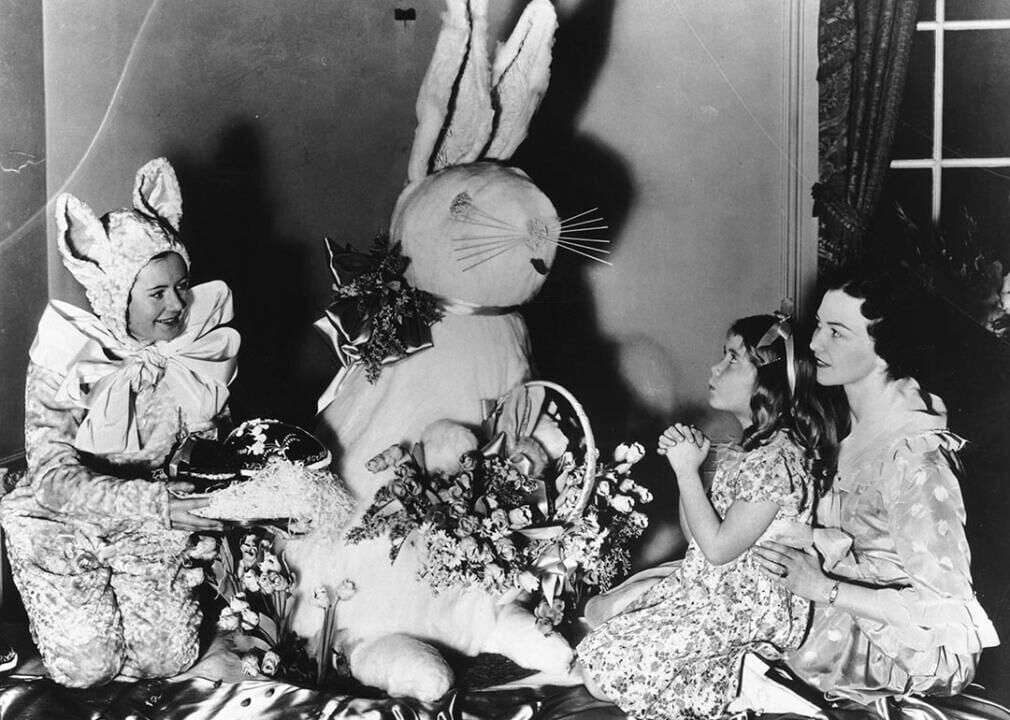
The Easter Bunny is a much celebrated character in American Easter celebrations. On Easter Sunday, children look for hidden special treats, often chocolate Easter eggs, that the Easter Bunny might have left behind.
Folklorist Tok Thompson, a professor of anthropology and communications at USC, writes for The Conversation on the origins of the long and interesting journey this mythical figure has taken from European prehistory to today.
Religious role of the hare
Easter is a celebration of spring and new life. Eggs and flowers are rather obvious symbols of female fertility, but in European traditions, the bunny, with its amazing reproduction potential, is not far behind.
In European traditions, the Easter Bunny is known as the Easter Hare. The symbolism of the hare has had many tantalizing ritual and religious roles down through the years.
Hares were given ritual burials alongside humans during the Neolithic age in Europe. Archaeologists have interpreted this as a religious ritual, with hares representing rebirth.
Over a thousand years later, during the Iron Age, ritual burials for hares were common, and in 51 B.C., Julius Caesar mentions that in Britain, hares were not eaten, due to their religious significance.
Caesar would likely have known that in the Classical Greek tradition, hares were sacred to Aphrodite, the goddess of love. Meanwhile, Aphrodite's son Eros was often depicted carrying a hare, as a symbol of unquenchable desire.
From the Greek world through the Renaissance, hares often appear as symbols of sexuality in literature and art. For example, the Virgin Mary is often shown with a white hare or rabbit, symbolizing that she overcame sexual temptation.

Hare meat and witches' mischief

But it is in the folk traditions of England and Germany that the figure of the hare is specifically connected to Easter. Accounts from the 1600s in Germany describe children hunting for Easter eggs hidden by the Easter Hare, much as in the contemporary United States today.
Written accounts from England around the same time also mention the Easter Hare, particularly in terms of traditional Easter hare hunts, and the eating of hare meat at Easter.
One tradition, known as the "Hare Pie Scramble," was held at Hallaton, a village in Leicestershire, England, which involved eating a pie made with hare meat and people "scrambling" for a slice. In 1790, the local parson tried to stop the custom due to its pagan associations, but he was unsuccessful, and the custom continues in that village until this day.
The eating of the hare may have been associated with various longstanding folk traditions of scaring away witches at Easter. Throughout Northern Europe, folk traditions record a strong belief that witches would often take the form of the hare, usually for causing mischief such as stealing milk from neighbors' cows. Witches in medieval Europe were often believed to be able to suck out the life energy of others, making them ill, and suffer.
The idea that the witches of winter should be banished at Easter is a common European folk motif, appearing in several festivities and rituals. The spring equinox, with its promise of new life, was held symbolically in opposition to the life-draining activities of witches and winter.
This idea provides the underlying rationale behind various festivities and rituals, such as the "Osterfeuer," or the Easter Fire, a celebration in Germany involving large outdoor bonfires meant to scare away witches. In Sweden, the popular folklore states that at Easter, the witches all fly away on their broomsticks to feast and dance with the Devil on the legendary island of Blåkulla, in the Baltic Sea.
Pagan origins
In 1835, the folklorist Jacob Grimm, one of the famous team of the fairy tale "Brothers Grimm," argued that the Easter Hare was connected with a goddess, whom he imagined would have been called "Ostara" in ancient German. He derived this name from the Anglo-Saxon goddess Eostre, that Bede, an Anglo-Saxon monk considered to be the father of English history, mentioned in 731.
Bede noted that in eighth-century England the month of April was called Eosturmonath, or Eostre Month, named after the goddess Eostre. He wrote that a pagan festival of spring in the name of the goddess had become assimilated into the Christian celebration of the resurrection of Christ.
It's interesting that while most European languages refer to the Christian holiday with names that come from the Jewish holiday of Passover, such as Pâques in French, or Påsk in Swedish, German and English languages retain this older, non-biblical word, Easter.
Recent archaeological research appears to confirm the worship of Eostre in parts of England and in Germany, with the hare as her main symbol. The Easter Bunny therefore seems to recall these pre-Christian celebrations of spring, heralded by the vernal equinox and personified by the Goddess Eostre.
After a long, cold, northern winter, it seems natural enough for people to celebrate themes of resurrection and rebirth. The flowers are blooming, birds are laying eggs, and baby bunnies are hopping about.
As new life emerges in spring, the Easter Bunny hops back once again, providing a longstanding cultural symbol to remind us of the cycles and stages of our own lives.
This story was produced by The Conversation and reviewed and distributed by Stacker.

What happened on April 13, 1975, would change the course of Lebanon. An attack on a bus in Beirut plunged the country into 15 years of civil war.

A floppy-eared Flemish giant who was larger than life in both size and spirit, Alex suffered complications from cancer treatment, according to his owners.


