


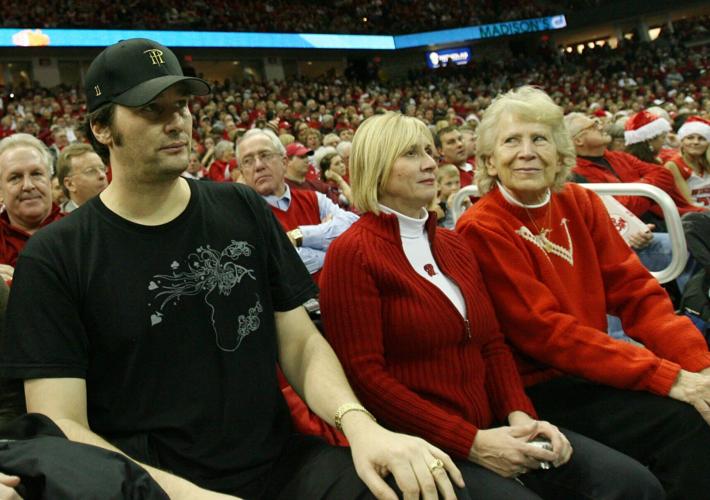
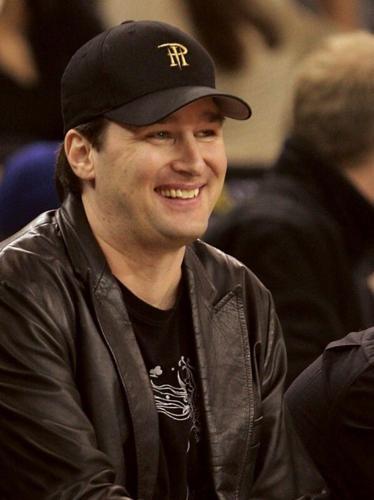
One by one, the psychic read the palms of the five Hellmuth children growing up on Jefferson Street in the Vilas neighborhood of Madison. The oldest, a teenager at the time, didn’t find anything particularly interesting about his siblings’ results.
His, though? Life-changing.
“She said, ‘You are going to become famous and infamous throughout the world,’” Phil Hellmuth Jr. said all these years later. “I took that to mean something.”
He’d become the winner of the World Series of Poker Main Event about a decade later at age 24, holding the title of youngest champion for the next 19 years. The 35th anniversary of a triumph that was shocking to most everyone but him arrives Saturday, and Hellmuth earlier this week rattled off details from that run that made it seem like it happened yesterday.
But that run in May of 1989 is only a tiny part of Hellmuth’s story, which is why an interview that was designed to only take 15 to 20 minutes lasted nearly an hour. There was a lot of ground to cover: how the self-described “black sheep” of the family went against his father’s wishes and pursued a dream; how beating Johnny Chan for that first title kickstarted a Hall of Fame career with no end in sight; and why what we see on television — a man who is quirky and prone to temper tantrums — doesn’t paint a full picture of Hellmuth.
He will turn 60 in July and spent last weekend celebrating early at an exclusive party thrown for him in northern California, where he lives. Among the two dozen guests who stopped in at some point at what Hellmuth called his Besties Billionaires Bash — yes, he rubs elbows with some extremely wealthy people — was Elon Musk.
Chalk one up for the palm reader because she nailed it: Hellmuth is famous and, yes, a little infamous, too.
The challenge of building self-esteem
Lynn Hellmuth sat at a table on the second floor of a downtown Madison coffee shop one morning last week, waiting for her husband, Phil Sr., to return with the couple’s order.
They are the type of parents who reach out to the local newspaper when their famous son does something special, as was the case last July after Hellmuth won his record 17th World Series of Poker bracelet. They just wanted to make sure the sports staff of the Wisconsin State Journal was aware that Hellmuth had won the Super Turbo Bounty No-Limit Hold’em event.
Hellmuth turned a $10,000 buy-in into a $803,818 prize in that three-day event and has won more than $30 million in live, sanctioned events during his career. He’s become famous in the process, but that’s not where Lynn wants to start.
After showing me a signed picture she’d pulled out of an envelope that also included an article about her son, Lynn goes into mother mode. So about that infamous side …
“I have to tell you one thing about Phil,” she said about her oldest, who the family refers to as PJ because he shares the same name as his father. “One of the best things about him is he has a really big heart.”
Phil is gentle with his mother, and the two have a bond that can’t be damaged even when they can’t see eye to eye on politics (they are polar opposites on that topic).
Lynn taped a handwritten message to the mirror in the bathroom so her children would see it and be inspired to achieve greatness. It read: “You are what you think. You become what you think. What you think becomes reality.” Hellmuth said it had a profound impact on his pursuit of a dream, especially during a childhood in which he struggled because he felt like he wasn’t keeping up in a family that was driven to succeed in the classroom and beyond.
Phil Sr. grew up in Chicago, the son of a heart surgeon who demanded his children pursue excellence in education, lest they end up working in the steel mills the rest of their life. He took that to heart, earning an undergraduate degree at the University of Chicago and a law degree at Marquette before moving to Madison a week after he married Lynn in 1963. He worked the next 36 years at UW-Madison, rising to dean in the College of Letters and Science.
The couple’s oldest child struggled with the pressure to live up to his parents’ expectations, he admits.
“My self-esteem was beat up,” Hellmuth said.
His grades didn’t match those of his siblings. Neither did his results in the athletic world. “At 8 years old I was one of the fastest swimmers in Wisconsin,” Hellmuth said. “But it just went downhill from there.
“So by the normal metrics that any parent would measure their children by — grades in school, athletics and maybe the ability to play a musical instrument, which I didn’t have, either — I was failing.”
Hellmuth did have one thing on his siblings: As the oldest, he could dominate them in Monopoly and other board games. Lynn remembers family trips to Minocqua in northern Wisconsin that ended with four children in tears when the last move was made in a game.
Meanwhile, Hellmuth would be smiling, celebrating another victory.
“My way of hanging on to a shred of self-esteem,” Hellmuth said, “was to become great at games.”
How a ‘loophole’ led to the pursuit of a dream
But poker? The idea of chasing that as a career only led to more clashes between Phil Sr. and PJ. They’d argue at the dinner table, everyone else with heads down and lips zipped as father and son went back and forth.
“I wanted our family to have excellence,” Phil Sr. said, “and poker didn’t compute.”
Hellmuth, despite his academic struggles growing up, had been accepted into UW-Madison with some help from the man with whom he’d been butting heads.
“My dad got me in through a loophole — a completely legal loophole where you were allowed to apply for special student access,” Hellmuth said. “My dad worked at the university, he knew about the loophole, so it was completely legal.”
Hellmuth got solid grades his freshman year but was rejected when he applied for admission into the business school. He had decided by that point that he enjoyed accounting and philosophy, two subjects that could be utilized in something else that had become an obsession in his life.
What began as poker games at the Memorial Union that required only $5 to enter had expanded into something bigger for Hellmuth: a spot at the table in what he referred to as the doctors’ game: It included physicians, surgeons, lawyers, none of them younger than 40 years old. Oh, and a cocky, 20-year-old who got a kick out of the fact that all of these educated men — with degrees Hellmuth’s father would have loved his children to pursue — were padding his bank account.
“I crushed those guys,” Hellmuth said. “I think the biggest day ever I think I won like $2,600, but that was 1985, so I think you can probably safely 15x that financially, maybe 20x it. But even if we 10x it, that would be $26,000 today.”
Much to the chagrin of his parents, Hellmuth dropped out of college. His first trip to Las Vegas came in late 1985. He walked into the Dunes Hotel & Country Club — that venue was destroyed eight years later and is now the Bellagio Hotel & Casino — and took a seat next to a man wearing a tuxedo on New Year’s Eve.
It was actor Telly Savalas.
Hellmuth brought with him $3,000 in traveler’s checks for that trip because he was afraid of carrying around so much cash. Either way, he went right through it, and that was a familiar trend in those early years that began with a bankroll of $21,000 after Hellmuth had paid off his student loans.
It wasn’t just that Hellmuth was losing at the card table. He also was spending heavily — expensive restaurants, the best liquor — because he wanted to act like he belonged in a city with so many high-rollers.
He’d lose money, return to Madison and tell his parents that he was a good player who just needed experience, head back to Vegas and start the same cycle all over again.
Then came the time that he was too broke to get a flight home. That’s when he called the woman he knew wouldn’t scream at him through the phone.
Lynn arranged for a flight but not before she delivered a stern warning to her son: You never will ask again.
“Fortunately,” Lynn said all these years later, “he never had to.”
A voicemail prediction that came true
Hellmuth was right about one thing: He just needed some seasoning.
He finished 33rd of 150 players at the 1988 World Series of Poker Main Event and was brimming with confidence heading into the next year’s event. By that point, he was driving around Madison in a Cadillac and living in the Allen House Apartments on University Avenue, where he left a message on his answering machine before leaving for the 1989 event:
“Hopefully,” Hellmuth told callers, “you’ll be talking to the 1989 World Champion of Poker.”
In fact, the cocksure Hellmuth had been telling anyone who would listen that he was going to win. He’d taken even-money bets that he would win, which seemed like a good idea until grandmothers were coming up to him at circuit events wanting action.
Hellmuth figured he’d have to go through two-time defending champion Johnny Chan to win that championship, and that’s exactly how it played out. Chan had knocked out Hellmuth the previous year and the two had faced off at big tournaments leading up to the 1989 event.
A freelance writer doing a story on Chan for the May 1989 issue of Esquire magazine was present for one of the showdowns and described scenes that, even then, made Hellmuth seem too cocky for his age.
But there was one other part of that piece that Hellmuth remembers to this day:
“I let my ego get out of hand when I was younger, too,” Chan told writer Peter Alson. “But Phil will be world champ someday. All he has to do is learn to tuck it in a bit.”
That was a compliment from Chan. But Hellmuth, even 35 years later, seemed to have taken it as at best a challenge and at worst a slight.
A tournament that began with 178 players fittingly came down to Hellmuth and Chan. Highlights of that head-to-head battle can be found on YouTube and document a final hand that featured Hellmuth, wearing Walkman headphones, going all in with a pair of nines and Chan called with an ace of spades and a seven of spades.
Hellmuth was a favorite to win the hand and yet he couldn’t shake the feeling that he was doomed.
“I was convinced I was going to lose the hand,” he said.
Chan didn’t catch an ace on the three-card flop, which came up with two kings and a 10. His chances increased when a queen showed up on the turn, giving Chan plenty of outs: an ace would give him a better pair; a queen or 10 would give him two higher pair with a better kicker; and a jack would give him a straight.
When a six of spades came up on the river, giving Hellmuth the win, he raised both arms in the air and pumped his right arm once more as an exclamation point. He then turned around toward the crowd to look for someone in particular.
The man who he’d clashed with, who’d told him that pursuing a poker career was silly, had been watching the proceedings play out for three days.
Phil Hellmuth Sr. had arrived in Vegas as a show of support, even after his son had told him that he had to focus for the four-day event and basically would be ignoring his father. When PJ reamed out his father for forgetting a banana on the first day of his stay — the son’s only request was to have breakfast waiting for him when he woke up each day — Hellmuth Sr. stuck around and didn’t make the same mistake again.
The father worked his way through the crowd, finally found his son and they embraced. The kid had called his shot: He was the 1989 Main Event champion.
How a big win was followed by an ego check
What would a lot of 24-year-olds do after winning $755,000? Spend it, of course.
The splurging began right away that Thursday night in Vegas, with Hellmuth treating his father and some friends in Madison to a dinner and drinks at a restaurant in Caesar’s Palace, ringing up a bill of nearly $2,000. He had employees at Binion’s Horseshoe, the site of Hellmuth’s big win, looking for accommodations for a private plane that would take the group back to Madison.
Hellmuth Sr. declined, deciding to stick with his commercial flight. His son got the private jet anyway and played spades, hearts and dirty clubs on the flight back home.
Hellmuth bought a penthouse condominium at The Cove along Lake Mendota in Shorewood Hills. He bought a new Cadillac and a Porsche with a whale tail.
“Normal ego cycle after winning,” Hellmuth said.
But he was in the giving mood, too. He helped fund the educations of siblings and other family members. He surprised his father with a Mercedes, the type of gestures that are remembered 35 years later and brought up as anecdotes when a mother describes a son with a big heart.
“I just felt a tree growing these huge roots,” Hellmuth said, “and I could put a lot of people under that tree.”
But the spending got out of hand, he admits, and it didn’t help matters that he followed his big win in Vegas with a bad cold spell over the next two years.
Plus, he’d added major priorities to his life. He was being counted on for support from Katherine Sanborn, the UW medical student he’d met, fallen in love with and married, and the first of two sons they’d have together.
The monthly condo fees and all the other bills were adding up, so Hellmuth had to make ends meet somehow. He’d drive that Cadillac to Escanaba, Michigan, on a Thursday and play poker until Saturday before driving back to The Cove after what was then called the Chip-In Casino had closed for the night.
Those trips were usually good for anywhere between $1,000 to $4,000.
“Didn’t go into debt, didn’t borrow any money,” Hellmuth said. “Just manned up and paid the bills.”
A mix of love and hate
Hellmuth’s game really started to take off in 1992 — he won another bracelet that year and three more in 1993 — but so did his reputation as being too cocky. There was an unflattering profile that appeared in a national poker magazine during that time in which some poker veterans were critical of Hellmuth.
The noise only got louder a decade later after the poker boom that was created, at least in part, by Chris Moneymaker’s win in the 2003 Main Event.
“A bunch of younger generations have trashed me consistently since they’ve come in: ‘Phil can’t do this, Phil can’t do that,’” Hellmuth said. “And now they’re all broke and at home. The generation from ’03, ’04 ’05, ’08 and ’10, they’re all out of the game by now and I just keep winning. There are some things I do that don’t make sense to the world, so they’d rather criticize than understand.
“It’s easier to throw shade, I think,” Hellmuth adds, immediately after dropping some major shade on his opponents.
Still, Hellmuth said he’s lived a charmed life. He’s helped raise nearly $80 million just from serving as an emcee at various charity poker tournaments. He’s taken a page out of Lynn’s manual by taping what he considers blessings on his mirror so he can leave home in a good mood each day, one of the eight life lessons he wrote about in his book titled “#Positivity”.
Playing professional poker anywhere, much less in Las Vegas, can be tough on marriages. But Hellmuth seems most proud of the fact that he and Sanborn are going strong after 30-plus years.
She’s a clinical associate professor in psychiatry and behavioral sciences at Stanford. Hellmuth Sr. has breakfast alone with his daughter-in-law twice a year and stresses to her how much he admires her.
“Kathy is really something special,” he said. “She’s able to deal with his sensitivities. She knows how to deal with him A to Z, which I’m impressed with. Now she’s had him twice as long as we did.”
Hellmuth has won seven more bracelets than any other player and has a goal of reaching 24, a number he said came to him in a vision in 1993. Or perhaps more.
As for his reputation as a whiner and poor loser? Well, that’s not going away anytime soon in part because he embraces it and uses it as a marketing tool.
One of his books is titled “Poker Brat”, and he’s currently promoting a “Beat the Brat” contest on social media. Phil Sr. and Lynn recently were watching a tournament and couldn’t help but notice how calm he was.
“The announcers were saying, ‘Watch this, any moment he’s going to explode,’” Phil Sr. said.
Mount PJ never erupted.
“He’s decided he wants to be a good guy,” Lynn said.
It all makes me wonder how much of the Poker Brat stuff is for show. Hellmuth said that a show is coming out in August that will show him throwing a microphone pack after a bad interaction with a fellow player.
“It’s going to go viral and all the haters are going to talk about what an a——- I am again,” he said. “Might have been the most justified mic-pack throw of all time, but it doesn’t matter. The haters will spin it as, ‘Look at this a——-’, lovers will think, ‘This guy really crossed the line with Phil.’ ”
It’s just the price of being famous. And infamous.


