UW-Madison researcher develops ice cream that doesn't melt
KIMBERLY WETHAL
Updated
Over the span of an hour, regular ice cream begins to lose its shape and drip into the beaker below after 30 minutes, while UW-Madison Ph.D. researcher Cameron Wick's ice cream, infused with polyphenols, holds its shape.
Two molds of ice cream sat atop metal mesh balanced over beakers in a warm Babcock Hall lab on Monday, an endurance test perfectly suited for the day's stifling heat.
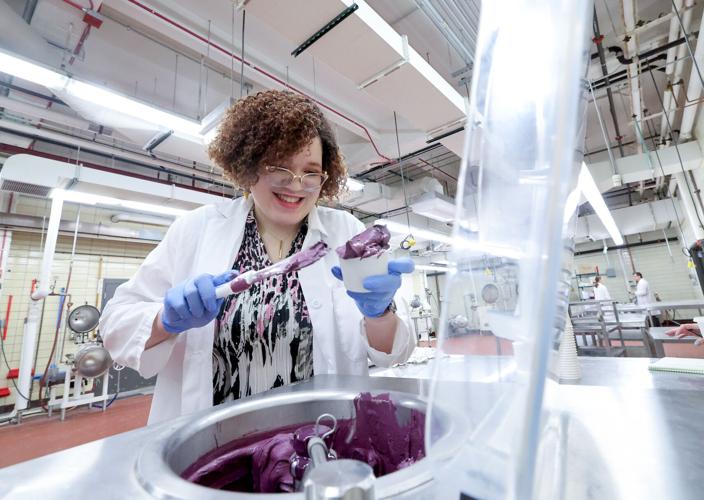
UW-Madison Ph.D. graduate Cameron Wicks scoops a batch of blueberry slow-melting ice cream into containers. Over the last six years of research, Wicks has discovered how infusing polyphenols — compounds found naturally in plants such as blueberries and green tea leaves — slows how quickly ice cream melts by increasing its viscosity.
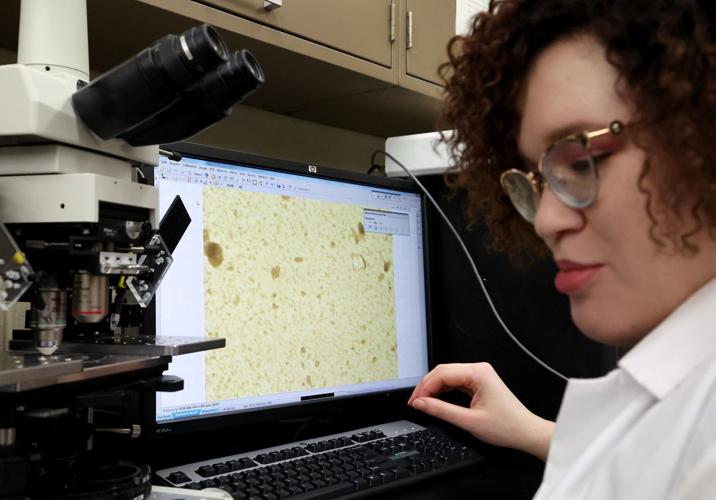
UW-Madison Ph.D. graduate Cameron Wicks views the fat cells of a slow-melting ice cream in a Babcock Hall lab. The sample had to be diluted with water to ensure the fat clusters could be seen, since the sheer number of them would be hard to see otherwise.
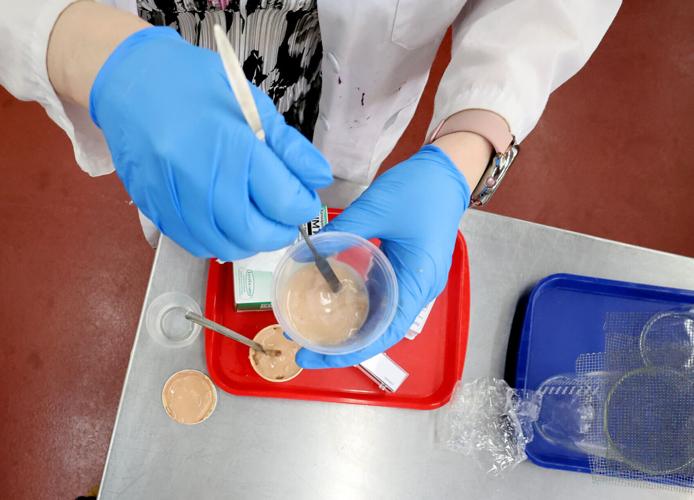
UW-Madison Ph.D. grad Cameron Wicks prepares a sample of slow-melt ice cream for evaluation under a microscope. Samples have to be diluted with water so she can see the fat clusters created by adding the polyphenols to the ice cream. Without it, they're hard to see.
Enter any temperature 80-112° Fahrenheit along with a relative humidity that is greater than 13. Calculate to see how the temperature feels to your body. Heat index values are for shady locations. If exposed to direct sunlight, the heat index value can be increased by up to 15°F.
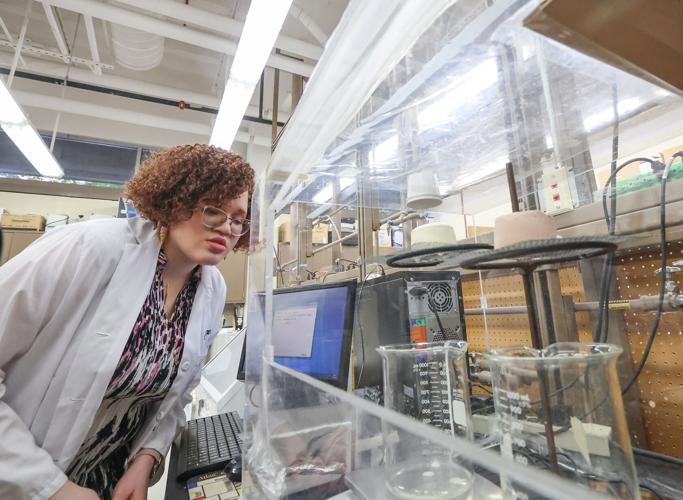
UW-Madison Ph.D. grad Cameron Wicks checks the progress of a melting demonstration between a conventional ice cream and a new slow-melt version in a Babcock Hall lab. The sample on the right, a green tea ice cream with high levels of polyphenols, kept its shape after multiple hours even as it started to drip into the beaker. The regular ice cream sample started to rapidly drip after 30 minutes left out at room temperature.
UW-Madison Ph.D. graduate Cameron Wicks scoops a batch of blueberry slow-melting ice cream into containers. Over the last six years of research, Wicks has discovered how infusing polyphenols — compounds found naturally in plants such as blueberries and green tea leaves — slows how quickly ice cream melts by increasing its viscosity.
UW-Madison Ph.D. grad Cameron Wicks prepares a sample of slow-melt ice cream for evaluation under a microscope. Samples have to be diluted with water so she can see the fat clusters created by adding the polyphenols to the ice cream. Without it, they're hard to see.
UW-Madison Ph.D. graduate Cameron Wicks views the fat cells of a slow-melting ice cream in a Babcock Hall lab. The sample had to be diluted with water to ensure the fat clusters could be seen, since the sheer number of them would be hard to see otherwise.
UW-Madison Ph.D. grad Cameron Wicks checks the progress of a melting demonstration between a conventional ice cream and a new slow-melt version in a Babcock Hall lab. The sample on the right, a green tea ice cream with high levels of polyphenols, kept its shape after multiple hours even as it started to drip into the beaker. The regular ice cream sample started to rapidly drip after 30 minutes left out at room temperature.