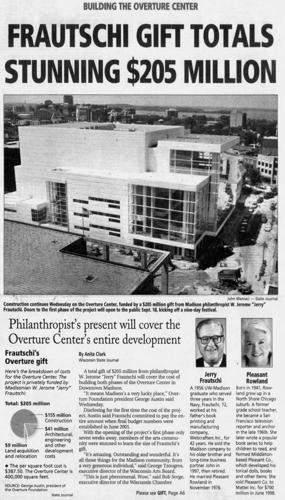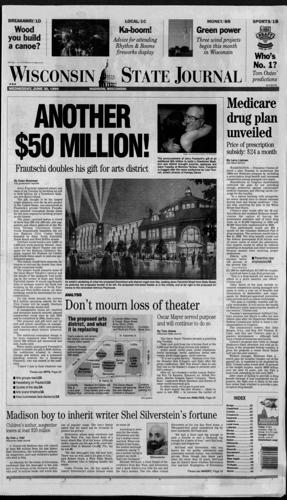


Jerry Frautschi and his wife, Pleasant Rowland, gave to countless projects, charities and missions over the decades. UW-Madison. The Wisconsin Youth Symphony Orchestra, to which Frautschi recently donated his clarinet. The Wisconsin History Museum.

Frautschi, who died Thursday, was instrumental in the Overture Center’s development.
But none was bolder and changed Madison the way Frautschi’s $205 million support of the Overture Center did. And according to news reports in 2000, the arts institution was named the Overture Center — and not after its major donor — because that’s what Frautschi wanted. The donation remains the single largest contribution to the arts in U.S. history.
This article encapsulates Frautschi, who died Thursday at age 94, and the impact of the Oveture Center.
It was printed in the Wisconsin State Journal on Sept. 12, 2004, just ahead of the Overture Center’s grand opening on Sept. 19. It was written by former reporter Tom Alesia.
People are also reading…
$205 million vision
Overture Center for the Arts' fountain of funding, Jerry Frautschi, didn't want to die and let others divide his vast, unexpected wealth.
Sitting on boards for various organizations, he watched when deceased donors' sizable money pies were sliced without input or enjoyment from their original sources.
That won't happen to the robust Frautschi, who turned 73 on Sept. 9. He walks the Overture Center's roomy corridors a few times each week, privately admiring the grandiose auditorium or the sky-blue swirling rotunda for children's shows.
Frautschi checks his ego at the glass doors. He gave an eyeball-popping $205 million to build Overture Center with no strings attached and asked - rather, demanded - that nothing bear his name. When the complex is complete without taxpayer funds in early 2006, none of its theaters, museums or rehearsal spaces will say "Frautschi."
He dismissed comments about his legacy, preferring to live in the moment. Offered a compliment about his almost unprecedented generosity he politely accepted it, then swatted it away as if a fly entered the room. He rushed to mention his family's history of philanthropy in Madison that nearly dates back to the Civil War.
So what ran through his mind when he strolled inside Overture Center?
"I can't believe," he said, his voice softening and his public facade down, "this is something that I've been able to give to the community."

How did it happen?
How did a retired Madison book manufacturer who savors fishing in Minocqua become an icon known and admired by arts officials worldwide?
Dolls.
Yes, to a large degree, it's dolls: from long-legged Barbie to historic orphan Samantha. Each played a role.
That's because on June 15, 1998, toy giant Mattel Inc., bought Middleton-based historic doll and book publisher Pleasant Co. for $700 million. Frautschi and his wife, company founder Pleasant Rowland, reaped the financial rewards. (On a 1998 list, Forbes magazine listed Rowland as being worth more than Oprah Winfrey.)
Frautschi privately amassed a fortune from the sale. He described himself during a recent interview at Overture Foundation offices as "a major shareholder" in Pleasant Co. and repeatedly cited the Mattel sale as Overture's seemingly endless financial source.
Six weeks after the transaction, Frautschi announced a $50 million gift to launch plans for a Downtown arts center.
"I was fortunate," he said. "I can't think of a better way to put my good fortune to work."
In August 1997, Frautschi retired and sold his portion of Webcrafters Inc., a book-manufacturing firm with 700 employees on Madison's East Side, to his lone sibling and longtime business partner, John Frautschi. Their father, Walter, helped build the company and became its owner in the 1950s.
Money earned through Webcrafters prompted Frautschi to develop the Overture Foundation and in 1997 members of the Madison Art Center board approached him about leading their financial campaign for a new space. Other ideas floated in Frautschi's mind. He knew the Madison Symphony Orchestra (MSO) needed an improved theater. Several other arts groups needed help, too.
Frautschi desperately wanted to support Madison, following his parents' example when they helped the city develop the Madison Civic Center, which opened in February 1980.
"That was an incentive for me," he said.
He envisioned Overture Center and, suddenly with Pleasant Co.'s sale, he had remarkable financial resources.
"It's almost comic that the stars would align as they happened to align," Rowland said in a separate interview. "These arts organizations needed more space, which we had become acutely aware of by people coming to us asking for donations. Then there's the fortuitous timing with my being ready to sell Pleasant Co."
She added that her husband eagerly sought to share his wealth: "Since I met him (in 1976), he was the one of us who always wanted to be a philanthropist."
As a result, Frautschi planted in Downtown Madison what is considered the largest gift to the arts in American history.
Downtown renewal
Looking out the window of Overture Foundation's eighth-floor board room, Frautschi savored his view of the state Capitol and praised its painstaking restoration. He noted Monona Terrace's positive effect on the city. Overture Center blends with those buildings to enhance Downtown, he said.
Frautschi said he remembers coming Downtown to Rowland's office several years ago and feeling discouraged.
"In the evening, this beautiful square was deserted," Frautschi said.
Frautschi wanted to help fill that void. He is an unlikely arts champion, though. He enjoys the arts, but he prefers to be a supportive patron and not a critic. When handed a list of Overture Hall's debut season with more than 40 shows, ranging from the Chicago Symphony Orchestra to the Peking Acrobats, and asked about his favorites, he waved his hand and said, "All of them."
Rowland said her husband has always loved classical music. She passed her devotion to visual arts to him, she added, and he instilled a passion for opera in her.
Frautschi remains active in Overture Center's construction and architecture decisions, but he rarely mentions arts programming. He made only one request: That the MSO play Saint-Saens' "Organ Symphony," a favorite of his and Rowland's, during its concert on the grand-opening's second day. The piece will be played on a massive pipe organ financed largely by Rowland.
Why did Frautschi choose the arts as the recipient of his largesse?
"I'm from the old school. I believe the No. 1 priority for the public sector is to take care of their citizens," he said. "That means it's up to the private sector to give to the arts."
Stirrings about Overture Center's accessibility to small arts groups and potential high ticket prices have been reduced by a nine-day grand opening featuring more than 120 free Dane County acts and initial ticket costs within reach of the Civic Center's.
"There are some negative comments from time to time," Frautschi said, "but as far as I know they're from a very small portion of the population."
What bothers Frautschi is that Overture Center faces some properties across the street from Overture Center that look shabby. In addition, several empty storefronts sit opposite of Overture Hall at the corner of West Mifflin and Fairchild streets.
"It's upsetting," Frautschi said. "I think there will be comments (from visitors) about that after the opening."
Family ties
Frautschi's great-grandfather, Christian Frautschi, settled in Madison in 1867. Jerry's father, Walter, was the son of Emil Frautschi, a Madison civic leader and one of Christian's 11 children.
In 1925, Walter began working at the printing company that he would eventually own and rename Webcrafters. Walter and Dorothy Frautschi were married 70 years until Walter's death in 1997. Dorothy, a banker's daughter, lived until age 97. She died in 2001.
Before giving his first $50 million to the Overture Center, Jerry told his mother about his plans. Dorothy was frugal and warned him, "Money has wings."
"It was difficult for her to conceive a gift like this," Frautschi said. "But she was proud."
Growing up, Frautschi attended the former Lakewood School in Maple Bluff. He attended Fountain Valley School, an all-boys boarding high school in Colorado Springs, Colo., where he played football and basketball and graduated in 1949. He remains one of the school's trustees.
After freshman year at the University of Virginia, Frautschi transferred to UW-Madison. The reason wasn't academic.
"Virginia was not co-ed," he said with a laugh. "I spent three years at boarding school that was not co-ed and I thought, 'Not this again.' "
Three years of duty in the Navy interrupted his UW studies, but he graduated in 1956. From there, he worked in sales and marketing for Webcrafters, beginning a 42-year career. He married a childhood sweetheart in 1960 and they had three sons before divorcing in 1973.
In May 1976, he met Rowland, a Webcrafters customer. They rode around Madison together on Frautschi's motorcycle and fell in love within one week. Five months later, they married.
Since then, Rowland's profile increased. With Overture Center, so did Frautschi's. That prompted public curiosity: What are they really like?
Rowland laughed at the question, then gave it considerable thought.
"I think Jerry and I are far more regular, down-home folks than most people think we are. People who have known us for a long time know us as very real and approachable people," she said.
"Coming into this incredible fortune puts you in the limelight. Then choosing to be public in how you spend the good fortune puts you in an even more visible posture. The consequence of being visible is that you become isolated from people. It's a sad consequence that has happened, but we do everything we can to still be the people that we always have been."

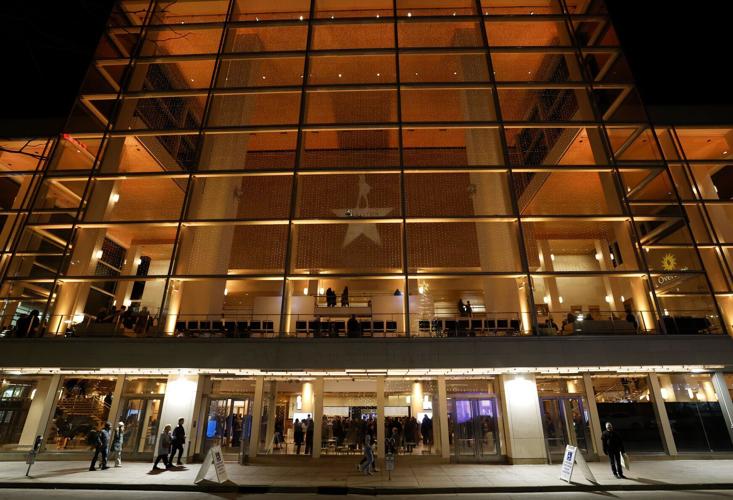
Theatergoers arrive to see “Hamilton” at the Overture Center Friday evening. The center is a lasting legacy to the generosity of Madison philanthropist W. Jerome Frautschi, who funded its construction in 1998.
Public privacy
Grant Frautschi, one of Jerry's sons and a Madison resident, sits on the Overture Foundation board and remembered when his father presented early plans.
"My initial question was, 'Do you think it can get done?' " said Grant, 38. "I didn't think it was possible. I'm amazed my dad and the city of Madison could move this project forward."
Jerry Frautschi keeps a low profile. On Overture Center's opening night, Frautschi may offer a wave to the crowd but he won't give a speech.
Is it shyness? No, said Jerry's brother John. Grant agreed.
"My dad's not a shy person," Grant said. "He's not a public person, though."
Rowland called her husband "very unpretentious and very principled."
John, Webcrafters' chairman, noted his family's desire to help the community without fanfare.
"We've always kind of wanted to be in the background a little bit," John said. "We certainly don't want to toot our own horn."
Overture officials and arts representatives asked Jerry to allow his name to be etched on a wall to acknowledge his gift. He consented to that token nod.
Frautschi will be at Overture Center often, embarrassed if he forgets a well-wisher's name, to see others enjoy his gift. He said he hopes his two grandchildren (another is due this fall) and maybe great-grandchildren can enjoy Overture Center.
To him, the $205 million price tag seemed like Overture's least interesting aspect to discuss.
"The amount is obviously important, but giving is not just the dollars you put in," he said. "What percentage of your wealth are you willing to share? There are people who may give what is relatively modest but for them it's more generous than what I give."

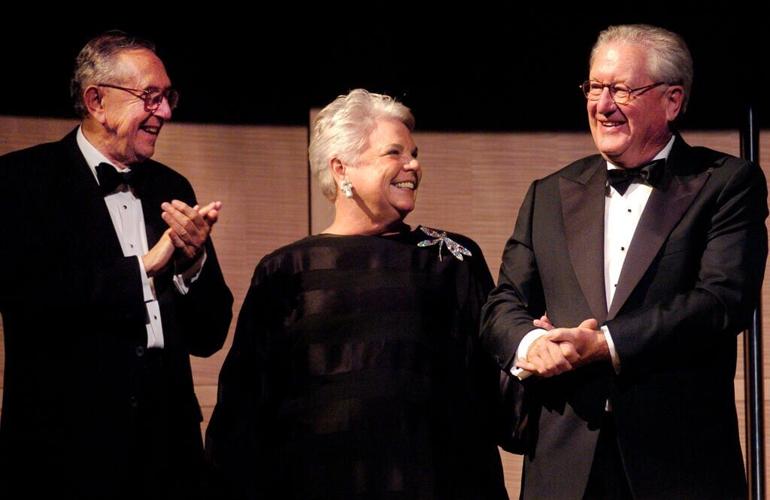
Philanthropist Jerry Frautschi, right, acknowledges applause from the crowd in Overture Hall on the opening night of the Overture Arts Center in 2004. Pleasant Rowland and architect Cesar Pelli, who designed the hall, are also pictured.