
The math for a college degree still makes sense: Nationally, a bachelor’s degree boosts a person’s annual average earnings by about $24,000, according to data from the Federal Reserve Bank of New York.
In Wisconsin, average earnings for a student entering the workforce directly after high school is $40,104, according to the U.S. Bureau of Labor Statistics; for graduates of the Universities of Wisconsin, the average starting salary is $61,221.
People are also reading…
But BLS data show that fields related to law, and business, technology and the STEM fields (science, technology, engineering and mathematics) provide a much greater return on investment for a bachelor’s degree than those related to humanities. Those higher-paying careers tend to pay an average of $10 to $35 more an hour than humanities-based jobs.
Workers without bachelor’s degrees in industries such as construction also can yield wages similar to, and even higher than, those in business and technology.

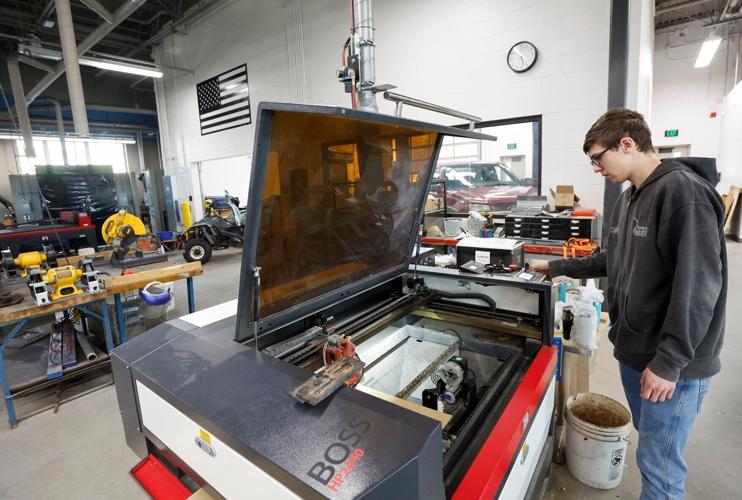
Senior Andrew Seiler works on a laser engraver in the shop at Wisconsin Dells High School. The Wisconsin Dells School District is one of many in rural areas that's investing in Career and Technical Education programs; expanded shop areas were part of a bid for Wisconsin Dells' recently built high school in 2020.
But to get more money, those college grads first have to spend it. In 2022-23, the average UW system graduate left school with about $24,144 in student loan debt. Student debt load has been falling in recent years: Five years ago, students graduated with an average of $26,388 in debt, just shy of $32,000 when adjusted to 2023 dollars.
Read more of this project:
>> Rural students’ college dreams grow dimmer
>> Technical colleges are filling the gap
>> College roadshows help prospective students
For humanities-related degrees across the UW system, however, the benefit of a bachelor’s degree is less substantial. Graduates with humanities-based degrees see roughly a $1- to $3-an-hour increase in pay over the state average for all occupations.

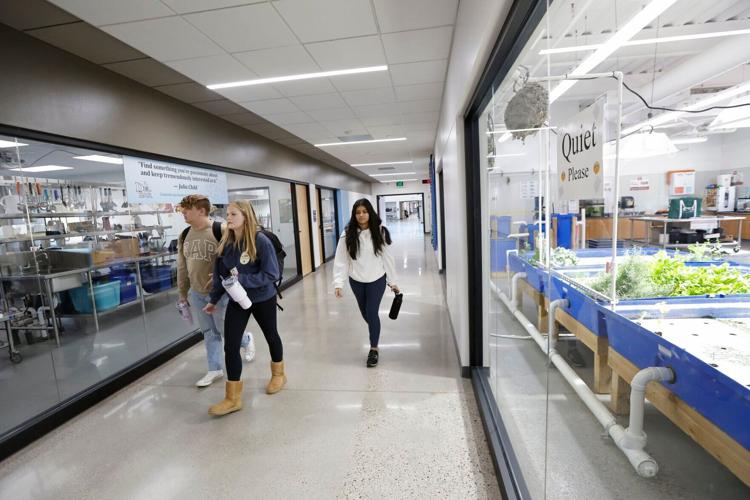
Wisconsin Dells High School seniors, from left, Nick Meller, Claira Weaver and Jaquelin Barrita, walk to their veterinary science and culinary classes at Wisconsin Dells High School. Many Wisconsin Dells High School students are pursuing college degrees, but administrators also have increased efforts to encourage students to find their own path, whether or not it includes a four-year degree.
For many of Wisconsin’s high school graduates, the cost of college isn’t worth the delayed gratification of higher wages. Or the work they’re pursuing doesn’t require it. Others haven’t ruled out college, but they can’t afford it.
Nekoosa High School senior Chase Newlun already has established an LLC for his landscaping company and plans to study for his real estate license.
“(I’m) not having to go tens or hundreds of thousands in debt for a job that you’re not even guaranteed,” Newlun said.
Classmate Hunter Rosplock is looking at a life that will allow him to afford his true passion: nice cars. He’s going into the workforce after high school, with plans to either pursue welding, which requires a three-month training program at Mid-State Technical College, or automotive repair. Rosplock’s father is a welder, and he sees how much you can make in that career.
“I’ll be paying for that school while I’m doing it, and then right after I’ll just instantly be making profit,” Rosplock said. “Honestly, anything above $80,000 is fine for me — not obviously at the start, but when I’m established … that’s livable in Wisconsin. Obviously, I’ll go places, but I think I’m going to stay stationed here for my lifetime. It’s a nice place.”
This story was produced with support from the Education Writers Association Reporting Fellowship program.