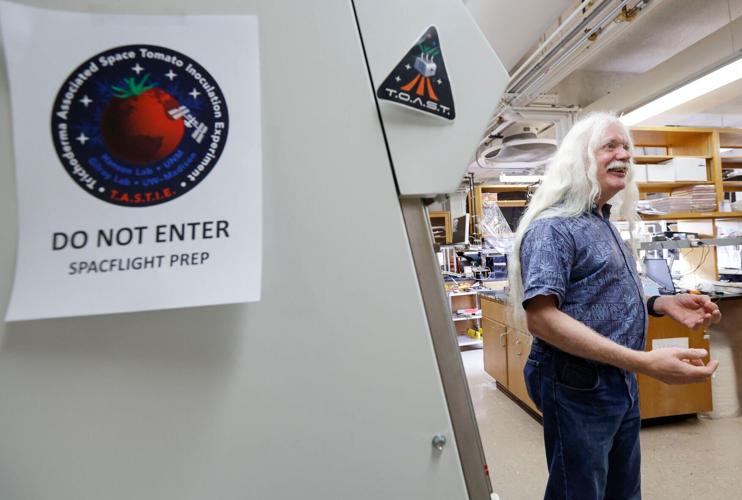
UW-Madison botany professor Simon Gilroy talks about how the general rules of biology and evolution that plants and animals have experienced on Earth often have to be engineered to happen in space, in his lab in Birge Hall on campus. The "do not enter" sign with flight-launch emblem lets visitors know that prep is underway for the Trichoderma Associated Space Tomato Inoculation Experiment, or TASTIE.
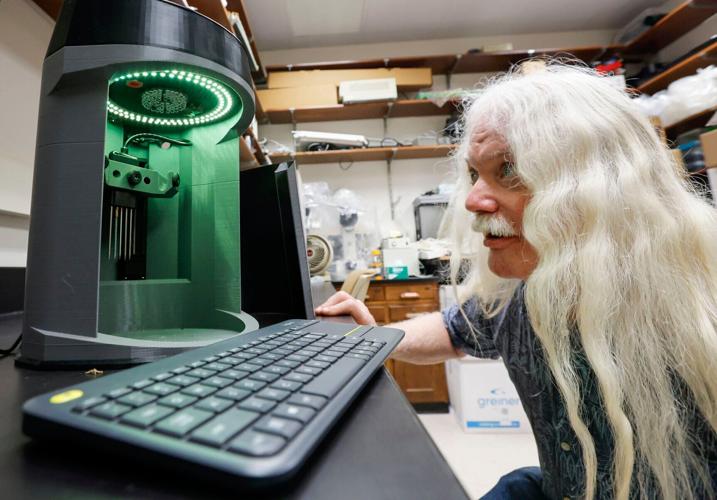
UW-Madison botany professor Simon Gilroy displays a lunar growth chamber prototype in the lab in Birge Hall on campus. The 3D-printed growth chamber is one of two in the world and seeks to automate as much of the growing process as possible.
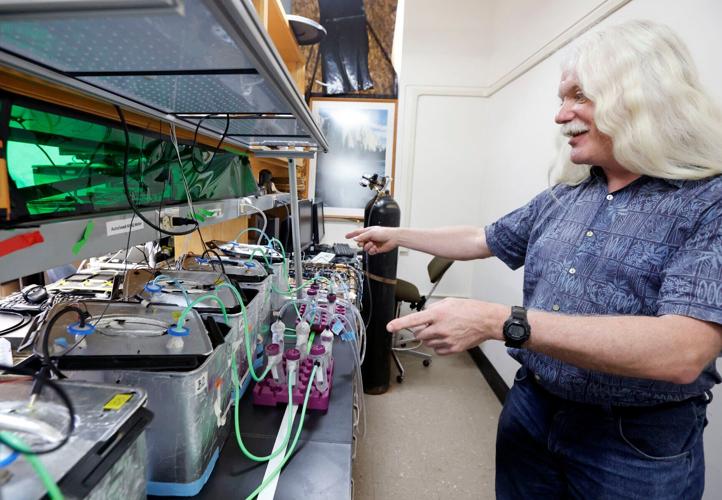
UW-Madison botany professor Simon Gilroy talks about the low oxygen chambers used to experiment with plant growth in space. The low oxygen chambers were the brainchild of UW-Madison engineering students, who designed them so researchers could adjust the level of oxygen concentration allowed inside.
UW-Madison botany professor Simon Gilroy talks about how the general rules of biology and evolution that plants and animals have experienced on Earth often have to be engineered to happen in space, in his lab in Birge Hall on campus. The "do not enter" sign with flight-launch emblem lets visitors know that prep is underway for the Trichoderma Associated Space Tomato Inoculation Experiment, or TASTIE.
UW-Madison botany professor Simon Gilroy displays a lunar growth chamber prototype in the lab in Birge Hall on campus. The 3D-printed growth chamber is one of two in the world and seeks to automate as much of the growing process as possible.
UW-Madison botany professor Simon Gilroy talks about the low oxygen chambers used to experiment with plant growth in space. The low oxygen chambers were the brainchild of UW-Madison engineering students, who designed them so researchers could adjust the level of oxygen concentration allowed inside.