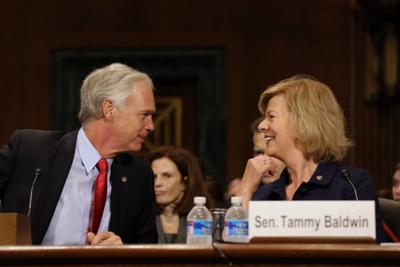


U.S. Sens. Ron Johnson and Tammy Baldwin may see eye-to-eye on the issue of same-sex marriage.
You already know what this flag stands for. It's one of the most recognizable symbols in the world, on par with the American flag or the recycling symbol, and especially during Pride Month, it's everywhere.Charley Beal, president of the Gilbert Baker Foundation: "It is unsurpassed as a global icon in terms of something that stands for hope and diversity, as opposed to a product being sold or a country. It is a global symbol."But this flag wasn't always so ubiquitous, and its predecessors included a lavender rhinoceros, the Greek letter lambda and the pink triangle all of which have their own separate meanings and histories, but weren't accepted by the LGBTQ community at large. So, how did we get here with the rainbow pride flag? Its history starts in the 1970s with artist and activist Gilbert Baker. Beal: "Gilbert had become fascinated with flags in 1976, during the Bicentennial. He just suddenly thought, 'These things are powerful.' He saw armies marching into war under a flag and he thought: 'We don't just need a new symbol. We need a flag.'"The very first rainbow pride flag was designed and hand made by Baker and a group of volunteers for the 1978 San Francisco Gay Freedom Day Parade. Originally eight colors , the flag's stripes stood for sex, life, healing, sunlight, nature, magic, serenity and spirit. After the parade and months later, after the assassination of San Francisco politician and gay icon Harvey Milk demand for the rainbow flag skyrocketed. James Ferrigan, vexillologist and former colleague of Gilbert Baker: "My little story in Polk Street was kind of the epicenter. Gilbert worked there, and I had access to some of the largest flag companies in the world." It was at the San Francisco-based Paramount Flag Company, where Baker worked with flag scholar James Ferrigan, that the rainbow pride symbol spread beyond the city not just as a specialty item, but something that could be as readily available as the Stars and Stripes. Ferrigan: "It was astonishing to me how quickly the rainbow, which truly was a flag of pride and not politics, eclipsed all the others." Ferrigan: "There were some hurdles. And some of the flag companies we approached said, 'Jim, do you know what that flag is?' I go, 'Yeah, I'm keenly aware of what that flag is. I need as many of them as I can get.' And then they go, 'Well, we'll make it, but we won't put our label on it.'" Those hurdles didn't stop the rainbow flag from being displayed across the country by allies, activists and even some government buildings. Baker even worked with the ACLU to make sure anyone could freely use it.In recent years, it's also become a seasonal symbol used by brands and corporations to use during pride month with activists being watchful and vocal about whether those efforts are genuine. Beal: "It's something were very passionate about. If youre not going to live up to the principles sewn into that flag, then dont use it. And if youre just trying to sell mugs and T-shirts, we cant stop you. But we will call you out."Today, the rainbow pride flag has also become a "mother of flags" for others within the LGBTQ community like the pink, lavender and blue bisexual flag created by Michael Page in 1998, or the blue, pink and white transgender flag created by Monica Helms in 1999.Beal: "You should fly the flag that speaks to your soul."Even after Baker's death in 2017, his rainbow flag has continued to live on and evolve through redesigns from artists like Daniel Quasar and Amber Hikes. With black and brown stripes, and the stripes of the transgender flag, the redesigns add visibility to the fact that the pride movement was led by transgender people of color a group that is still one of the most disenfranchised and marginalized groups in society.Beal: "It's a brave thing to do, to create an image and an icon and we totally encourage people to do it. And we're really proud that people would see the rainbow flag as inspiration for a new flag."
People are also reading…
Photos: Gay pride events in Madison over the years
Rainbow flag at the Capitol, 2019

A rainbow flag observing Pride Month is displayed over the east wing of the State Capitol in Madison on June 7, 2019. The display, endorsed by Democratic Governor Tony Evers, drew backlash from conservative Republican lawmakers.
Rainbow flag at City Hall, 2019

Madison Mayor Satya Rhodes-Conway speaks to a crowd during an event to raise a rainbow flag outside the Madison Municipal Building to celebrate Lesbian, Gay, Bisexual, Transgender and Queer (LGBTQ) Pride Month in Madison on June 3, 2019. She is the city's first openly gay mayor.
Pride Parade in Madison, 2018

Marchers make their way down State Street en route to the state Capitol during Madison's Pride Parade on Aug. 19, 2018. The annual LGBT event, which takes place in August so as not to compete with larger parades in June in cities such as Chicago and Minneapolis, draws thousands for the parade and a rally.
Church shows its colors, 2016

Marching in the Pride Parade with First Congregational United Church of Christ, Jeanne Marshall holds up a LGBT Pride flag with other members of the church on Aug. 21, 2016. First Congregational has been open to the LGBT community for almost 25 years, with LGBT people in leadership roles from its start.
OutReach Pride Parade, 2015

Johnice Miller, left, of the Madison-based LGBT band Color Me Once, sings during a rally in front of the Capitol after the OutReach Pride Parade in August 2015.
Police join the parade, 2014

Police officers, including Police Chief Mike Koval, join in the Pride Parade in Downtown Madison on Aug. 10, 2014.
Gay Pride Parade, 2007

The annual Gay Pride Parade makes its way down West Washington Avenue toward Brittingham Park on July 22, 2007. Hundreds turned out for the spirited but peaceful event, including some who stood on the sidewalks holding signs in opposition.
25 years of OutReach, 2007

The Gay Pride Parade makes its way up West Washington Avenue on July 22, 2007.
Pride parade in the capital city, 2006

Marchers in the Madison Pride parade move down West Washington Avenue on their way to a rally at Brittingham Park on July 9, 2006.
Miss Gay Madison, 2005

Alicia D. Stone, second from right, Miss Gay Madison, poses with some friends before the Gay Pride Parade on July 17, 2005.
Colors of the rainbow, 2004

Residents of the Lothlorien Co-Op, 244 W. Lakelawn Place, painted themselves as the gay pride flag and marched in the parade in Madison on July 18, 2004. From left to right are Tori Gross (in pink), Ann Christensen (orange), Debbie Perticara (yellow), Cole Taylor (green), Annie Hostetter (blue), Trudy DeLong (purple), and Rachel Winch (gold).
Undeterred by protesters, 2003

Protesters didn't deter those who turned out for the Pride Parade on July 20, 2003. Terry Halverson, with boa and balloons, dances around a representative from Wisconsin Christians United.
Capping weekend of events, 2002

A parade down State Street on July 21, 2002, helped cap a weekend of Madison Pride, the city's annual celebration of gay, lesbian, bisexual and transgender community and culture.
Rainbow banner, 2001

Jeanne Marshall, Janet Pugh and Sara Ator, left to right, joined other members of First Congregational Church of Christ, 1609 University Ave., carrying a large rainbow banner in the Madison Pride Parade on July 22, 2001.
Miss Gay Pride, 2001

Miss Gay Pride, Izana Troi, and Miss Capitol City, Destiny Matthews, ride in the Gay Pride parade on July 22, 2001.
Gay Pride Parade, 2000

Gay Pride parade marchers head down State Street as they march to Brittingham Park on July 16, 2000. Photo by David Sandell
Gay pride brides, 1999

Two brides take part in the Gay Pride Parade on July 18, 1999.
Gay Pride Parade, 1998

Chris Halvorsen and Kathy Borkowski lead the Gay Pride Parade in Madison on July 19, 1998.
Madison Pride march, 1996

Thousands of gay and lesbian marchers and well-wishers joined in the third annual Madison Pride march in Madison on July 21, 1996.