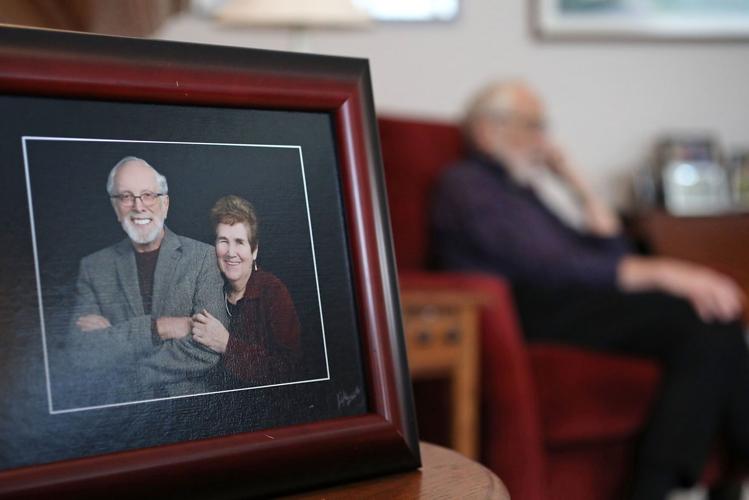

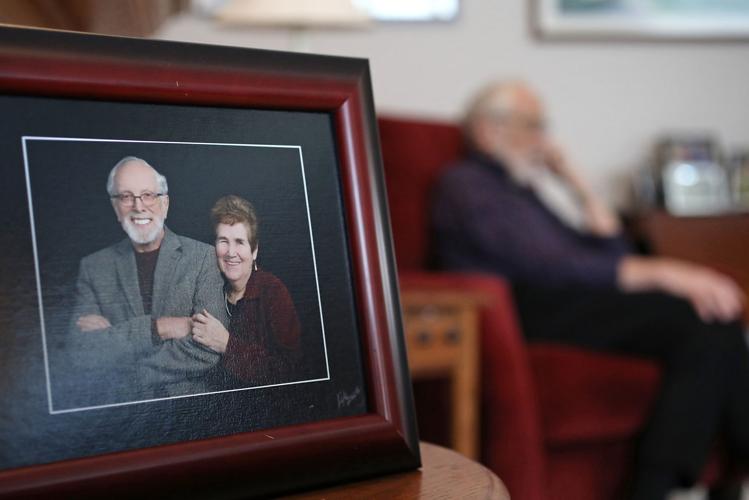

A photo of Peter and Cheryl Ziegler in their Madison condo. Cheryl, who was diagnosed with dementia in 2017, died in 2020.
People are also reading…
Don Moran has dementia and was cared for by his wife, Mary, until he died in January.

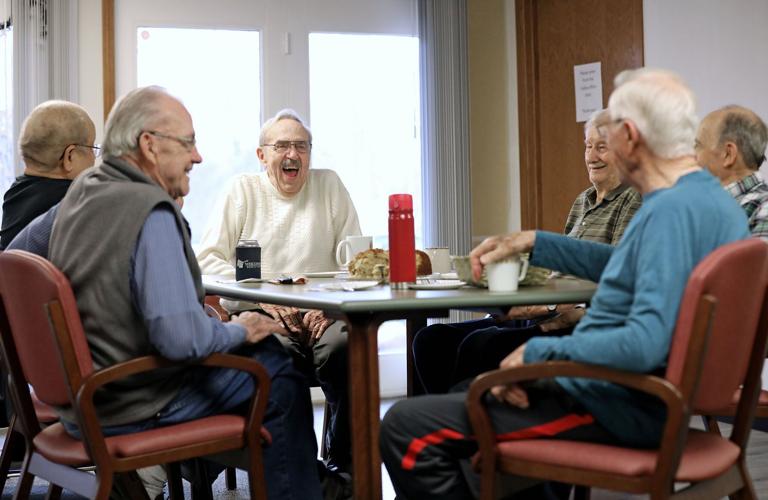
Don Moran, center, died from dementia in January. Before the pandemic, he started a "boys' club" at his senior apartment complex, inviting other men to meet for coffee once a week.

Mary cared for her husband, Don Moran, for years, until he died from complications related to dementia in January.

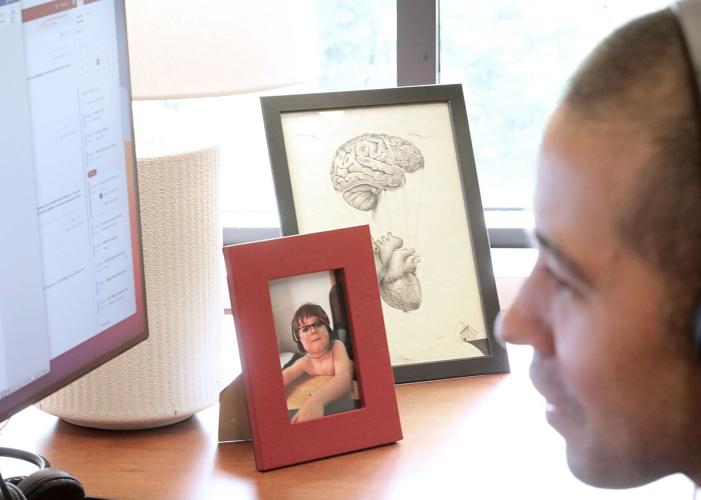
Dr. Nathaniel Chin in his UW Hospital office with a photograph his son, Auggie, and a rendering of the heart and brain.
Photos from a Special Report | Fading away: Wisconsin's dementia crisis
Martin Schreiber with Sun Prairie mayor

Former Wisconsin Gov. Martin Schreiber, right, talks with Paul Esser, mayor of Sun Prairie, before a talk by Schreiber in October at the Colonial Club in Sun Prairie. Schreiber wrote the book "My Two Elaines," about his wife having Alzheimer's disease.
Mary and Don praying

Mary and Don Moran, who attend a non-denominational church, pray before eating lunch at their apartment in Cottage Grove. They met decades ago in Dallas, where she grew up and he was working as a phone company lobbyist. He played chess with her friend's husband and asked her out. "It was kismet; fate brought us together," Mary said.
Mary and Don preparing to leave apartment

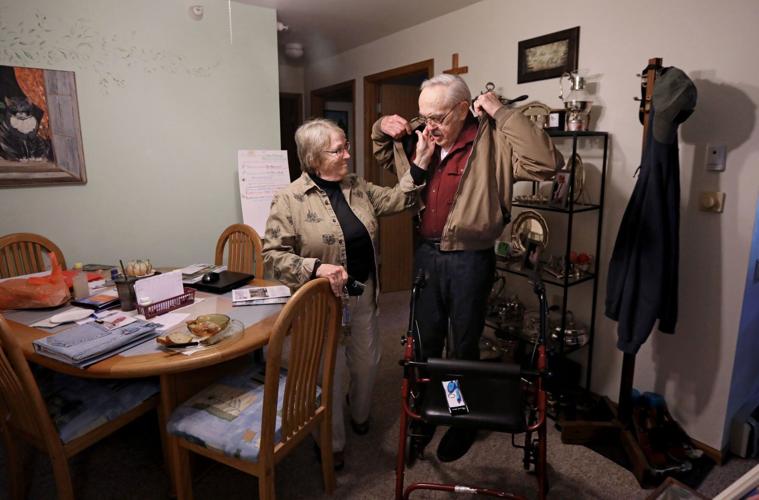
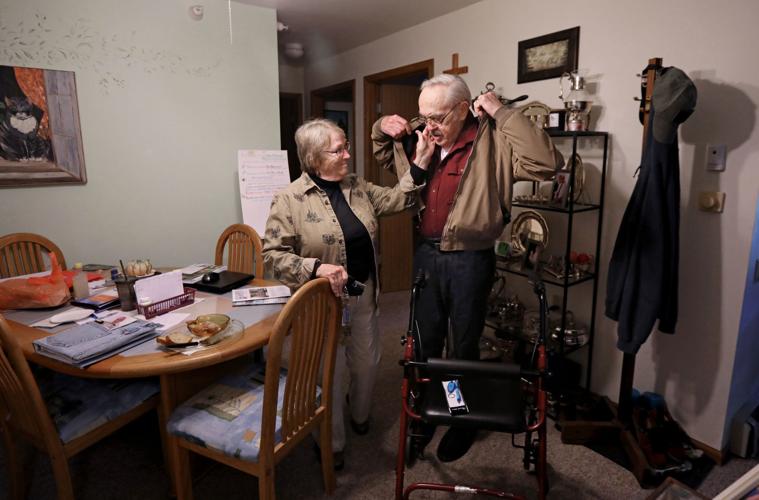
Mary and Don Moran, who have been married 44 years, get ready to leave their apartment in Cottage Grove this month to visit an assisted-living facility. Don planned to stay at the facility after Mary had surgery for breast cancer. Caring for Don, who has dementia, is difficult, Mary said. "Before cancer, it was just a little stressful," she said. "Now it's scaring me to death."
Mary loading Don's walker

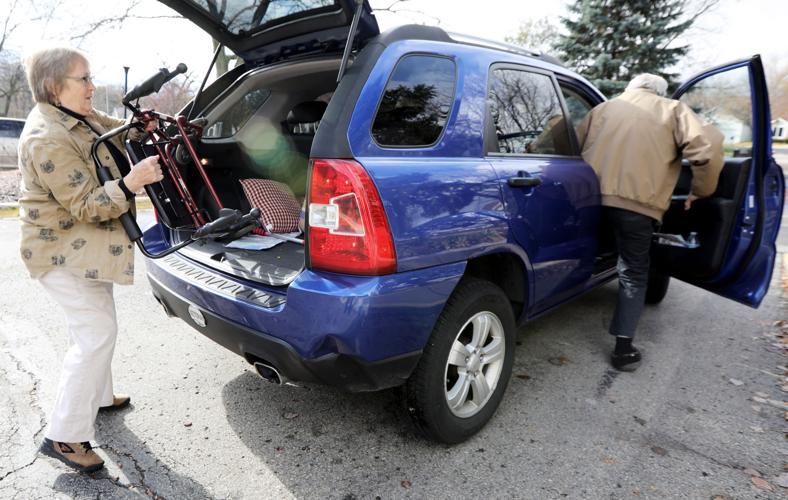
Mary Moran, 75, loads her husband Don's walker into their car outside of their apartment in Cottage Grove. Two of their daughters live nearby and help out when can, but they work full-time and have children. Mary does most of the caregiving for Don, 85, who has dementia.
Mary and Don at pumpkin painting

Mary and Don Moran attend a pumpkin-painting outing in October as part of the Spry Society, a program of the Alzheimer's Association. Mary also joins Don, who has dementia, at the association's memory cafes. "They're forgiving places to be," Mary said. "If you can't remember something, well, they can't either."
Don's "boys' club"

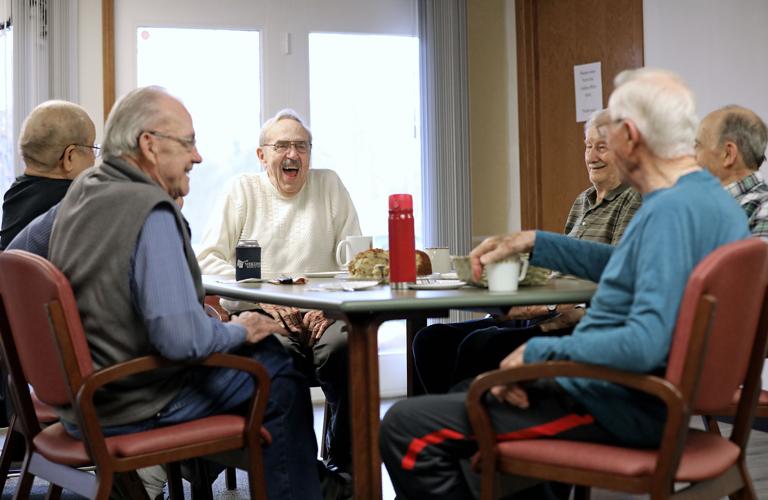
Don Moran, center, has dementia. At his wife Mary's urging, he started a "boys' club" at his senior apartment complex, inviting other men to meet for coffee once a week. He told the group why he was participating in an article about dementia. "It is to take away from people pointing and laughing at those of us who have lost their memory a little bit," he said.
Photo album

Mary Moran made a photo album of family and friends, labeled with names, for her husband, Don, who has dementia. After a recent gathering with extended family, Don still couldn't recognize some people. "I need a bigger book," he said. "I was embarrassed. I shouldn't have been, but I was."
Peter and Cheryl Ziegler

A photo of Peter and Cheryl Ziegler sits in their Madison condo. Cheryl, who was diagnosed with dementia two years ago, thinks every day is Sunday and always wants to go to church. Peter said.
Peter Ziegler

Ziegler
Bill brushing Jacqui's hair

Bill Cadotte brushes the hair of his wife Jacqui, who has dementia, at their home on the Lac Courte Oreilles reservation near Hayward. Caring for someone with dementia in rural Wisconsin, where services such as adult day care and paid caregivers can be scarce, is difficult, Cadotte said. "It's like you're on call all the time," he said. "It's hard, real hard."
Bill sorting Jacqui's meds

Bill Cadotte prepares medication for his wife Jacqui, who has dementia. If he doesn't watch, she sometimes hides her pills, he said. She has started taking CBD oil, which Bill thinks is helping, but her dementia continues to get worse. He doesn't know how long she'll be able to stay in their home.
Cindy Dunbar

Dunbar
Bill and Jacqui outside of their home

Bill and Jacqui Cadotte live near the Chippewa Flowage on the Lac Courte Oreilles reservation. They married in 1970 and raised three children on the reservation, where Bill continues to work as purchasing manager for the tribe. Jacqui was diagnosed with dementia three years ago.
Jacqui and Bill at casino

Jacqui and Bill Cadotte visit Sevenwinds Casino near Hayward, where they typically eat dinner. Caring for Jacqui, who has dementia, is difficult, Bill said. But most people at the casino and on the Lac Courte Oreilles reservation, where they live, know her situation, which helps, he said.
Randy and Wonaquance

Randy and Wonaquance Cadotte said it's hard to see their mother, Jacqui, decline from dementia. But "I understand that and accept that," Randy said. "What I have a hard time accepting is putting that added stress onto my father."
Jennifer and Jacqui

Jennifer Cadotte helps her aunt, Jacqui Cadotte, who has dementia, prepare to put on her shoes. Jennifer started working as Jacqui's paid caregiver on weekdays last year after other caregivers hired by Jacqui's husband, Bill, didn't work out. Jennifer, who previously ran youth programming at the local community college, said she wouldn't work as a caregiver for anyone else. "This is more out of love than anything else," she said. "It's too hard."
Tammy with Frances in Eagle River

Tammy Walport, who works for Loving Touch Home Care in Rhinelander, visits Frances Bombka, 98, who has dementia, at Bombka's home in Eagle River. There's a shortage of caregivers for dementia, especially in rural Wisconsin. Caring for Bombka around the clock every day takes five of Loving Touch's 20 workers, only three of whom live in or near Eagle River, general manager Paul McKenzie said. "I'm pulling people from other areas," he said.
Frances doing exercises

Frances Bombka exercises in her Eagle River home as Tammy Walport, who works for Loving Touch Home Care in Rhinelander, looks on. Walport, who lives in Rhinelander, about 25 miles away, cares for Bombka three days a week.
Doreen on phone with Lyle

Doreen Conner said her husband, Lyle, has become more gentle since he developed Alzheimer's disease. But it can be a struggle to care for him and do tasks such as grocery shopping, she said. "It's a long, hard day for me when I have to do that," she said.
Doreen and Lyle holding hands

Doreen Conner cares for her husband, Lyle, who has dementia. They live in Prentice, in northern Wisconsin, and have been married 67 years. As Lyle's dementia has gotten worse, Doreen has started leaving him in their locked car when she goes grocery shopping. But with winter approaching, "I'm not going to let him sit in the car," she said. "I'm going to have to get somebody to come (to their home) and sit with him."
Friendship Village

Connie Wang, 85, reads to children at Friendship Village, an intergenerational day care center in Phillips, in northern Wisconsin. The center, which opened for children last year, also started taking older adults with dementia and other needs this fall.
Lori Kiefer

Lori Kiefer cares for children and older adults at Friendship Village, an intergenerational day care in Phillips, in northern Wisconsin.
Cyclotron

The cyclotron in the basement of the Wisconsin Institutes of Medical Research near UW Hospital produces radioactive atoms for use in PET scans, said Jon Engle, who works in the lab.
Sara Tirner doing yoga with others

Sara Tirner of Madison, whose mother died from Alzheimer's disease two years ago, participates in a yoga class at Tantra Yoga and Wellness in Downtown Madison. She has undergone 11 brain scans in dementia studies at UW-Madison. "Because of my yoga, I'm very relaxed being in MRIs and PET scans," Tirner said.
Tirner doing yoga

Sara Tirner, shown doing yoga at Tantra Yoga and Wellness in Madison, became a yoga instructor herself after working in banking for many years. Before her mother died from Alzheimer's disease two years ago, Tirner moved in with her and her father, in Two Rivers, to care for them.
Karen and Barb before PET scan

Karen Ingmundson, left, talks with PET technologist Barb Mueller before getting a PET scan. Ingmundson doesn't have Alzheimer's disease or a family history of it, but she has participated in several studies to help increase scientific understanding of the disease.
Karen getting PET scan

Karen Ingmundson of Waunakee prepares to undergo a PET scan at UW-Madison's Waisman Center, as part of a research study on Alzheimer's disease. Researchers are injecting people with radioactive tracers to see if they have proteins associated with Alzheimer's. Some scans also look at synapses, where brain cells exchange information.