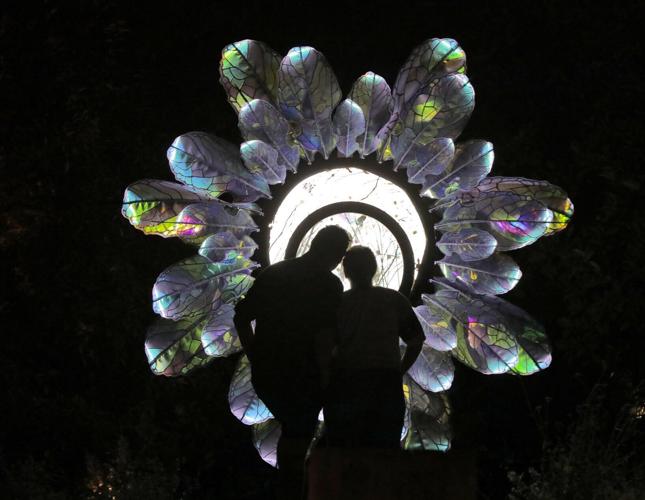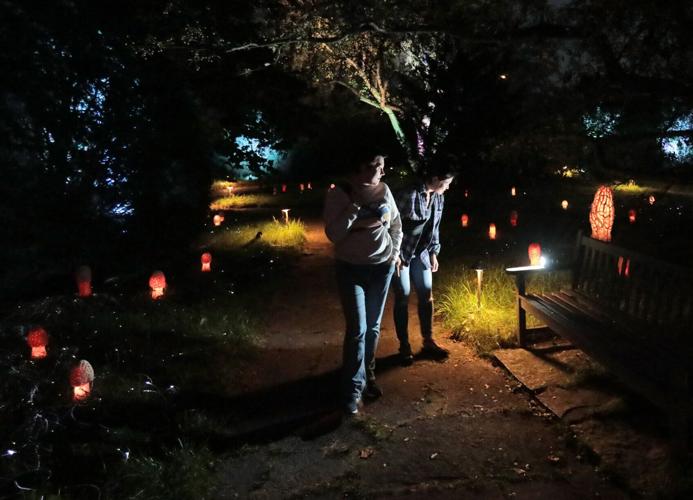


Karrie Maz and Alex Thore walk through “Mushroom Grove,” by artists James Ream and Benjamin Smith. The morel mushrooms are made from locally harvested beeswax and pulsate with changing color.
People are also reading…

Visitors to GLEAM at Olbrich Gardens interact with “Out Of The MeowVerse” by artist Katherine Cannistra.

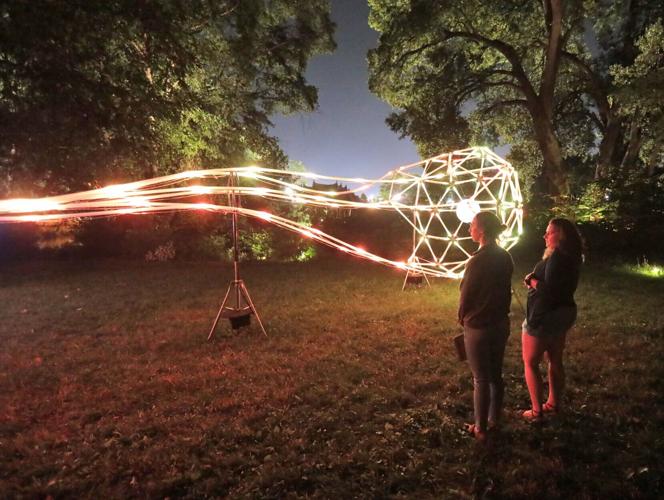
Kaylin Beiter, of New Orleans, and Chelsea Wilson, of Madison, take in “Tidal Disruption," a representation of the powerful draw of a black hole. Created by Toronto artist Mark-David Hosale, the light show on the installation takes four minutes to cycle through.

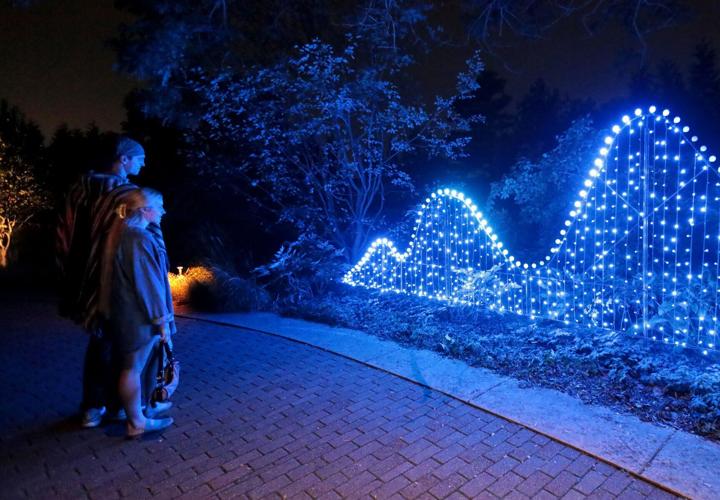
A work titled “Dynamic Equilibrium” by a collective of artists from Melbourne, Australia, draws the interest of Zach Smith and Rachel Martin during their recent visit to "GLEAM: Art in a New Light" at Olbrich Botanical Gardens. The event runs through Oct. 29 and is expected to draw more than 35,000 visitors.

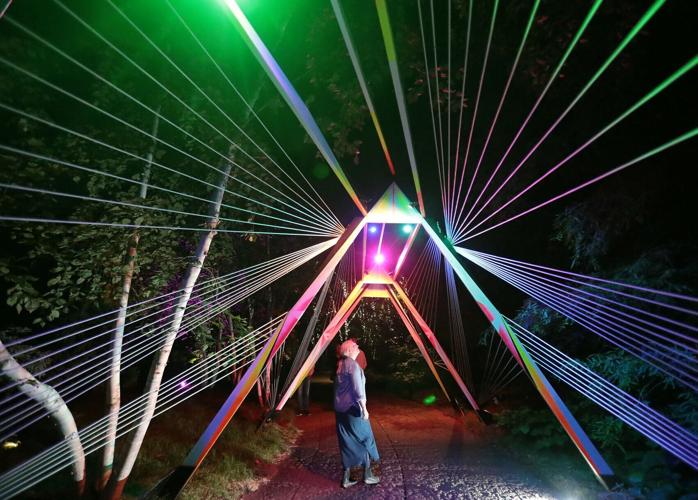
Lauren Sukup walks through “Astral Entrance,” a piece by artist Ash Armenta.

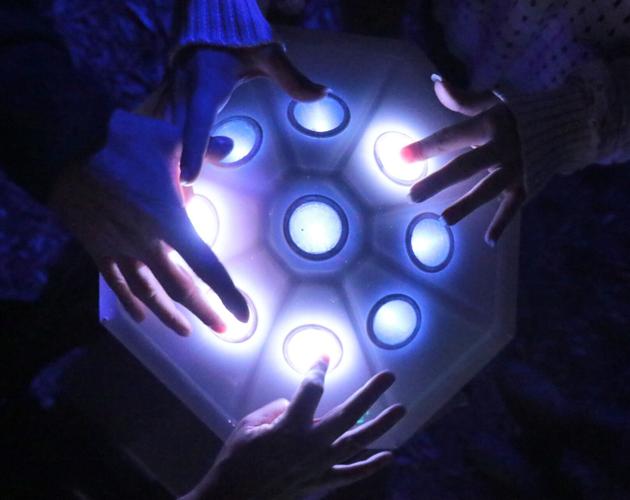
Visitors to GLEAM use touch pads to generate sound by interacting with “Phonosynthesis,” a multimedia installation by artist Mark Penisten of Madison.

Cooper Fitzpatrick and Nicole Rago view “Wavy Harps,” by artist Zach Zweifel, during their recent visit to GLEAM at Olbrich Botanical Gardens.

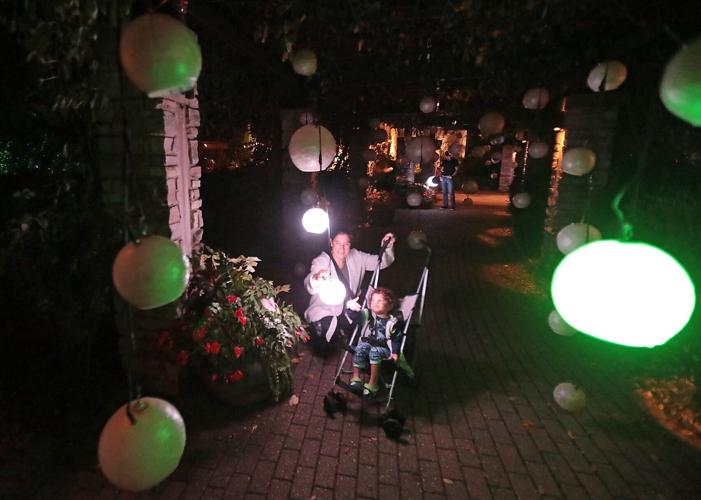
Teresa Gedao and her son, Cervantes, 2, interact with the sound and light installation “MICRO," a series of hanging lighted balls created by artists Aaron Sherwood and Kiori Kawai.
Photos: St. Wenceslaus near Waterloo
St. Wenceslaus

The church is hosting a public celebration on Sunday, Sept. 25. Guided tours are planned from 11 a.m. to 4 p.m.
St. Wenceslaus

Built during the Civil War by German and Bohemian immigrants, St. Wenceslaus Roman Catholic Church sits on a mound east of Waterloo and is referred to as the Island Church.
St. Wenceslaus

Cliff Haberman rings the bell that was installed when the church was built during the Civil War.
St. Wenceslaus

Cliff Haberman, whose ancestors settled in the area around the St. Wenceslaus Church in Waterloo, Wis. sits in one of the original wooden pews of the historic church.
St. Wenceslaus

Farming artifacts dating to the early days of the St. Wenceslaus Church near Waterloo are displayed in a building adjacent to the church.
St. Wenceslaus

The view from one of the four windows.
St. Wenceslaus

Ed Langer, a historian and member of the Island Church Foundation, prepares to close the doors that cover the windows of the historic church. St. Wenceslaus sits on a mound that, when it was built in 1863 and 1864, was surrounded by marsh.
St. Wenceslaus

An ecumenical service is planned for 2:30 p.m. Sunday, Sept. 25.
St. Wenceslaus

Wooden pews, built in the 1860s with hand-sawed pine and put together with pegs and dovetail joints, remain in place at St. Wenceslaus in rural Jefferson County. The church will be open for tours and will host a service on Sept. 25.
St. Wenceslaus

Cliff Haberman, whose ancestors settled in the area around St. Wenceslaus in the 1850s and are buried in the cemetery, walks the grounds of the historic church that was built in 1863 and 1864.
St. Wenceslaus

Island Church Foundation member Edward Langer looks over photographs of former residents of the land surrounding St. Wenceslaus. The photos and other artifacts are stored in a utility building near the church.
St. Wenceslaus

Built during the Civil War by German and Bohemian immigrants, St. Wenceslaus Roman Catholic Church east of Waterloo was decommissioned in the 1890s, but has remained largely intact since.
St. Wenceslaus

Original religious artifacts have remained in place and largely untouched since the church was decommissioned in 1890s.
Barry Adams covers regional news for the Wisconsin State Journal. Send him ideas for On Wisconsin at 608-252-6148 or by email at badams@madison.com.