


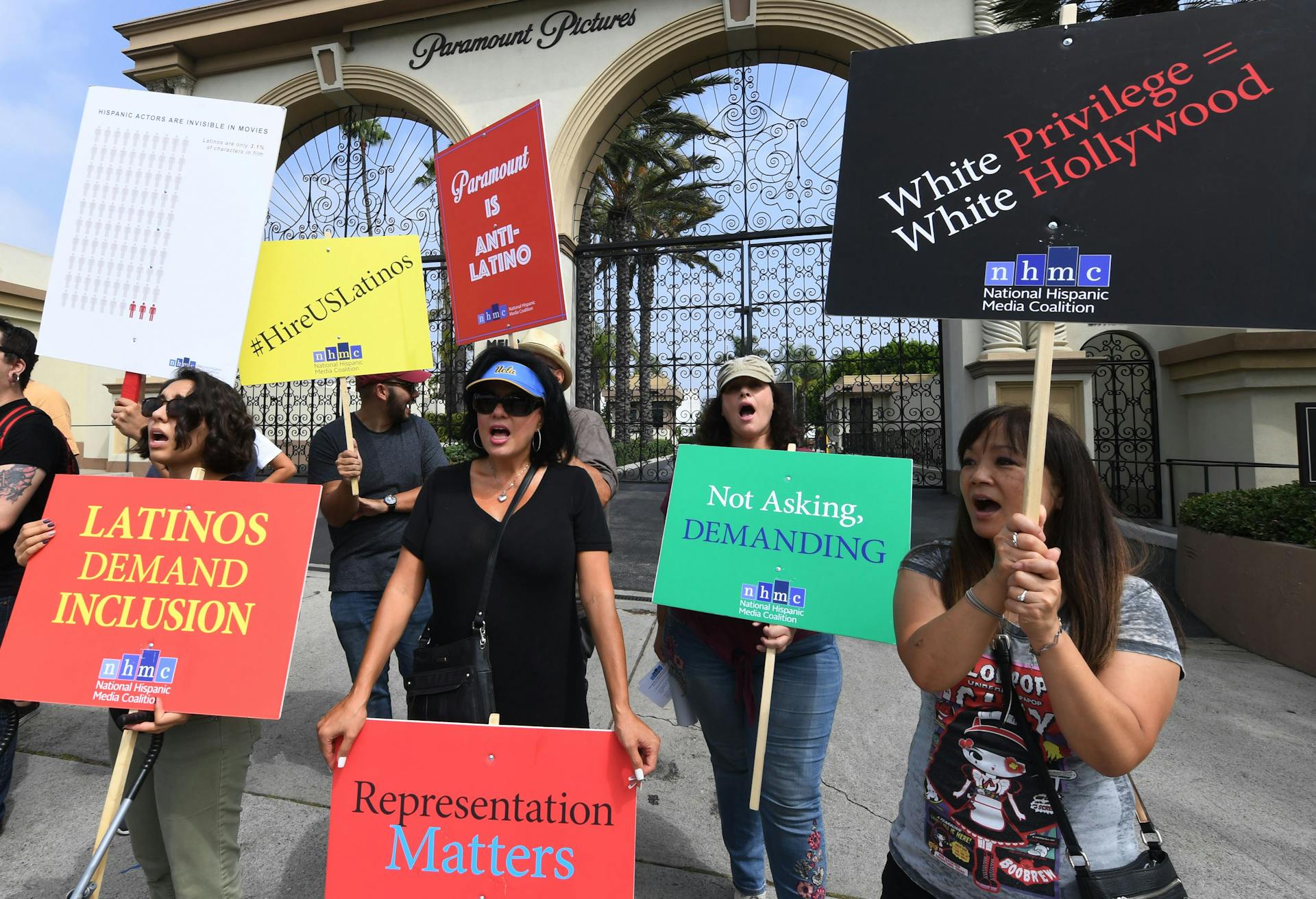
 Less than 5% of U.S. Latinos use 'Latinx' as a racial or ethnic identity. Mark Ralston/AFP via Getty Images
People are also reading…
Timeline: A brutally honest history of Latinos in Hollywood
1908: Birth of a stereotype
Before his Ku Klux Klan-promoting film “Birth of a Nation” (1915), D.W. Griffith codified Mexican characters and themes that persist today. The reprobate father. The saintly mother. The wayward son. And especially the “greaser,” often with white actors darkening their skin to play either thieves and rapists or doomed souls whose noble nature cannot be rewarded because they’re, well, Mexicans. Griffith’s “The Greaser’s Gauntlet” (1908) was the first to use the slur in its title.

D.W. Griffith, internationally known movie director and producer, greets the press in this 1922 photo before sailing for Europe. (AP Photo)
1921: The Latin lover

This is an 1921 photo of actor Rudolph Valentino in "The Four Horsemen of the Apocalypse." (AP Photo)
Was the first Latin lover Spanish or Italian? According to the documentary "The Bronze Screen," Spaniard Antonio Moreno establishes the type, best seen in 1923's "The Spanish Dancer."
But Hollywood immortalizes the Latin lover with Italian star Rudolph Valentino, whose reputation is set when he plays a tango-dancing Argentine in “The Four Horsemen of the Apocalypse” (1921). The film establishes a different kind of leading man with darker looks that at first makes the studio nervous. Valentino comes to hate the label.
1935: ‘Bordertown’
Starring the white Paul Muni as Mexican law school graduate Johnny Ramirez, "Bordertown" sets up East Los Angeles and Boyle Heights as the place for Hollywood's Mexican stories.
Ramirez — outmaneuvered in his law case and rejected by his love interest as a "savage" — retreats there to be with his "own people" when society won't have him.

Oscar winners Paul Muni, holding statuette, Louise Rainer, center, and Frank Capra are shown during the 9th annual Academy Awards in Hollywood, Ca., on March 6, 1937. (AP Photo)
1951: First Latino acting Oscar
Puerto Rican Jose Ferrer becomes the first Latino to win an Academy Award for acting when he receives the lead actor Oscar for “Cyrano de Bergerac.” He earns two other nominations, for his supporting role in “Joan of Arc” (1948) and his leading role in “Moulin Rouge” (1952).
Mexico-born Anthony Quinn (aka Manuel Antonio Rodolfo Quinn Oaxaca) wins the supporting actor Oscar in 1953 for “Viva Zapata.” He wins again in 1957 for “Lust for Life” and is nominated in 1965 as lead actor in “Zorba the Greek” and in 1958 for “Wild Is the Wind.”

Actor Jose Ferrer is outfitted with a nose after trying out 200 noses for the title role of "Cyrano De Bergerac" by make-up artist Josef Norin in Hollywood, Ca., in May 1950. Looking on are director Michael Gordon, center, and screenwriter Carl Foreman. (AP Photo)
1951: The Latino sitcom
Desi Arnaz turned his Cuban nightclub singer and exasperated husband Ricky Ricardo into one of television's most iconic characters in “I Love Lucy” (1951-1957). He was credited with developing the multicam sitcom setup still used today, as well as (with Lucille Ball) the syndicated rerun.
Still, it took nearly 20 years for NBC's “Chico and the Man” (1974-1978) to arrive. The series started with good intentions as Freddie Prinze schooled Jack Albertson on the errors of his bigoted thinking. But unlike “All in the Family,” the slurs and cringe-worthy scenes overtook the show, especially after Prinze's death when Charo was made to indulge her cuchi-cuchi persona.

Eddie Cantor, right, talks with comedienne Lucille Ball, center, and her husband Desi Arnaz during dinner at Los Angeles' Brown Derby, Oct. 10, 1946. (AP Photo)
1960: First Chicana Oscar nomination
Susan Kohner is nominated for her supporting role as the daughter passing for white in Douglas Sirk's race and class drama "Imitation of Life" (1959). Kohner, born in Los Angeles, is the daughter of producer Paul Kohner and Mexico-born early sound star Lupita Tovar, famous for "Santa" (1932), the first Mexican talkie, and her performance in the Spanish-language version of "Dracula" (1931), shot on the same sets as the Bela Lugosi-starring "Dracula."
Kohner is also the mother of Chris and Paul Weitz, who together made "About a Boy" (2002), which was nominated for an adapted screenplay Oscar, and "American Pie" (1999).

Actress Susan Kohner, nominated as best supporting actress for her role in “Imitation of Life,” and actor George Hamilton arrive for the Academy Award presentations in Hollywood, April 4, 1960. (AP Photo)
1962: First Latina acting Oscar

Rita Moreno and George Chakiris pose with their Oscars after they each won Academy Awards in Santa Monica, April 9, 1962. He was named best supporting actor and she was named best supporting actress of the year for their respective roles in "West Side Story." (AP Photo)
Puerto Rican actress Rita Moreno becomes the first Latina to win an Oscar for her supporting role in “West Side Story,” in which non-Latina Natalie Wood plays the central role of Maria.
Thirty years later, Mercedes Ruehl, who is not always counted as Latina (though her maternal grandmother was Cuban) wins the supporting actress Oscar in 1992 for “The Fisher King.” In 2009, Penelope Cruz, who is Spanish and not officially considered Latina, wins the supporting actress Oscar for “Vicky Christina Barcelona” and is nominated in 2010 for her supporting role in “Nine” and in 2007 for her lead role in “Volver.” In 2014, Lupita Nyong’o becomes the first Kenyan-Mexican to win an acting Oscar for her supporting role in “12 Years a Slave.”
1976: 150 maid roles
El Paso, Texas-born Lupe Ontiveros plays her first credited role on ABC's "Charlie's Angels" — as a maid. Toward the end of her career she famously says she played a maid more than 150 times, most memorably in “As Good As It Gets.”
Still, she managed to make her mark in other roles, including the mother in “Zoot Suit” and “Real Women Have Curves,” the murderous fan club president in “Selena” and the mother-in-law on “Desperate Housewives.”

FILE - This Aug. 21, 2008 file photo shows actress Lupe Ontiveros at the 23rd Annual Imagen Awards in Beverly Hills, Calif. (AP Photo/Gus Ruelas, file)
1989: First Chicano Oscar nomination
Edward James Olmos becomes the first Mexican American to earn a lead actor nomination for his role in “Stand and Deliver” about Garfield High calculus teacher Jaime Escalante. Dustin Hoffman wins the award for “Rain Man.”
Thomas Gomez, though not Latino, was born in New York to Spanish parents and is considered the first Hispanic to earn a supporting actor nomination in 1948 for “Ride the Pink Horse.”

Best actor nominees Dustin Hoffman, right, (“Rain Man”) and Edward James Olmos (“Stand and Deliver”) exchange best wishes in front of the Shrine Auditorium in Los Angeles, Wednesday, March 29, 1989 as they arrived for the 61st Academy Awards presentations. (AP Photo/Lennox McLendon)
1993: High-class whitewashing
Six non-Latino Academy Award nominees (and three winners) — only one native Spanish speaker among them — are cast as Chileans in the film adaptation of Isabel Allende’s novel “The House of Spirits”: Meryl Streep as Clara del Valle Trueba, Glenn Close as Ferula Trueba, Jeremy Irons as Esteban Trueba, Winona Ryder as Blanca Trueba, Spain’s Antonio Banderas as Pedro Tercero Garcia and Vanessa Redgrave as Nivea del Valle. Despite its star power, the film earns mostly negative reviews.
Other notable films with Latino characters “whitewashed” by Hollywood: “Juarez” (1939, with Paul Muni as Benito Juarez and Bette Davis as Carlota), “Viva Zapata!” (1952, with Marlon Brando as Zapata), “Touch of Evil” (1958, with Charlton Heston as Ramon Vargas), “The Good, the Bad, and the Ugly” (1966, with Eli Wallach as Tuco Ramirez), “Che!” (1969, with Omar Sharif as Che and Jack Palance as Fidel Castro), “Evita” (1996, with Madonna as Evita Peron), “A Beautiful Mind” (2001, with Jennifer Connelly as John Nash’s Salvadoran wife, Alicia Nash) and “Argo” (2012, with Ben Affleck as CIA officer Tony Mendez).

“Evita” star Madonna poses for dozens of photographers as she arrives at the film’s premiere on Saturday, Dec. 14, 1996 at the Shrine Auditorium in Los Angeles. (AP Photo/Chris Pizzello)
2002: Elevated maid
Jennifer Lopez transforms the maid trope from character part to leading role in “Maid in Manhattan.” But the Cinderella story, with Ralph Fiennes as a Senate candidate who falls for Lopez, gets mixed reviews for its lazy use of rom-com tropes.
Nadine E. Velazquez’s role as the maid Catalina Aruca becomes a key character in “My Name Is Earl” (2005-09). When her character speaks Spanish, she breaks the fourth wall and sends messages to Spanish-speaking viewers. In 2013, Eva Longoria defends the choice to put maids at the center of Lifetime’s Marc Cherry series “Devious Maids” (2013-16), for which she was executive producer. She says the best way to break stereotypes is to not ignore them. Alfonso Cuaron casts Yalitza Aparicio as the star of “Roma” (2017), centered on the life of a domestic worker. Aparicio’s performance earns an Oscar nomination for lead actress.

Jennifer Lopez performs at KIIS-FMs Jingle Ball 2003 at the Staples Center in Los Angeles, on Friday, Dec. 5, 2003. (AP Photo/Chris Carlson)
2013: Rise of the Mexican director
Mexico's Alfonso Cuaron wins the directing Oscar for “Gravity” and begins an unprecedented five-year streak of wins for Mexican directors, with Alejandro Gonzalez Inarritu winning in 2014 and 2015 for “Birdman” and “The Revenant,” Guillermo del Toro in 2017 for “The Shape of Water” and Cuaron again in 2018 for “Roma.” Only “Roma” featured Latino lead characters.

From left, directors Alfonso Cuaron, Alejandro Gonzalez Inarritu and Guillermo del Toro attend the 79th Annual Academy Awards held at the Kodak Theatre on Feb. 25, 2007, in Hollywood, California. (Vince Bucci/Getty Images/TNS)
2014: The Chris Rock question
Chris Rock's incendiary 2014 essay on race in The Hollywood Reporter asks a question that set off a reckoning still in progress. “Forget whether Hollywood is black enough,” he writes. “A better question is: Is Hollywood Mexican enough? You’re in L.A., you’ve got to try not to hire Mexicans. ... You’re telling me no Mexicans are qualified to do anything at a studio? Really? Nothing but mop up?”
U.S. Rep. Joaquin Castro, D-Texas, and the Congressional Hispanic Caucus take up the challenge with a series of studio meetings in 2019. The House Judiciary Committee holds a hearing on Hollywood diversity in September 2020. In October, the nonpartisan Government Accountability Office accepts the caucus' request to initiate a report on Latino representation in film, television and publishing. “Vida” creator Tanya Saracho founds the writer and showrunners group Untitled Latinx Project, which in October releases an open letter signed by 270 demanding change: “No stories about us without us.”
2018: Hot ‘Coco’
A box-office hit that made more than $731 million worldwide, “Coco” wins two Oscars: animated feature and original song (“Remember Me”). It's an apex moment for Latino-themed animation. The film earns praise not only for its look, but for capturing Mexican traditions. Coming out not long after then-President Donald Trump dismantles the Obama-era immigration policy DACA (Deferred Action for Childhood Arrivals), it takes on an extra layer of meaning. “I am certain that Disney/Pixar did not set out to make this a political film,” Benjamin Bratt, who voices the music idol of 12-year-old Miguel, tells the LA Times, “but that is exactly what they have done.”

The visual logo at the premiere of Disney Pixar's 'Coco' at Le Grand Rex in Paris, Tuesday Nov. 14 2017. (AP Photo/Francois Mori)
2021: ‘Heights’ expectations
“In the Heights,” the first big-budget musical from Latino creators — Lin-Manuel Miranda and Quiara Alegria Hudes — opens to rave reviews. The question many are asking: Will more Latino blockbusters follow?
1922: Mexico bans Hollywood
Portrayals of Latinos get so bad that letters of protest are sent from the Mexican government, and even Woodrow Wilson reportedly tells Hollywood producers, “Please be a little kinder to the Mexicans.”
Mexican president Alvaro Obregon bans the import of movies from studios that denigrate his people. Honduras and Costa Rica also complain.
1983: The drug lord
Peak Latino drug lord is reached with Al Pacino's over-the-top performance as Cuban cocaine fiend Tony Montana in “Scarface” (1983).
The stereotype does real harm for the way society views Latinos. It also presents a conundrum for Latino actors with few other opportunities to show their dramatic chops. More conflicted feelings arise for audiences with the surplus of Spanish-language drug-themed films and telenovelas, plus popular U.S. shows such as Netflix's “Narcos,” based on the real life of Colombia's cartel boss Pablo Escobar.

Actor Al Pacino arrives at "Scarface" Legacy Celebration Event in Los Angeles, Tuesday, Aug. 23, 2011. (AP Photo/Matt Sayles)


