
WASHINGTON (AP) — Ketanji Brown Jackson, the first Black woman on the Supreme Court and its newest justice, said before the term began that she was "ready to work." She made that clear during arguments in the opening cases.
People are also reading…

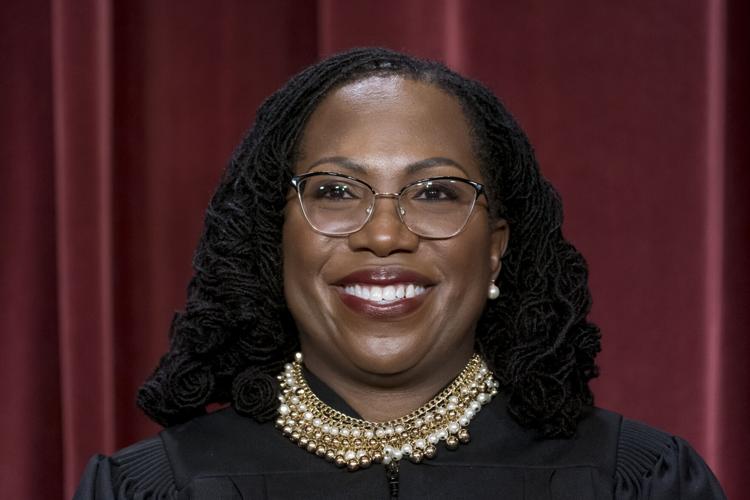
Associate Justice Ketanji Brown Jackson stands as she and members of the Supreme Court pose for a new group portrait following her addition, at the Supreme Court building in Washington, Friday, Oct. 7, 2022. (AP Photo/J. Scott Applewhite)

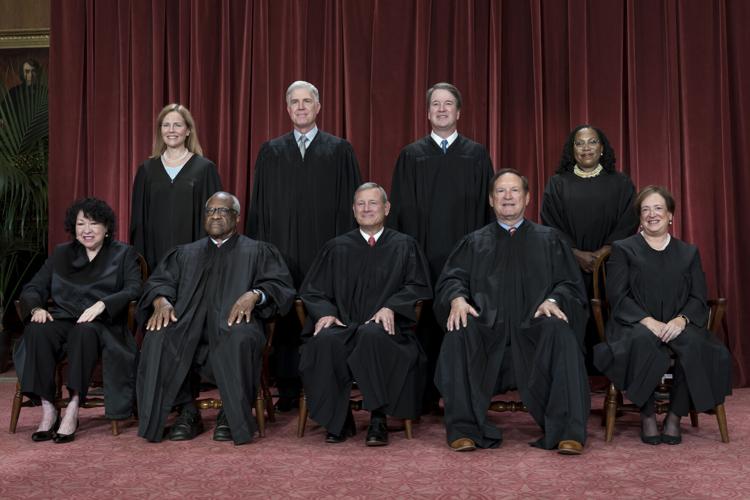
Members of the Supreme Court sit for a new group portrait following the addition of Associate Justice Ketanji Brown Jackson, at the Supreme Court building in Washington, Friday, Oct. 7, 2022. Bottom row, from left, Associate Justice Sonia Sotomayor, Associate Justice Clarence Thomas, Chief Justice of the United States John Roberts, Associate Justice Samuel Alito, and Associate Justice Elena Kagan. Top row, from left, Associate Justice Amy Coney Barrett, Associate Justice Neil Gorsuch, Associate Justice Brett Kavanaugh, and Associate Justice Ketanji Brown Jackson. (AP Photo/J. Scott Applewhite)


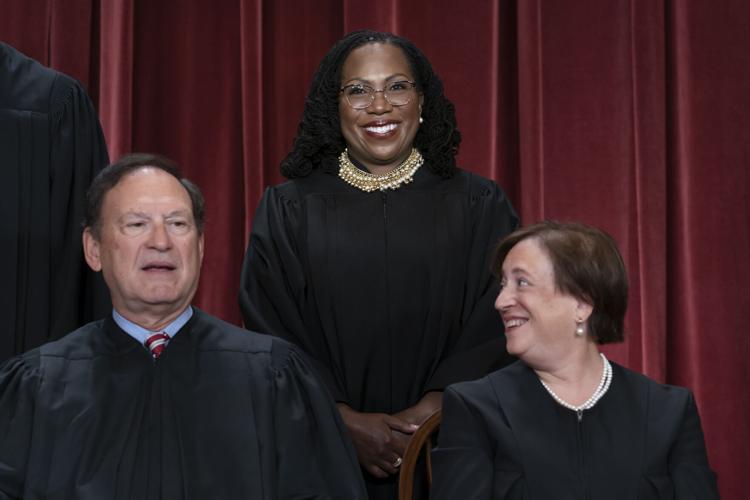
Associate Justice Ketanji Brown Jackson stands between Associate Justice Samuel Alito, left, and Associate Justice Elena Kagan, right, as she and members of the Supreme Court pose for a new group portrait following her addition, at the Supreme Court building in Washington, Friday, Oct. 7, 2022. (AP Photo/J. Scott Applewhite)
9 cases the Supreme Court will hear this term
Affirmative action

AFFIRMATIVE ACTION
In cases from Harvard University and the University of North Carolina, the court could end any consideration of race in college admissions. If this seems familiar, it's because the high court has been asked repeatedly over the past 20 years to end affirmative action in higher education. In previous cases from Michigan and Texas, the court reaffirmed the validity of considering college applicants' race among many factors. But this court is more conservative than those were.
Voting rights

VOTING RIGHTS
The court could further reduce protections for minority voters in its third major consideration in 10 years of the landmark Voting Rights Act, which was enacted to combat enduring racial discrimination in voting. The case the justices are hearing involves Alabama, where just one of the state's seven congressional districts has a Black majority. That's even though 27% of the state's residents are Black. A three-judge panel that included two appointees of President Donald Trump agreed that the state should have to create a second district with a Black majority, but the Supreme Court stopped any changes and said it would hear the case. A ruling for the state could wipe away all but the most obvious cases of intentional discrimination on the basis of race.
About the photo: Khadidah Stone stands on the dividing line between her old Alabama congressional District 7, to her right with River City Church, and her new district, District 2, to her left, in downtown Montgomery, Ala., Tuesday, Sept. 20, 2022. The line splits Montgomery between two congressional districts and is the subject of a high-stakes case before the U.S. Supreme Court.
Elections

ELECTIONS
Republicans are asking the justices to embrace a novel legal concept that would limit state courts' oversight of elections for Congress. North Carolina's top court threw out the state's congressional map that gave Republicans a lopsided advantage in a closely divided state and eventually came up with a map that basically evenly divided the state's 14 congressional districts between Democrats and Republicans. The state GOP argues that state courts have no role to play in congressional elections, including redistricting, because the U.S. Constitution gives that power to state legislatures alone. Four conservative justices have expressed varying levels of openness to the “independent state legislature” theory.
Clean water

CLEAN WATER
This is yet another case in which the court is being asked to discard an earlier ruling and loosen the regulation of property under the nation's chief law to combat water pollution. The case involves an Idaho couple who won an earlier high court round in their bid to build a house on property near a lake without getting a permit under the Clean Water Act. The outcome could change the rules for millions of acres of property that contain wetlands.
Immigration

IMMIGRATION
The Biden administration is back at the Supreme Court to argue for a change in immigration policy from the Trump administration. It's is appealing a ruling against a Biden policy prioritizing deportation of people in the country illegally who pose the greatest public safety risk. Last term, the justices by a 5-4 vote paved the way for the administration to end the Trump policy that required asylum-seekers to wait in Mexico for their court hearing. In July, also by a 5-4 vote, the high court refused to allow the administration to implement policy guidance for deportations. A Trump-era policy favored deporting people in the country illegally regardless of criminal history or community ties.
About the photo: An immigrant considered a threat to public safety and national security waits to be processed by U.S. Immigration and Customs Enforcement agents at the ICE Metropolitan Detention Center in Los Angeles, after an early morning raid, June 6, 2022.
LGBTQ rights

LGBTQ RIGHTS
A new clash involving religion, free speech and the rights of LGBTQ people will also be before the justices. The case involves Colorado graphic and website designer Lorie Smith who wants to expand her business and offer wedding website services. She says her Christian beliefs would lead her to decline any request from a same-sex couple to design a wedding website, however, and that puts her in conflict with a Colorado anti-discrimination law.
The case is a new chance for the justices to confront issues the court skirted five years ago in a case about a baker objected to making cakes for same-sex weddings. The court has grown more conservative since that time.
Native American adoption

NATIVE AMERICAN ADOPTION
In November, the court will review a federal law that gives Native Americans preference in adoptions of Native children. The case presents the most significant legal challenges to the Indian Child Welfare Act since its 1978 passage. The law has long been championed by Native American leaders as a means of preserving their families and culture. A federal appeals court in April upheld the law and Congress’ authority to enact it. But the judges also found some of the law’s provisions unconstitutional, including preferences for placing Native American children with Native adoptive families and in Native foster homes.
Bacon law backlash

BACON LAW BACKLASH
Also on the menu for the justices: a California animal rights law. The case stems from a 2018 ballot measure where California voters barred the sale of pork in the state if the pig it came from or the pig's mother was raised in confined conditions preventing them from laying down or turning around. Two agricultural associations challenging the law say almost no farms satisfy those conditions. They say the “massive costs of complying” with the law will “fall almost exclusively on out-of-state farmers” and that the costs will be passed on to consumers nationwide.
Art world

ART WORLD
The court's resolution of a dispute involving pieces by artist Andy Warhol could have big consequences in the art world and beyond. If the Warhol side loses a copyright dispute involving an image Warhol made of the musician Prince, other artworks could be in peril, lawyers say. But the other side says if Warhol wins, it would be a license for other artists to blatantly copy.
About the photo: Pop artist Andy Warhol smiles in New York in this 1976 photo.