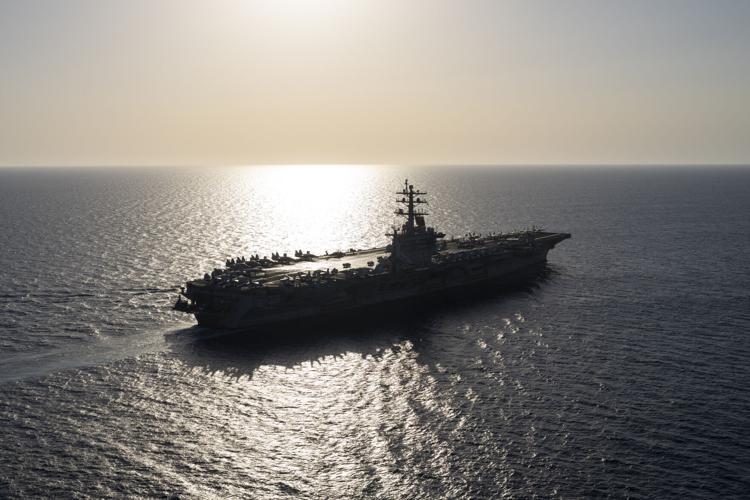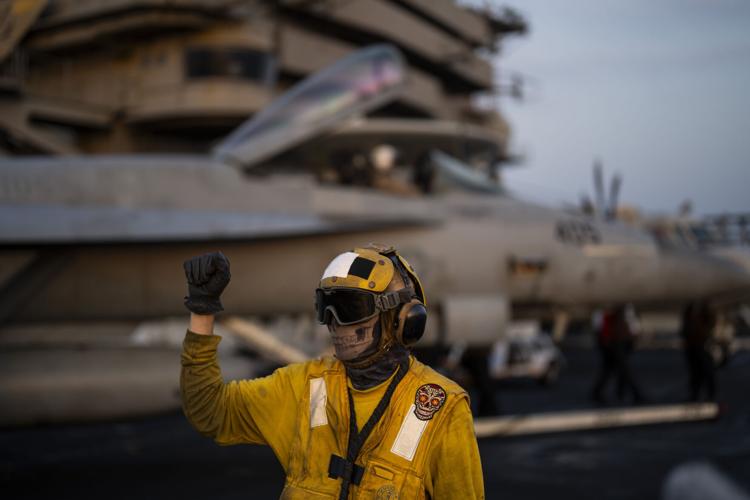

ABOARD THE USS DWIGHT D. EISENHOWER IN THE RED SEA — The USS Dwight D. Eisenhower may be one of the oldest aircraft carriers in the U.S. Navy, but it's still fighting — despite repeated false claims by Yemen's Houthi rebels.

The USS aircraft carrier Dwight D. Eisenhower sails June 12 in the Red Sea.
People are also reading…

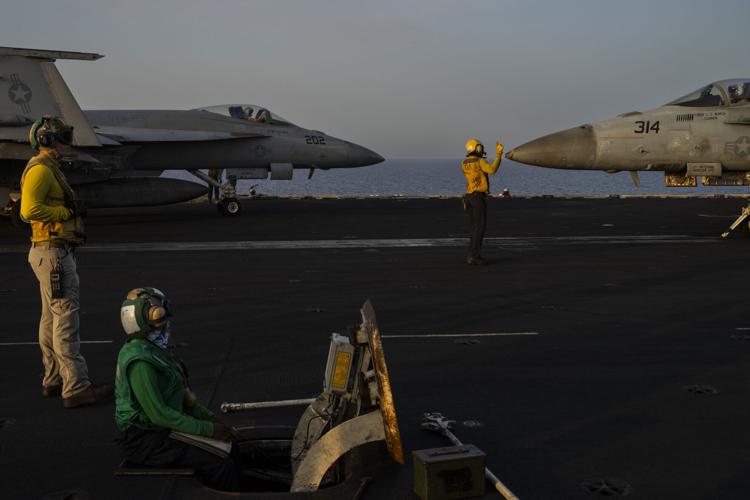
Fighter jets maneuver during take-off operations on the deck of the USS Dwight D. Eisenhower on June 11 in the Red Sea.

An aircraft handling officer directs a plane on the flight deck of the USS Dwight D. Eisenhower on June 11 in the Red Sea.
How Houthi attacks crimp global trade
Why are Houthis attacking ships?

The Houthis are Iranian-backed rebels who seized most of northern Yemen and the country's capital of Sanaa in 2014. The following year, a Saudi-led coalition entered the conflict, seeking to restore Yemen's internationally recognized government to power.
The Houthis have sporadically targeted ships in the region, but the attacks have increased since the start of the Oct. 7 Israel-Hamas war. They have used drones and anti-ship missiles to attack vessels and in one case used a helicopter to board and seize an Israeli-owned ship and its crew.
They have threatened to attack any vessel they believe is either going to or coming from Israel. That's now escalated to apparently any vessel, with container ships and oil tankers flagged to countries like Norway and Liberia being attacked or drawing missile fire.
Above: The USS Mason, an Arleigh Burke-class destroyer, passes a dock in Norfolk, Va., April 8, 2021.
Why is the Red Sea important?

The Red Sea has the Suez Canal at its northern end and the narrow Bab el-Mandeb Strait at the southern end, leading into the Gulf of Aden. It's a busy waterway with ships traversing the Suez Canal to bring goods between Asia and Europe and beyond.
In fact, 40% of Asia-Europe trade normally goes through the area, including a huge amount of oil and diesel fuel for import-dependent Europe. So do food products like palm oil and grain and anything else brought over on container ships, which is most of the world’s manufactured products.
In all, about 30% of global container traffic and more than 1 million barrels of crude oil per day typically head through the Suez Canal, according to global freight booking platform Freightos Group.
Above: Sea Viper missiles are prepared Jan. 10, 2024, to be fired in the Red Sea from the operation room of HMS Diamond.
How are Houthi attacks affecting trade?

Huge shipping container companies, including Maersk, are avoiding the Red Sea and sending their ships around Africa and the Cape of Good Hope. That adds a week to two weeks to voyages and increases costs for for shipping, fuel and more.
At least 90% of the container ships that had been going through the Suez Canal are now rerouting around the tip of Africa, said Simon Heaney, senior manager of container research for Drewry, a maritime research consultancy.
The cost to ship a standard 40-foot container from China to northern Europe has jumped from $1,500 to $4,000, according to the Kiel Institute for the World Economy in Germany. But that is still far from the $14,000 seen during the pandemic.
The delays contributed to a 1.3% decline in world trade in December, reflecting goods stuck on ships rather than being offloaded in port.
“There will be initial shock and there will be possibly initial shortages of parts that will potentially slow up production,” Heaney said.
But “pretty soon,” the system “will adjust to the new reality of having to go around the Cape” and manufacturers have to prepare and plan for longer wait times, Heaney said.
He thinks the crisis is shaping up to last for months, but that shipping has more capacity — unlike during the pandemic — and lessons from that time mean companies have more inventory on hand. Plus, shipping costs are a tiny fraction of the value of items.
“Noticeable consequences for consumer prices in Europe are scarcely to be expected, since the share of freight costs in the value of high priced goods such as consumer electronics is a fraction of a percent,” said Julian Hinz, director of the Research Center Trade Policy at Kiel.
However, analysts at JP Morgan say that the cost increase could slow the recent decline in inflation: “While these cost increases are coming off low levels, they will reinforce the fading of recent deflationary dynamics for goods prices.”
Above: Sea Viper missiles are fired in the Red Sea on Jan. 10, 2024, seen from the bridge of HMS Diamond.
What does it mean for oil prices?

Crude prices rose about 4% following the U.S.-led airstrikes. International benchmark Brent traded at around $78 per barrel Friday, still down from about $84 on the eve of the Oct. 7 Hamas attack on Israel.
“While this puts upwards pressure on global oil prices, it is unlikely to represent a serious energy supply shock for now,” Simone Tagliapietra, an energy analyst at the Bruegel think tank in Brussels, tweeted.
That could change if the Hamas-Israel and Houthi conflicts escalate and lead to trouble at the Strait of Hormuz at the southern end of the Persian Gulf, he said.
"That would have massive implications for global energy markets,” Tagliapietra said.
And White House spokesman Andrew Bates said, "We are monitoring conditions” on oil prices.
“Let me be very clear," Bates said. "It is the Houthis who have been endangering the freedom of navigation in one of the world’s most vital waterways.”
Above: A satellite image shows damage from airstrikes Jan. 12, 2024, on a radar site at Sanaa Airport in Yemen.
How is the world responding?

The U.S. is leading a security initiative to protect ships in the Red Sea that includes United Kingdom, Bahrain, Canada, France, Italy, Netherlands, Norway, Seychelles and Spain. The Houthis have no navy to impose a cordon, relying on harassing fire and only one helicopter-borne assault so far.
Friday's strikes killed at least five Houthi troops and wounded six, the rebels said, without elaborating on what was targeted. It was unclear how extensive the damage from the U.S. strikes were, though the Houthis said at least five sites, including airfields, had been attacked.
Above: An RAF Typhoon aircraft takes off Jan. 11, 2024, from RAF Akrotiri in Cyprus, for a mission to strike targets in Yemen. The U.S. and British militaries bombed more than a dozen sites used by the Iranian-backed Houthis in Yemen the day before, in a massive retaliatory strike using warship- and submarine-launched Tomahawk missiles and fighter jets.