
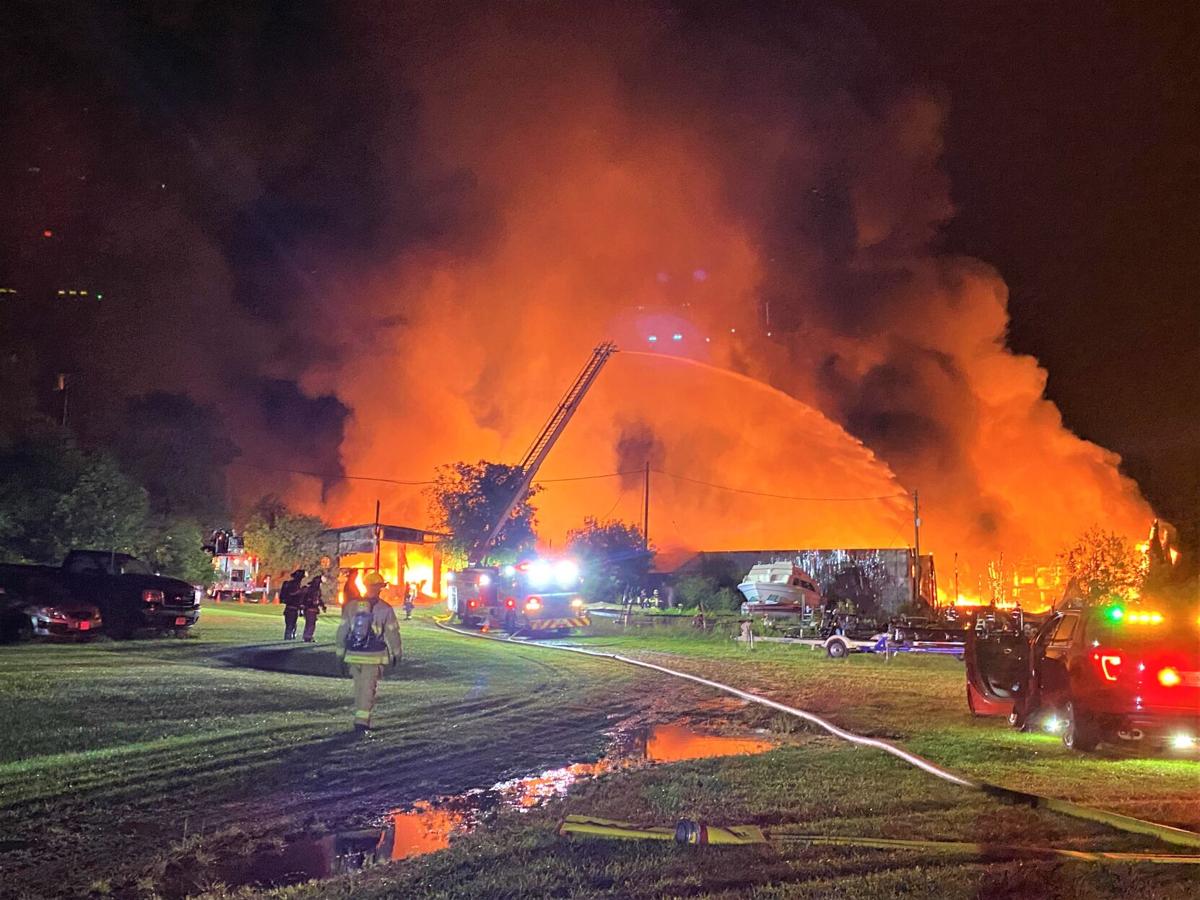
A total loss Sept. 12-13 structure fire in rural Sugar Creek, west of Elkhorn, left a swath of destruction in its wake, including the loss of 10 boats and 50 vintage snowmobiles among other items.
People are also reading…
Photos: 150th anniversary of the 1871 Peshtigo Fire

Pauline King, a volunteer docent, gives a tour at the Peshtigo Fire Museum. The tabernacle from the Catholic church, which can be seen behind King, was removed from the church by a priest. The tabernacle, which held the host and a chalice, was found days after the fire floating in the river.

A large mural on the back wall of the Peshtigo Fire Museum attempts to depict the horror of Oct. 8, 1871, when a wind-fueled fire tore across northeastern Wisconsin. The massive blaze killed between 1,200 and 2,400 people, including 800 in Peshtigo. Many of those who survived fled into the Peshtigo River.

Visitors, from left, Vicki Morris, Bruce Topp and Bruce Morris all of Edgerton, Wisconsin, read through an exhibit at the Peshtigo Fire Museum in Peshtigo, Wis., Wednesday, Sept. 22, 2021. KAYLA WOLF, STATE JOURNAL

A petrified and charred Bible was found after the Peshtigo Fire of 1871 and is on display with a variety of other artifacts at the Peshtigo Fire Museum in Peshtigo, Wis., Wednesday, Sept. 22, 2021. KAYLA WOLF, STATE JOURNAL

Artifacts from the home at 150 S. Beebe Ave. in Peshtigo include a charred piece of lumber. Pieces of charred wood remain on the home, which was under construction in 1871.

Wade Schenk stands on the porch of his home at 150 S. Beebe Ave. in Peshtigo. When fire tore through the city in 1871, the home, which was under construction, was charred but remained standing. It's the only structure that survived the devastating and deadly fire.

Volunteer curator Pauline King at the Peshtigo Fire Museum in Peshtigo, Wis., Wednesday, Sept. 22, 2021. KAYLA WOLF, STATE JOURNAL

Visitors walk through the cemetery where many victims of the Peshtigo Fire are buried. Located next to the museum, the cemetery is also home to a mass grave filled with the remains of an estimated 350 people who died in the fire but who could not be identified.

A mass grave holds the remains of an estimated 350 victims of the 1871 Peshtigo Fire.

Exhibits ranging from the Peshtigo Fire of 1871 to classroom and apothecary exhibits showing what life was like in Peshtigo around that time, fill the first floor and basement at the Peshtigo Fire Museum in Peshtigo, Wis., Wednesday, Sept. 22, 2021. KAYLA WOLF, STATE JOURNAL

A mural of the 1871 fire in Peshtigo adorns the side of Peshtigo Pharmacy on French Street in Peshtigo, Wis., Wednesday, Sept. 22, 2021. KAYLA WOLF, STATE JOURNAL

Pauline King, a volunteer docent, gives a tour at the Peshtigo Fire Museum. The tabernacle from the Catholic church, which can be seen behind King, was removed from the church by a priest. The tabernacle, which held the host and a chalice, was found days after the fire floating in the river.

A large mural on the back wall of the Peshtigo Fire Museum attempts to depict the horror of Oct. 8, 1871, when a wind-fueled fire tore across northeastern Wisconsin. The massive blaze killed between 1,200 and 2,400 people, including 800 in Peshtigo. Many of those who survived fled into the Peshtigo River.

Visitors, from left, Vicki Morris, Bruce Topp and Bruce Morris all of Edgerton, Wisconsin, read through an exhibit at the Peshtigo Fire Museum in Peshtigo, Wis., Wednesday, Sept. 22, 2021. KAYLA WOLF, STATE JOURNAL

A petrified and charred Bible was found after the Peshtigo Fire of 1871 and is on display with a variety of other artifacts at the Peshtigo Fire Museum in Peshtigo, Wis., Wednesday, Sept. 22, 2021. KAYLA WOLF, STATE JOURNAL

Artifacts from the home at 150 S. Beebe Ave. in Peshtigo include a charred piece of lumber. Pieces of charred wood remain on the home, which was under construction in 1871.

Wade Schenk stands on the porch of his home at 150 S. Beebe Ave. in Peshtigo. When fire tore through the city in 1871, the home, which was under construction, was charred but remained standing. It's the only structure that survived the devastating and deadly fire.

Volunteer curator Pauline King at the Peshtigo Fire Museum in Peshtigo, Wis., Wednesday, Sept. 22, 2021. KAYLA WOLF, STATE JOURNAL

Visitors walk through the cemetery where many victims of the Peshtigo Fire are buried. Located next to the museum, the cemetery is also home to a mass grave filled with the remains of an estimated 350 people who died in the fire but who could not be identified.

A mass grave holds the remains of an estimated 350 victims of the 1871 Peshtigo Fire.

Exhibits ranging from the Peshtigo Fire of 1871 to classroom and apothecary exhibits showing what life was like in Peshtigo around that time, fill the first floor and basement at the Peshtigo Fire Museum in Peshtigo, Wis., Wednesday, Sept. 22, 2021. KAYLA WOLF, STATE JOURNAL

A mural of the 1871 fire in Peshtigo adorns the side of Peshtigo Pharmacy on French Street in Peshtigo, Wis., Wednesday, Sept. 22, 2021. KAYLA WOLF, STATE JOURNAL

A petrified and charred Bible was found after the Peshtigo Fire of 1871 and is on display with a variety of other artifacts at the Peshtigo Fire Museum in Peshtigo, Wis., Wednesday, Sept. 22, 2021. KAYLA WOLF, STATE JOURNAL

Visitors, from left, Vicki Morris, Bruce Topp and Bruce Morris all of Edgerton, Wisconsin, read through an exhibit at the Peshtigo Fire Museum in Peshtigo, Wis., Wednesday, Sept. 22, 2021. KAYLA WOLF, STATE JOURNAL

A mass grave holds the remains of an estimated 350 victims of the 1871 Peshtigo Fire.

Exhibits ranging from the Peshtigo Fire of 1871 to classroom and apothecary exhibits showing what life was like in Peshtigo around that time, fill the first floor and basement at the Peshtigo Fire Museum in Peshtigo, Wis., Wednesday, Sept. 22, 2021. KAYLA WOLF, STATE JOURNAL

Pauline King, a volunteer docent, gives a tour at the Peshtigo Fire Museum. The tabernacle from the Catholic church, which can be seen behind King, was removed from the church by a priest. The tabernacle, which held the host and a chalice, was found days after the fire floating in the river.

A large mural on the back wall of the Peshtigo Fire Museum attempts to depict the horror of Oct. 8, 1871, when a wind-fueled fire tore across northeastern Wisconsin. The massive blaze killed between 1,200 and 2,400 people, including 800 in Peshtigo. Many of those who survived fled into the Peshtigo River.

Artifacts from the home at 150 S. Beebe Ave. in Peshtigo include a charred piece of lumber. Pieces of charred wood remain on the home, which was under construction in 1871.

Wade Schenk stands on the porch of his home at 150 S. Beebe Ave. in Peshtigo. When fire tore through the city in 1871, the home, which was under construction, was charred but remained standing. It's the only structure that survived the devastating and deadly fire.

Volunteer curator Pauline King at the Peshtigo Fire Museum in Peshtigo, Wis., Wednesday, Sept. 22, 2021. KAYLA WOLF, STATE JOURNAL

Visitors walk through the cemetery where many victims of the Peshtigo Fire are buried. Located next to the museum, the cemetery is also home to a mass grave filled with the remains of an estimated 350 people who died in the fire but who could not be identified.

A mural of the 1871 fire in Peshtigo adorns the side of Peshtigo Pharmacy on French Street in Peshtigo, Wis., Wednesday, Sept. 22, 2021. KAYLA WOLF, STATE JOURNAL

A petrified and charred Bible was found after the Peshtigo Fire of 1871 and is on display with a variety of other artifacts at the Peshtigo Fire Museum in Peshtigo, Wis., Wednesday, Sept. 22, 2021. KAYLA WOLF, STATE JOURNAL

Visitors walk through the cemetery where many victims of the Peshtigo Fire are buried. Located next to the museum, the cemetery is also home to a mass grave filled with the remains of an estimated 350 people who died in the fire but who could not be identified.