



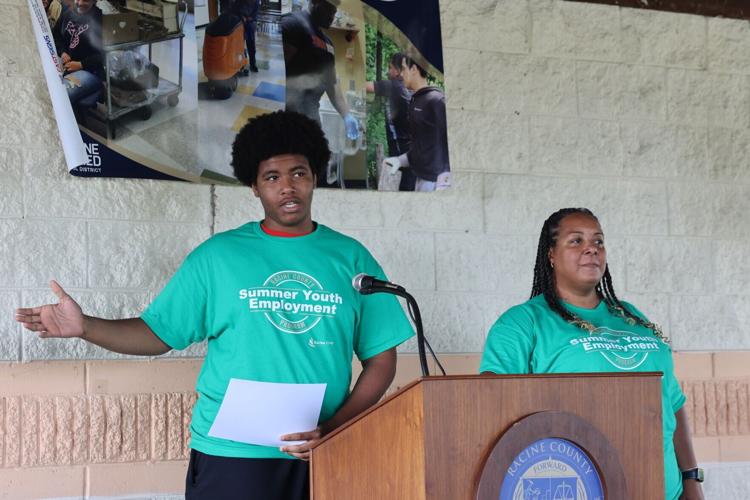
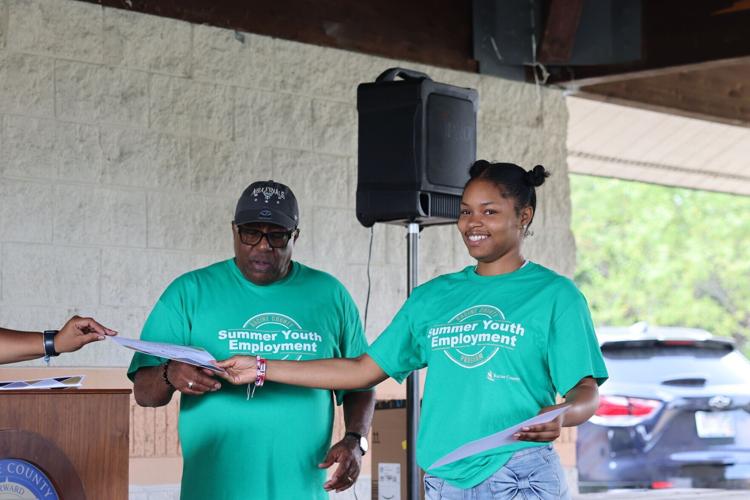


Racine County on Friday celebrated the 117 youth who completed the county's 2026 Summer Youth Employment Program, marking the program's sixth year. More than 50 businesses participated in the eight-week program, providing employment to the teens, ages 15-18, at $14 an hour and helping the youth build both hard and soft job skills. The ceremony was held at the Wieczorek Pavilion at Pritchard Park, 2800 Ohio St., in Racine.

The best summer jobs, then and now
Then: Beauty salon assistant

“I swept the floor, washed hair, worked the registers,” says Diane Gold (not pictured), who helped out at a salon in Skokie, Illinois, that was owned by her aunt in the 1960s and ’70s. “I started working there in sixth grade and spent every summer weekday there for the next nine years. They paid me in cash and gossiped all day long about people I knew and people I didn’t know. It was like the Jewish TMZ.”
Now: Beauty consultant

Abigail Brickton (not pictured) is a makeup consultant, working at a mall near the University of Michigan during the school year and one closer to her home in Grand Rapids, Michigan, during the summer. “The work is good,” she says. “It’s one-and-done for most customers. You help them with their makeup and skin products and send them on their way.”
Then: Telemarketer

Sharon Kowalczyk (not pictured) worked as a telemarketer most summers during high school in Chicago and college at Western Illinois University. “It was an easy job to get since people quit all the time,” she says. “I sold auto club memberships, solicited donations to the Chicago Fraternal Order of Police and tried to book appointments for a window-and-door company.”
Now: Website builder

From his home in Stockton, California, Aarav Patel (not pictured) creates retail websites for various businesses across the country. “I try to build new sites in the summer and then do maintenance and general tasks during the school year,” says the 20-year-old student at California State University, Fresno.
Then: Lawnmower

Chicago’s Tim Nowak (not pictured) put an ad in his parish bulletin and some fliers up in his neighborhood. “I charged ten bucks a house in 1982. I made about 40 bucks a day, which was more than my friends were making at minimum wage,” says Nowak. “I did it on Mondays, Tuesdays and Wednesdays and went to the beach on Thursday and Friday."
Now: Landscape service worker

Shaun Muller (not pictured) helps his friend’s father’s landscape service in the suburbs of Cleveland. “Ten hour days, man. We bust our butts, but I love it,” says the student at Wayne State University. “I’m skinny, tan and have cash money. I’m loving life.”
Then: Dog walker

“I’d like to think I was a pioneer but probably not,” says Elaine Galanis (not pictured), who advertised her dog walking services in 1988 by placing fliers in “about 1,000 mailboxes” near her family’s home in San Fernando, California. “I was busy but it wasn’t too bad except for the people who wanted their dogs to be walked at five in the morning,” Galanis says. “My daughters are on Rover.com and do some dog walking and dog sitting during the year. I tell them to make some printouts of what they do and deliver them to our neighbors, but they just look at me like I’m crazy.”
Now: Dog groomer

Vince Galenti (not pictured), who will be entering his sophomore year at Arizona State University this fall, works for two traveling dog grooming services this summer. “We pull into the driveway in a custom van, and the owners bring the dog out, we bathe them, trim their nails and dry them off,” he says. “It’s like dirty-dog-in, clean-dog-out while the owner sits inside and watches Fox News.”
Then: Dishwasher

Rodney Froelich (not pictured) spent his high school and college summers washing dishes at various restaurants and banquet halls near his home in Chicago. “It was the 1970s so there wasn’t a lot of automation when it came to washing dishes and pots and pans,” he says. “But I could sleep in since I didn’t start until four or five most days and the work was simple. Disgusting, sometimes, but really easy. My friend used to call it ‘hangover-proof work.’ He was right. You really couldn’t screw it up.”
Now: Catering assistant

Hired by a family friend to help cater business seminars in Charleston, South Carolina, Beth Clarke (not pictured) gets to work at 4:30 a.m. and is finished by 12:30 p.m. “I’m on the prep and deliver crew,” says Clarke, who is an incoming freshman at Sam Houston State University in Huntsville, Texas. “We make a lot of sandwiches, a lot of salads, and chop a lot vegetables. It’s early, but I get home early, too.”
Then: Camp counselor

Ed Tarnowski (not pictured) worked summer camps during the 1970s as a counselor for the Chicago Park District. “You basically kept an eye on kids while their parents were at work,” he says. “We swam, played softball, played basketball and did anything else we could think of to keep them busy.”
Now: Tutor

Michelle Flores (not pictured) spoke Spanish at home and took French in high school and college. The upcoming junior at Colorado State University has stayed in Fort Collins the last two summers to tutor children and adults in Spanish and French. “I have a family of four this summer that’s going to Paris in September, so we meet three times a week for French lessons,” Flores says.
Then: Car washer

“I’d go driveway to driveway with a bucket, a brush, some rags and some soap,” says Glen Moch (not pictured) of his summer job in 1990, 1991 and 1992. “I was an entrepreneur. I’d find a nice subdivision, park on one end and ring doorbells. At least half the people who answered pulled their cars out of the driveway and paid me $10 for a wash. If they had a vacuum, I’d vacuum it out for an extra five bucks. Half the time, they’d tell me to come back next week and do the same thing, so I did.”
Now: Driver

Uber and Lyft require their drivers to be 21, so many college juniors and seniors drive during their summers off from school. “I don’t know if I can make enough money to bring a huge nut back to school, but it’s enough to keep cash in my pocket all summer,” says Donald Riaz (not pictured) of St. Paul, Minnesota, who will be entering his senior year at Creighton University in Omaha, Nebraska, this fall.
Then: Meat packing assistant

For three summers, Paul Best (not pictured) worked at a meat packing plant in Des Moines, Iowa. “It was pretty messy work. I went through a lot of socks and T-shirts that summer because you’re working with meat all day so there’s a lot of scraps,” Best says. “But it was a lot of fun and a real learning experience. The people I worked for were nuts about cleanliness and following the process they’d set up. I think it taught me a lot about food and how much work it takes to keep the consumer safe.”
Now: Fish observer

Paul Best’s son Alan (not pictured), a junior at Iowa State University in Ames, Iowa, headed to Maine this summer to work on a research project. “They’re out on the Atlantic for two weeks at a time, recording weather patterns, levels of the ocean ... and how it all impacts the fish,” Best says. “He’s really interested in the oceans, and he’s not going to see any oceans in Iowa, so it’s a good fit.”
Then: Babysitter

For four summers, Tricia Young (not pictured) watched a neighbor’s three children during the summer in Hoffman Estates, Illinois. “We’d walk to the park, play in the yard, watch a lot of PBS Kids during the afternoon,” she says.
Now: Babysitter

Rachel Huber (not pictured), Tricia Young’s daughter, watches a set of twins in Overland Park, Kansas, where Young and her family now live. “I found my job on Facebook this summer and Care.com last summer,” Huber says. “I do things with the kids, but I spend most of my time driving them to and from basketball camps, swimming lessons and piano lessons. This summer, they’re taking cooking classes, too.”


