

Evasive rationale
Trump administration gives shifting reasons for its attacks on Iran

President Donald Trump speaks March 3 during a meeting with German Chancellor Friedrich Merz in the Oval Off ce at the White House in Washington.
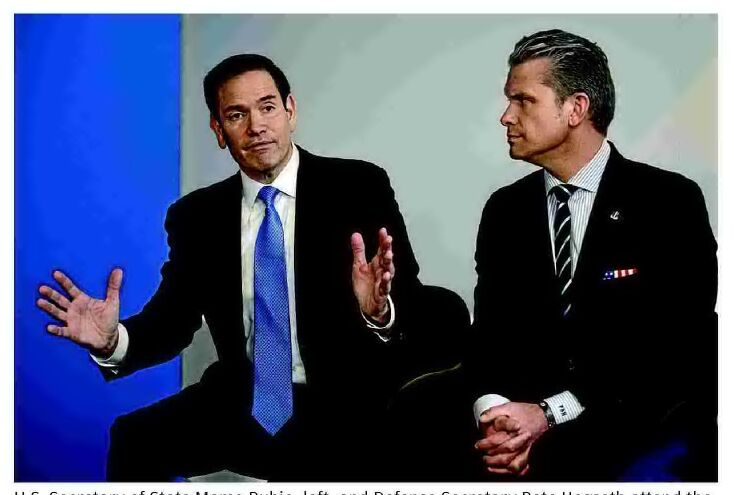
U.S. Secretary of State Marco Rubio, left, and Defense Secretary Pete Hegseth attend the NATO summit of heads of state and government June 25 in The Hague, Netherlands.
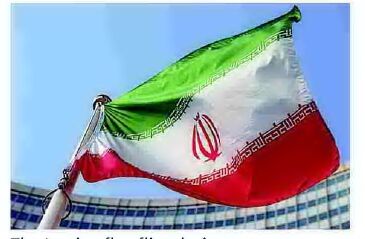
The Iranian flag flies during an International Atomic Energy Agency meeting on March 2 in Vienna, Austria.
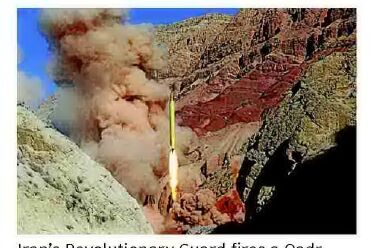
Iran's Revolutionary Guard fires a Qadr H long-ange ballistic missile during a maneuver in Iran.
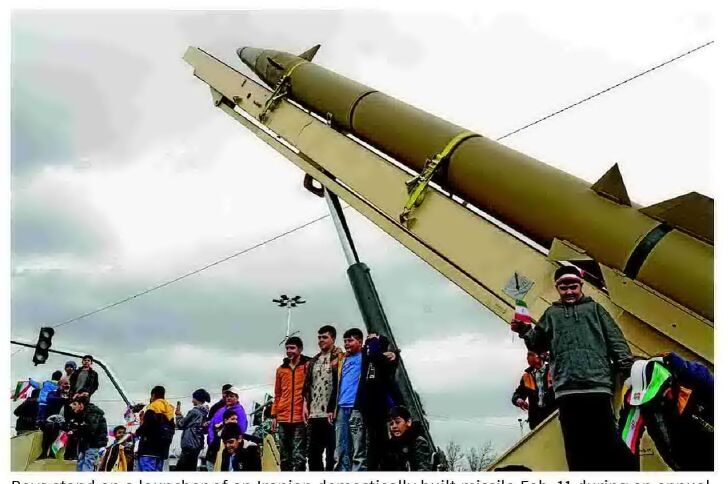
Boys stand on a launcher of an Iranian domestically built missile Feb. 11 during an annual rally marking 1979 Islamic Revolution at the Azadi Square in Tehran.
MIDDLE EAST
I ran's nuclear capabilities. Its ballistic missiles. Its proxies. The ruling Islamic theocracy. Israel. All of the above are part of the Trump administration's shifting rationale for pummeling Iran and killing its leader without first seeking the buy-in of Congress and U.S. allies. There's more that's unclear about the widening war launched by the president and Board of Peace leader — including an exit strategy, a timeline and who President Donald Trump wants to take control of Iran.
The Trump administration's own off cials do not appear to be clear or uniform on the important questions at hand: Why and why now?
"It's the standard practice to agree on the rationale before you start and then stick to delivering a consistent messaging," said David Schenker, a former Trump administration off cial who is now a fellow at the Washington Institute for Near East Policy. "But that's a challenge for this administration."
By Wednesday, the White House described the Republican president's decision to launch Operation Epic Fury as a consideration of past Iranian threats to the U.S. "and the president's feeling, based on fact, that Iran does pose an imminent and direct threat to the United States of America." Analysts say that's unclear.
Here's a curated selection of the Trump administration's explanations.
NUCLEAR PROGRAM
"THE NUCLEAR SITES IN IRAN ARE COMPLETELY DESTROYED!" Trump claimed in a June 24 social media post after the U.S.-Israel strikes on Iran.
"That is a false story, and it's one that really shouldn't be re-reported," Secretary of State Marco Rubio said in a June 25 interview with Politico after a reported intelligence analysis suggested Iran's nuclear program was set back a few months.
"If we didn't do what we're doing right now, you would have had a nuclear war and they would have taken out many countries," Trump said March 3 after the strike that killed Iranian Supreme Leader Ayatollah Ali Khamenei.
Background: Iran long insisted its program is peaceful, but the United Nations' nuclear watchdog and Western nations say Tehran had an organized nuclear weapons program up until 2003. The current state of the program remains a mystery as off cials have not allowed the International Atomic Energy Agency access to the nuclear facilities that were bombed since June, according to a confidential report by the watchdog. Iran is legally obliged to cooperate with the IAEA under the Treaty on the Non-Proliferation of Nuclear Weapons, but it suspended all cooperation after the war with Israel.
BALLISTIC MISSILES
"Iran possesses a very large number of ballistic missiles, particularly shortrange ballistic missiles, that threaten the United States and our bases in the region, and our partners in the region, and all of our bases in the UAE, Qatar and Bahrain," Rubio said Feb. 25.
"The regime already had missiles capable of hitting Europe and our bases — both local and overseas — and would soon have had missiles capable of reaching our beautiful America," Trump said at a March 2 White House ceremony.
Iran "was building powerful missiles and drones to create a conventional shield for their nuclear blackmail ambitions," Defense Secretary Pete Hegseth said at a March 2 Pentagon briefing.
Background: Iran hasn't acknowledged it seeks to build intercontinental ballistic missiles. The country has a self-imposed limit on its ballistic missile program, limiting their weapons' range to 1,240 miles. That puts all of the Mideast and some of Eastern Europe in range. Trump administration off cials told congressional staffers in private briefings that U.S. intelligence did not suggest Iran was preparing to launch a preemptive strike against the U.S. The administration off cials instead acknowledged there was a more general threat from Iran and proxy forces.
ISRAEL'S ROLE
"We knew that there was going to be an Israeli action. And we knew that if we didn't preemptively go after (Iran) before they launched those attacks, we would suffer higher casualties," Rubio told reporters March 2.
"Israel was determined to act in its own defense here, with or without American support," House Speaker Mike Johnson, R-La., told reporters. If that happened, he added, "exquisite intelligence" by the U.S. indicated that Iran would retaliate against American assets.
"No," Trump told reporters at the White House when asked March 3 if Israel forced his hand on attacking Iran. "If anything, I might have forced Israel's hand."
Background: In a televised address, Prime Minister Benjamin Netanyahu declared that Israel carried out the strikes "in full cooperation" with the U.S. but there is no sign Israel was forced into cooperating. An Israeli military off cial, on condition of anonymity, described lockstep planning between the U.S. and Israel for weeks. The Israeli army deliberately suggested the military would stand down for the weekend, releasing photos suggesting that staffers and senior commanders were heading home for Shabbat dinner. The shared information allowed the strikes to be carried out hours later Feb. 28, people familiar with the operation said.
The U.S.-Israeli attacks came so quickly, they were nearly simultaneous — with three strikes in three locations hitting within a minute — killing Khamenei and about 40 senior figures, another Israeli military off cial said. The U.S. and Israeli war rooms were synchronized in real time to allow for quick adjustments, the first Israeli military off cial said Wednesday.
REGIME CHANGE
"If Iran shoots and violently kills peaceful protesters, which is their custom, the United States of America will come to their rescue. We are locked and loaded and ready to go," Trump said Jan. 2.
"When we are finished, take over your government. It will be yours to take," the U.S. president said to Iranians on social media Feb. 28 after the first strikes.
"This is not a so-called regime change war. But the regime sure did change, and the world is better off for it," Hegseth said March 2 at the Pentagon.
Background: Washington has a long, complicated history with regime change. See Vietnam, Panama, Nicaragua, Iraq and Afghanistan after Sept. 11, 2001, and Venezuela just weeks ago. In Iran, the CIA in 1953 helped engineer a coup that toppled Iran's democratically elected leader and gave near-absolute power to Shah Mohammad Reza Pahlavi. As with the shah, who was overthrown in Iran's 1979 Islamic Revolution, regime change rarely goes as planned.
That's in part because it's fundamentally out of Trump's complete control, as he acknowledged March 3. "Most of the people we had in mind are dead," he told reporters. "Now we have another group. They may be dead also based on reports. So, I guess you have a third wave coming, and pretty soon we're not going to know anybody."