

Strong but stalled
Economy resilient but many of president's vows still unfulfilled


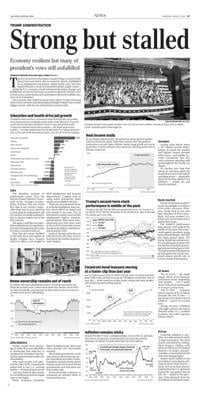
President Donald Trump greets workers June 23 as he arrives to deliver remarks during a visit to a Mack Trucks' assembly plant in Macungie, Pa.


TRUMP ADMINISTRATION
The first 18 months of President Donald Trump's second White House term saw policy-driven economic shocks, highlighted by an immigration crackdown, higher tariffs and a war that boosted the price of oil and threatened global supply chains.
While the U.S. economy overall withstood the policy changes and Middle East war better than many economists expected, Trump's vows to lower prices, boost factory jobs and improve life for the middle class have yet to materialize.
The economy also stalled in many areas where Trump said mass deportations of undocumented people and higher import taxes would trigger a boom, with the war intensifying some key risks.
Jobs
The broadest measure of employment comes from the Bureau of Labor Statistics' household survey. Changes in population statistics this year mean BLS data is not strictly comparable from year to year, showing a sharp drop in employment and the number of people looking for jobs in January largely due to the new controls.
The agency used the new population estimates for an experimental series that looked back five years to create a consistent data set.
That data also shows declines in the labor force and number of people working since Trump's return to office, as he sought to limit immigration and increase deportations. Coupled with an aging native population, fewer people are available to fill jobs.
There was an investment boom in artificial intelligence data centers, but its effects on output and jobs remain to be seen. The AI investment pushed construction employment higher. However, payroll reports show fewer manufacturing jobs than there were at the end of Democratic former President Joe Biden's administration in January 2025.
Some of Trump's priorities are reflected in the jobs data, such as the drop in the number of government workers.
Affordability
Trump veered from promising to make life more affordable to dismissing that objective as unimportant, refusing to sign legislation aimed at improving home affordability.
After years of ultra-low interest rates, the COVID-19 pandemic added fuel to the U.S. housing market — driving up home prices — and then Fed rate hikes meant to curb inflation pushed mortgage rates to new highs.
Home insurance premiums linked to higher home values and other relevant costs also remain elevated.
The federal government can do only so much about housing supply. Extending tax credits or similar policies can help, but the sector remains under the control of local governments and their land-use and zoning rules.
Homeownership continues to command an outsized share of household income.
Incomes
Setting aside debate about a "K"-shaped income distribution, in which the wealthy and highest earners prosper while lowerand middle-income households fare less well, consumer spending held up throughout the Trump-era shocks.
It's unclear how long that trend can continue, given the broadest measure of household spending power — disposable personal income adjusted for inflation — stalled out and recently declined.
Stock market
Trump touted major indexes' recent record highs as evidence of his policy successes. However, stocks tend to rise over time regardless of who is president, and most modern U.S. leaders saw record equity prices during their terms.
The market's performance since January 2025 ranks in the middle of the pack when measured against presidents going back to Ronald Reagan. The S&P 500 index gained about 25% during Trump's second term versus a median gain of about 24% over the first 18 months of presidential terms dating back to 1981. That performance still measures up well against the overall compound annual growth rate of 9.5% for stocks in that period.
AI boom
The AI sector — the single largest driver of the business investment boom supporting GDP growth — was a major driver of the stock market gains in Trump's current term.
Year-to-date corporate bond issuance of $1.52 trillion through the end of June — a big chunk of it to finance the AI buildout — also is on a record pace.
Strong issuance combined with tight spreads and robust demand point to a resilient economy and solid corporate balance sheets.
Prices
Lowering inflation is possible, but improvement under Trump was modest. The most closely watched price indexes show progress stalling, with inflation still above the Federal Reserve's 2% target, and policymakers concerned about the risks of it moving higher.
Import tariffs added to the price hikes to some degree; oil's surge to about $100 a barrel — about 50% more than where it traded before the U.S. and Israel started the war against Iran on Feb. 28 — added to the pressure. Now, demands from the AI buildout are doing the same.