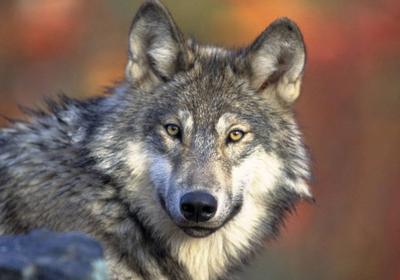


This April 18, 2008, file photo provided by the U.S. Fish and Wildlife shows a gray wolf.
The Wisconsin Natural Resources Board (NRB) on Oct. 25 approved, with amendments, the Wisconsin Department of Natural Resources’ (DNR) revised 2023 Wisconsin Wolf Management Plan, and an administrative rule for wolves.
The board approved the wolf plan with an amendment to subzone 1B that allows the department to close any subunit if two wolves are harvested within that subunit while maintaining the four wolf subzone harvest limit.
The board approved the rule with amendments. The amendments allow landowners enrolled in the wildlife damage, abatement and claims program to restrict the use of dogs by hunters who have access to their land according to the public access requirement of the wildlife damage program. The board’s amendment also allowed the department additional flexibility on the timing of depredation compensation payments which would allow payments to be made as soon as possible.
The DNR began developing the updated management plan in early 2021 to align its wolf management strategies with the current state of the wolf population and the desires of a diverse public. The DNR collected and considered public input throughout the development process through various methods, including via the creation of a Wolf Management Plan Committee (consisting of 29 stakeholders from tribal representatives to external agency representatives), consultations with Wisconsin’s Tribal Nations and the Great Lakes Indian Fish and Wildlife Commission (GLIFWC), discussions with other state and federal wolf management in their states, and a 3.5-month public review and comment period which gave the public a chance to weigh in.
The DNR also held a public comment period and a public hearing for a corresponding administrative rule change (often called the Wolf Management Rule), which implements specific provisions of the Wolf Management Plan. The Wolf Management Rule codifies provisions of an emergency rule, EmR 1210, which went into effect on Aug. 18, 2012. It also implements recommendations from the Wolf Management Plan and updates regulatory text. The NRB also approved this rule, which now goes to Gov. Tony Evers for final approval.
Photos: The 1871 Peshtigo Fire
Peshtigo Fire

This new monument will be dedicated Friday outside the Peshtigo Fire Museum. The event will take place 150 years to the day of the fire that destroyed the northeastern Wisconsin city and surrounding region.
Peshtigo marker, 1951

Survivors of the Peshtigo Fire meet 80 years later in 1951 to dedicate a historical marker in Peshtigo on the 80th anniversary of the blaze.
Peshtigo Fire

A portrait of Father Peter Pernin hangs on the wall of the Peshtigo Fire Museum. Pernin wrote detailed and lengthy accounts of the fire.
092321_peshtigo_12-09292021085314

The tabernacle that Father Pernin saved during the Peshtigo Fire in 1871 is on display at the Peshtigo Fire Museum in Peshtigo, Wis., Wednesday, Sept. 22, 2021. KAYLA WOLF, STATE JOURNAL
Peshtigo Fire

A monument dedicating the bridge in Peshtigo points out the importance of the river and the fundamental change the Peshtigo Fire of 1871 brought to the Marinette County community. Many people fled into the river in an attempt to escape the inferno.
092321_peshtigo_04-09232021153246

Visitors, from left, Vicki Morris, Bruce Topp and Bruce Morris all of Edgerton, Wisconsin, read through an exhibit at the Peshtigo Fire Museum in Peshtigo, Wis., Wednesday, Sept. 22, 2021. KAYLA WOLF, STATE JOURNAL
Peshtigo Fire

A mass grave holds the remains of an estimated 350 victims of the 1871 Peshtigo Fire.
Peshtigo Fire

A large mural on the back wall of the Peshtigo Fire Museum attempts to depict the horror of Oct. 8, 1871, when a wind-fueled fire tore across northeastern Wisconsin. The massive blaze killed between 1,200 and 2,400 people, including 800 in Peshtigo. Many of those who survived fled into the Peshtigo River.
092321_peshtigo_11-09232021153246

A mural of the 1871 fire in Peshtigo adorns the side of Peshtigo Pharmacy on French Street in Peshtigo, Wis., Wednesday, Sept. 22, 2021. KAYLA WOLF, STATE JOURNAL
Peshtigo Fire

Visitors walk through the cemetery where many victims of the Peshtigo Fire are buried. Located next to the museum, the cemetery is also home to a mass grave filled with the remains of an estimated 350 people who died in the fire but who could not be identified.
092321_peshtigo_05-09232021153246

A petrified and charred Bible was found after the Peshtigo Fire of 1871 and is on display with a variety of other artifacts at the Peshtigo Fire Museum in Peshtigo, Wis., Wednesday, Sept. 22, 2021. KAYLA WOLF, STATE JOURNAL
092321_peshtigo_02-09232021153246

Volunteer curator Pauline King at the Peshtigo Fire Museum in Peshtigo, Wis., Wednesday, Sept. 22, 2021. KAYLA WOLF, STATE JOURNAL
Peshtigo Fire

Wade Schenk stands on the porch of his home at 150 S. Beebe Ave. in Peshtigo. When fire tore through the city in 1871, the home, which was under construction, was charred but remained standing. It's the only structure that survived the devastating and deadly fire.
092321_peshtigo_10-09232021153246

Exhibits ranging from the Peshtigo Fire of 1871 to classroom and apothecary exhibits showing what life was like in Peshtigo around that time, fill the first floor and basement at the Peshtigo Fire Museum in Peshtigo, Wis., Wednesday, Sept. 22, 2021. KAYLA WOLF, STATE JOURNAL
Peshtigo Fire

Artifacts from the home at 150 S. Beebe Ave. in Peshtigo include a charred piece of lumber. Pieces of charred wood remain on the home, which was under construction in 1871.
Peshtigo Fire

Pauline King, a volunteer docent, gives a tour at the Peshtigo Fire Museum. The tabernacle from the Catholic church, which can be seen behind King, was removed from the church by a priest. The tabernacle, which held the host and a chalice, was found days after the fire floating in the river.
Historical marker

A Wisconsin Historical Society marker in the Fire Cemetery in downtown Peshtigo tells the story of the Peshtigo Fire. Earlier estimates of the number of lives lost have been increased as the fire has been more closely studied. It's believed as many as 2,500 people were killed in the firestorm the night of Oct. 8, 1871. More people died in the Peshtigo Fire than any other wildfire in U.S. history.
Museum

The Peshtigo Fire Museum stands along Oconto Avenue in Peshtigo, Wisconsin. The museum houses artifacts and tells the story of the great Peshtigo Fire of 1871. The building was a church until 1963. Visit www.peshtigofiremuseum.com for more information.
Peshtigo Fire

An artist's rendering of the Peshtigo Fire, October 8, 1871. As wind-fed fire raged through town, people fled to the river.