

HIGH-OCTANE 'HIJACK'
Apple TV series takes advantage of format to tell thrilling story

"Hijack" director Jim Field Smith
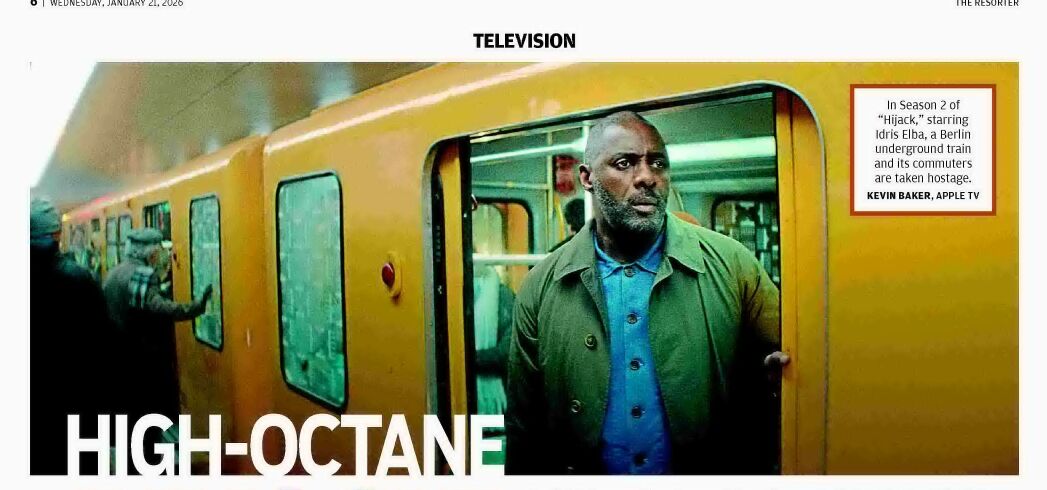
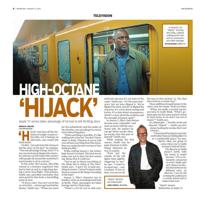
In Season 2 of "Hijack," starring Idris Elba, a Berlin underground train and its commuters are taken hostage.
TELEVISION
'Hijack" may have all the elements of a high-octane action film, but it belongs on television, says creator Jim Field Smith.
On film, "you only have the chance to tell the story of the plot," he explains. "The real advantage of long-form TV is you can reach much deeper into character, and you can tell stories that connect with people all around the world that's much harder to do in a movie."
In the series' first season, Idris Elba starred as a business negotiator who had to find an end to a hijacking during a seven-hour flight. That premise, Smith says, provided constraints that were good for him from a storytelling point of view.
"It forces rules. You can't cut to this or cut to that … and you get much better drama," Smith says. "When you reach for the authenticity and the reality of the situation, you actually get to a much more interesting place.
"When anything is possible, it's like walking into a free bar. You don't know what to drink. Whereas if you're told you can have one thing from this menu, then you make the best version of that drink possible."
While crafting Season 1, the writers kept Season 2 in mind. The trick was to make sure not to deny the first season any drama that it could use.
"You've got to throw everything at the thing you're doing at the time," Smith says. "I don't try to hold anything in reserve. I'm just trying to make the best version of the thing I'm making at the time."
Season 2, Elba's character has to handle a crisis on an underground train in Berlin. There, passengers are taken hostage and he's their hope.
"There's a lot for you to sink your teeth into because it's not more of the same," Smith says. "It's the same character, but we have flipped it. We've flipped the show, and we've flipped the character. It's a story about revenge and justice. It's a story about consequences. And it's a story about the resilience and the strength of human spirit."
In Season 1, Elba's Sam Nelson became more vulnerable "and more in touch with his emotional side. He realizes he can get better results when he reaches into that part of himself," Smith says.
While making the first season, Smith says he paid attention to little things whenever he was on a plane.
"Even just the sounds of the call lights were slightly triggering to me," he says. "I tried to be observant … and I realized, 'If you sit here, you can see all the way to that section' or 'Oh, that door locks in a certain way.'"
Those additions brought power to the series; now, he's hyper-aware on trains.
"When you make a second season, you have to really think, 'What's going to give me the same amount of fuel in story terms so we don't run out of steam?'" Smith says.
As a filmmaker — he both wrote and directed "Hijack" — Smith says he's always looking for an idea that's not a breeze.
"I find myself having to reach for stuff rather than just feeling like I'm in a comfortable place," he says. "Better ideas are going to come when you're really having to look for them."
The director in Smith doesn't battle with the writer in Smith because "I'm so intimately connected to every single part of it, there is no distinction between my diff erent roles. As director, I see my job as being the audience to a certain extent and to make it feel real."
"Hijack" streams Wednesdays on Apple TV.