

PROUDLY PATRIOTIC
Sheila Bridges' new collection for Walmart is inspired by Independence Hall, the Ben Franklin Bridge and West Philly cookouts

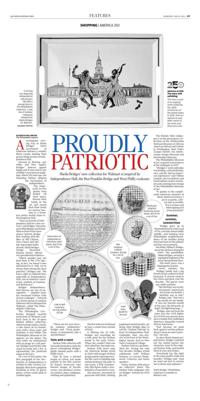
A serving tray depicting Independence Hall dancers ($12.88) is among items in The Philadelphia Collection, a new line of outdoor tableware designed by Sheila Bridges for Walmart.

Sheila Bridges

Declaration of Independence melamine salad plates, $14.76 for a set of four

Liberty Bell melamine serving platter, $12.88

Multicolor gingham melamine dinner plates, $19.76 for a set of four


Red Gingham Lowball Tumblers, $12.88 for a set of four

Oven mitts, $6.88 for the pair

SHOPPING| AMERICA 250
A rectangular serving tray in Sheila Bridges' latest assortment of tableware features a swanky Black couple shaking their groove things in front of Independence Hall.
Dressed in flowing, red, white and blue regalia, Bridges' dancers appear happy and at ease next to one of Philly's most historic buildings, where 250 years ago, the Founding Fathers adopted the Declaration of Independence.
The Americans on this platter have kicked off their shoes, thrown their hands in the air and reared back their heads in a joyous twostep as a boom box rattles beside them to the imaginary beat.
"They are in front of Independence Hall for a few reasons," said Bridges, who grew up in Philadelphia and found fame as head of her eponymous interior design firm working with the likes of Bill Clinton, Tom Clancy and late hip-hop mogul Andre Harrell. Sheila Bridges Design decorated Kamala Harris' official Kamala Harris' official vice presidential residence.
"(Black people) may not have been at the 1776 signing. In fact, we weren't even mentioned in it. Still, we've always been among the most patriotic," Bridges said. "We have a right to celebrate that, especially at Independence Hall, one of America's most iconic symbols of freedom and democracy."
Bridges' Independence Hall dancers are one of six vignettes — adopted from her renowned Harlem Toile de Jouy wallpaper — featured in a festive group of outdoor tableware she has designed for Walmart, called The Philadelphia Collection.
The Philadelphia Collection dropped recently exclusively on Walmart.com. Each item in the 14-piece limited edition collection, which includes plates, bowls, a cake stand, an ice bucket, oven mitts, place mats and tumblers, is very Philly: The Philadelphia Museum of Art appears on the plates; the oven mitts are emblazoned with an image of a soft pretzel. (Bridges insisted the salty snack be made into a No. 8, representing the preferred shape in the city.)
On a set of four plates, the first paragraph of the Declaration of Independence is written in 18th-century calligraphy. Most have a gingham backdrop in hues of grassy green, cotton candy pink or candied apple.
"These are for your favorite summer celebration," Bridges said. "From graduations, to Juneteenth, July 4 and birthdays."
Toile with a twist
Harlem Toile collectors will be beside themselves with the pieces reimagining Bridges' idyllic Harlem prints with a Philly touch.
Toile de Jouy, a printed length of cotton, was made popular in the 18th century by French aristocrats who fancied images of bucolic scenes and mythical stories on curtains, linen, wallpaper, clothing and upholstery.
The first toile was fashioned in Jouy, a small town outside of Paris.
A lifelong fan of toile, Bridges was searching for a toile print for her Harlem abode in the early 2000s. When she couldn't find one that suited her, she made one.
Harlem Toile burst onto the American design world in 2006 with images of Black people quietly enjoying everyday life, such as jumping rope and picnicking in the park. In one scene, a Wilt Chamberlain-like figure dunks a basketball to a hoop tied to a tree.
The dancers, presented in grayscale with their clothing popping in muted pastels, are doing what Bridges likes to call the "Harlem Toile jig" in front of Independence Hall. Originally, they cha-chacha-ed in front of the Washington Square Arch in New York's Greenwich Village.
Harlem Toile was an immediate hit. During the next two decades, Bridges would collaborate with William Sonoma, Le Creuset, Wedgwood, Converse and Sonos speakers.
Today, Harlem Toile pieces are collectors' items. The Harlem Toile wallpaper sells on Bridges' website for $350 per roll.
The Harlem Toile wallpaper is in the permanent collections of the Smithsonian National Museum of African American History and Culture in Washington, New York's Cooper Hewitt, the Smithsonian Design Museum and the Brooklyn Museum.
The Philadelphia Museum of Art acquired several pieces of the wallpaper in 2023.
"(Bridges') work embodies storytelling, cultural identity, race, and the African American experience," said Tiffany Lambert, the Lisa Roberts and David Seltzer curator of modern and contemporary design at the Philadelphia Museum of Art.
"It speaks to the complicated American narrative of
Black American history. I see it as poetic, critical and accessible. It is as serious and interrogating as it is fun and joyful."
Summer, summer, summertime
Bridges grew up in Wynnefield in the 1960s and 1970s, a racially mixed solidly middle-and working-class Philadelphia neighborhood. Many of the families living there had been in the military and they were patriotic.
Her father, Sidney R. Bridges, was in the Air Force during the 1950s. Her grandfather, Sidney Bridges, served in a segregated regiment of the Army during World War I.
Her mom, Joyce, was a kindergarten teacher.
Every summer, the Bridges family had a big Fourth of July cookout in their backyard. It started small in the 1960s and grew over the decades. The guests wore red, white and blue.
"My birthday was in July, my parents' anniversary was in July, my brother's birthday was in July,"
Bridges said. "July was a big month for my family.
It was my favorite month of the year: the fireworks at night; the lightning bugs…"
Bridges, who was born the same year the Civil Rights Act of 1964 was passed, grew up in a family that challenged America's inequality toward African Americans.
"Just because we push back against certain policies doesn't mean we aren't patriotic," she said.
To show Black Americans' patriotism, Bridges switched out the muted pastels her characters wore in the original Harlem Toile, and decked them in stars and stripes.
"Everybody has the right to the same quality of life and benefits," Bridges said. "And we want not just to survive but to thrive and celebrate."
Sheila Bridges' Philadelphia Collection is available on Walmart.com.
America at 250: The story still unfolding
This story is part of an ongoing series exploring the 250th anniversary of the United States in 2026. Visit our website to read other stories in the series and share your own.