
Bag & tag
End of an era? Hermes' famed Birkin losing its scarcity-driven appeal

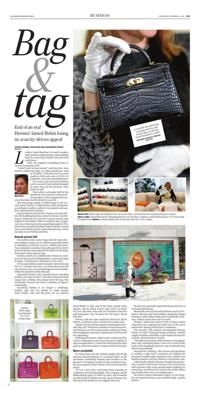
Hermes Birkin bags are displayed Oct. 19 at London Bear.

A woman walks past an Hermes shop Oct. 19 in London.

Antoinette Hunter, Managing Director of Lilac Blue, unboxes a 2025 Birkin bag Oct. 19 in the shade of peppermint.

Birkin bags are displayed Oct. 19 at Lilac Blue, a private Hermes resale boutique in London.

A crocodile-skin Birkin bag is among items for sale at Lilac Blue, an Hermes resale boutique in London.
London-based Baochun Cai used to make a hefty profit reselling Hermes' famed Birkin bags for more than double their $10,000 retail price.
Now, he stopped stockpiling them as second-hand prices fall.
"I don't want to lose money," said Baochun, who started selling the bags on online platforms such as Vestiaire Collective and on social media in 2020 and rode a COVID-19 pandemic-era luxury spending boom.
The resale value of unworn Birkins sold as second-hand online dropped by more than $6,000 from its 2022 peak, he said.
That reflects a broader shift in the market for one of luxury's most exclusive products, whose appeal and success have been mostly driven by scarcity.
The increasing supply of Birkin bags in the second-hand market is depressing resale premiums, according to resellers, industry consultants and analysts interviewed by Reuters.
Named after the late British-French actor Jane Birkin, the handbag has been central to Hermes' performance. Between 2015 and 2025, group annual sales tripled to $18 billion while its market value surged. Last year, Hermes posted an operating margin of 41%, above that of rivals including Chanel, Kering-owned Gucci and LVMH's leather and fashion division, which includes Louis Vuitton and Dior.
Resale prices fall
Six resellers who source bags directly from Hermes shoppers said access to a Birkin is generally linked to spending on Hermes scarves, clothes and shoes. Two estimated customers typically spend $10,000 to $20,000 before being off ered the Birkin or the Kelly, the brand's other popular bag.
Hermes, which says a Birkin takes 15 hours to craft, does not disclose its selling policies or how many bags it makes. It declined to comment for this story.
Of the nine Birkin resellers Reuters interviewed in the U.S., Europe and Asia, six said resale prices fell over the past year as more handbags became available, while five reported softer demand.
Antoinette Hunter, who founded luxury handbag reseller Lilac Blue in 2007, said when she got the first request for a Birkin, few people knew the bag. She eventually sourced one from a member of Japan's royal family.
Acquiring Birkins is no longer a challenge, Hunter said, but it's harder to make money from resales. She said the price for an unworn black Birkin 25 bag, one of the most sought-after models, fell by about $5,336 since 2022, to about $32,160. Baochun, who sells via Vestiaire Collective and Instagram, says his price for the bag is about $26,800.
Hermes sells the same model for about $12,582 in Britain, an Hermes sales assistant in London said.
Hunter said she still sees plenty of demand for Hermès bags, but "If Hermes continues to raise the prices, and the prices on the resale market continue to drop, that margin gets squeezed, and perhaps it will become less appealing."
Brokerage Bernstein, which tracks auction results, said in a September note the resale price on Birkin 25 bags averaged about 1.7 times the retail tag in the third quarter, down from about 2.6 times at their 2022 peak.
More available
For more than a decade, limited supply and strong demand allowed Birkins to command hefty resale premiums, benefiting Hermes and resellers as the prospects of making a profit via the secondary market encouraged Hermes clients to buy more from the brand.
"It was a win-win," said Sarah Davis, founder of California-based Fashionphile. The company said its Birkin listings grew 32-fold in 15 years, and it website recently listed 212 Birkins for sale. Davis said prices for the bag on the platform rose slightly this year.
Hermes has gradually expanded the production of its handcrafted items.
Meanwhile, the rise of resale platforms such as Vestiaire Collective and The RealReal, alongside vintage boutiques with online shops and social media channels, made it easier than ever to resell.
Hermes' shares lost almost 40% of their market value this year, making the brand one of the worst performers among listed luxury companies.
This month, UBS analysts downgraded Hermes shares to "sell," saying growing secondary-market supply of Birkins and Kellys could weaken the brand's scarcity-driven business model.
"We believe the nature of the business is changing," they said, estimating there's now six to seven times more of the handbags listed for sale worldwide than before the pandemic.
Demand for clothing, silk scarves and perfumes is cooling, a sign fewer customers are making the purchases traditionally required to buy a Birkin, two equities analysts and two industry consultants said.
Asked in July whether Hermes should slow production to protect the brand, Hermes CEO Axel Dumas told reporters that some people feared making too many bags would hurt its exclusivity, while others questioned why it was not making more.
He noted output depended largely on the number of trained artisans and available high-quality leather.