This content is unavailable. Please contact customer service for more information.
Already a subscriber? Login or Activate your account.
You've reached the end of the standard E-Edition.
This content is unavailable. Please contact customer service for more information.
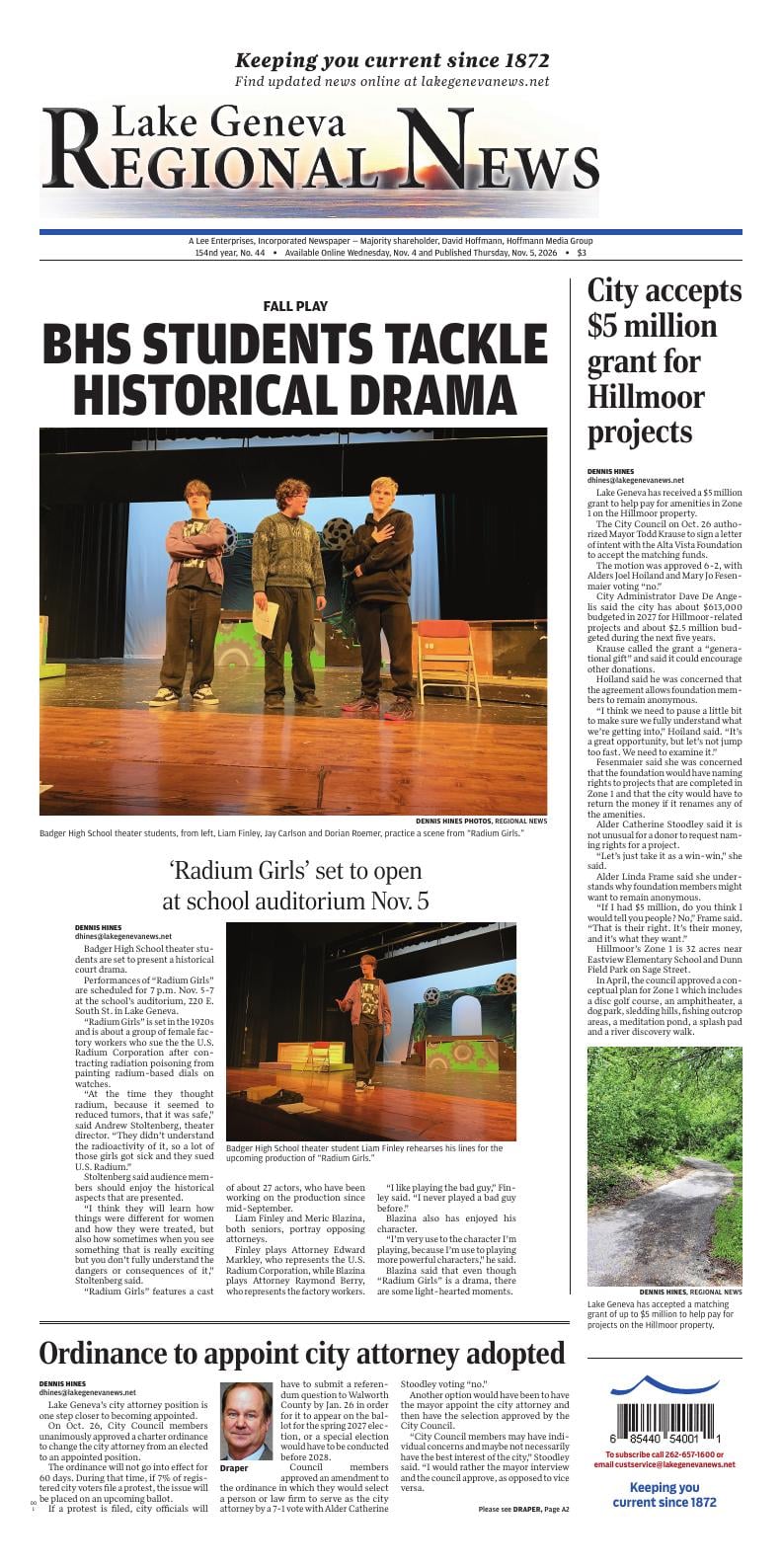
Ordinance to appoint city attorney adopted
DENNIS HINES
Draper
Lake Geneva's city attorney position is one step closer to becoming appointed.
On Oct. 26, City Council members unanimously approved a charter ordinance to change the city attorney from an elected to an appointed position.
The ordinance will not go into effect for 60 days. During that time, if 7% of registered city voters file a protest, the issue will be placed on an upcoming ballot.
If a protest is filed, city officials will have to submit a referendum question to Walworth County by Jan. 26 in order for it to appear on the ballot for the spring 2027 election, or a special election would have to be conducted before 2028.
Council members approved an amendment to the ordinance in which they would select a person or law firm to serve as the city attorney by a 7-1 vote with Alder Catherine Stoodley voting "no."
Another option would have been to have the mayor appoint the city attorney and then have the selection approved by the City Council.
"City Council members may have individual concerns and maybe not necessarily have the best interest of the city," Stoodley said. "I would rather the mayor interview and the council approve, as opposed to vice versa.
Lake Geneva's city attorney has been an elected position since 1994, serving two-year terms.
City Attorney Dan Draper, who has served for about 18 years, has indicated that he will not seek re-election when his term expires in April 2028.
Lake Geneva is one of seven Wisconsin communities that has an elected city attorney.
In other business, the council:
■ Approved a public event permit filed by Downtown Lake Geneva Inc. for the Business Improvement District Fall Wine Walk, located at various downtown businesses, for Nov. 1.
■ Approved a temporary “Class B” wine liquor license filed by Downtown Lake Geneva Inc. for the Fall Wine Walk, from 11 a.m. to 4 p.m. Nov. 1.
■ Approved a temporary “Class B” wine liquor license filed by the Geneva Lake Arts Foundation Inc. for an open house event, from 5-7 p.m. Nov. 13.
■ Approved an ordinance to have all City Council standing committee meetings televised and livestreamed.
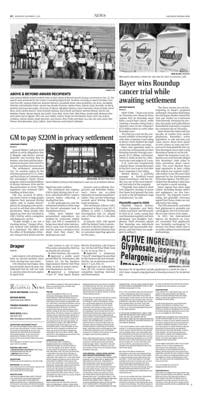
ABOVE & BEYOND AWARD RECIPIENTS
Lake Geneva Middle School students hold up their Above & Beyond
awards during a ceremony on Oct. 15. The awards were presented by
the school’s Counseling Department. Students receiving an award
included, front row from left, Audasia Pedersen, Braelynn Romero,
Annabelle Dame, Alexa Krakofsky, Lily Artus, Annabelle Fleischer
and Gabriella Fisher; second row, Brooke O’Connor, Adalyn Perez,
Dakota Lloyd, Ava Kolb, Ivy Rorig Gerblick and Grace Burroughs;
third row, Eli Myron, Mhaddyx Domino, Gavin Townsend, Ethan
Orlando, Keren Nicia, Arely Garfias-Huerta, Tania Ordonez-Vazquez,
Elora Hundt and Naomi Sanchez Roman; fourth row, Matthew Theyer,
Waylan Hewitt, Koa Smith, Jonas Wall, Vivian Volm, Mila Pekny,
Amelia Kolb, McKenna Rice and Camilo Garcia Aguilar; fifth row,
Jace Valdez, Audrey Torgerson and Delaney Dyon; sixth row, Aubrey
Lindberg, Colston Heaton, Bode Dammeir, Jace Graves, Rhys Finley
and Dylan Lux; top row, Lena Leach, Ben Pilman, Alex Meverden,
Alaric Gilbert, Zoey Patterson and Graham Callender.
SUBMITTED
GM to pay $220M in privacy settlement
JONATHAN STEMPEL Reuters
General Motors Entrance One showroom is seen Jan. 16 at
Hudson's Detroit.
JUSTIN WAN, DETROIT FREE PRESS
General Motors will pay $220 million to settle allegations that it illegally sold drivers' private behavior and location data to brokers, who then sold the information to insurers that used it to set and sometimes increase rates.
The settlement, announced Oct. 29, resolves claims by the attorneys general of 35 U.S. states and the District of Columbia over the automaker's Smart Driver program, which enrolled millions of drivers between 2016 and its discontinuation in 2024. Other regulators also reviewed GM's handling of driver data.
GM was accused of pitching Smart Driver to help people improve their personal driving safety, only to violate drivers' privacy by reneging on its promise not to sell their data without permission. Many people who signed up were also enrolled in GM's OnStar safety, navigation and diagnostic service.
"People bought a car, not a tracking device," Oregon Attorney General Dan Rayfield said in a statement. His office and the office of Washington Attorney General Nick Brown led the bipartisan state coalition.
The settlement also requires GM to limit driving data it collects, and obtain drivers' express consent before collecting or sharing that data.
A GM spokesperson said the settlement reinforces other steps the Detroit automaker took to strengthen privacy.
"Safer, more helpful and personalized experiences are enabled by connected vehicle data, and GM is committed to being clear about what information is used, how it's protected, and the choices customers have about what they share," the spokesperson said.
Insurers such as Allstate, Progressive and Berkshire Hathaway's Geico use so-called telematics in monitoring drivers' habits. They say the technology rewards g ood driving through lower premiums.
The settlement follows GM's agreement in May to pay $12.75 million to settle a California investigation into its alleged sale of driver data to two data brokers.
In January 2025, GM agreed with the Federal Trade Commission not to disclose vehicle geolocation and driver behavior data to consumer reporting agencies for five years.
Bayer wins Roundup cancer trial while awaiting settlement
DIETRICH KNAUTHReuters
Roundup's list of ingredients includes glyphosate on a
bottle for sale in 2022. Bayer stopped using glyphosate in Roundup
products for residential use.
ANDREW KELLY, REUTERS
Monsanto's Roundup is shown for sale June 26, 2017, in
Encinitas, Calif.
MIKE BLAKE, REUTERS
NEW YORK — Bayer won a trial on Thursday over claims by three women that its Roundup weed killer caused their cancer, while awaiting a broader ruling from a separate court on the company's $7.25 billion effort to settle other Roundup cases.
The trial was a test for the continued viability of Roundup lawsuits after a Supreme Court ruling in Bayer's favor limited the legal claims that plaintiffs can bring.
Bayer also separately seeks to resolve tens of thousands of other Roundup lawsuits through a proposed $7.25 billion settlement, which is under review by a Missouri state court judge in St. Louis.
A St. Louis jury unanimously ruled for Bayer-owned Monsanto in the first case to go to trial after June's Supreme Court ruling.
Markus Manns, a portfolio manager at Frankfurt-based Union Investment, said the verdict was one of the most important trial wins for the company.
"Plaintiffs have failed in their new litigation strategy to prove that Bayer had ignored the risks as early as the development stage of glyphosate," he said.
Plaintiffs sued in 2020
Plaintiffs Theresa Aretino, Cynthia Fernandez and Betty Larkin sued Bayer unit Monsanto in 2020 in St. Louis, saying they used Roundup regularly and later developed non-Hodgkin lymphoma. Their attorneys argued that Roundup was defectively designed and unreasonably dangerous, and that Bayer was negligent in selling it.
The three women are not participating in Bayer's proposed settlement. Fernandez died before the trial began. Reuters viewed the trial and verdict on Courtroom View Network. Attorneys for Aretino, Fernandez and Larkin did not immediately respond to a request for comment late on Thursday.
Bayer denies t he claims and says decades of studies have shown glyphosate, Roundup's active ingredient, is safe and does not cause cancer. Bayer faces about 65,000 claims in state and federal courts from Plaintiffs who say they d eveloped cancer after using Roundup at home or on the job.
Before the Supreme Court ruling this year, most lawsuits alleged that Roundup's label failed to warn consumers about cancer risks. The court blocked those legal arguments in June, ruling that federal law requires herbicide makers to use t he exact label approved by the Environmental Protection Agency. The EPA concluded that Roundup's label does not require a cancer warning.
Bayer argued that other legal claims, including design-defect and negligence, are also foreclosed by the Supreme Court's ruling, but Plaintiffs' attorneys argued that those claims are not affected by the ruling.
The EPA previously concluded that glyphosate is probably not carcinogenic, but it is in the middle of a new review of its safety.
In 2015, the International Agency for Research on Cancer concluded that glyphosate was "probably carcinogenic" to humans, but Bayer claims that is an outlier opinion based on flawed methodology.
Click and hold your mouse button on the page to select the area you wish to save or print.
You can click and drag the clipping box to move it or click and drag in the bottom right corner to resize it.
When you're happy with your selection, click the checkmark icon next to the clipping area to continue.