

DOWN BUT NOT OUT
A year after glacier collapsed, residents rebuild lives in Alps

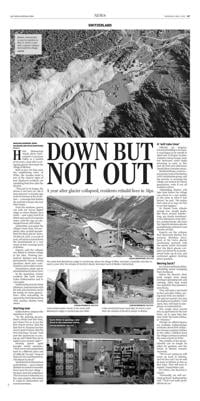
Blatten, Switzerland, is seen by satellite on May 21, nearly a year after a glacier collapse destroyed the village.

The newly built Momentum Lodge in Lauchernalp, above the village of Wiler, overlooks a landslide area May 21, nearly a year after the collapse of the Birch Glacier destroyed much of Blatten, Switzerland.
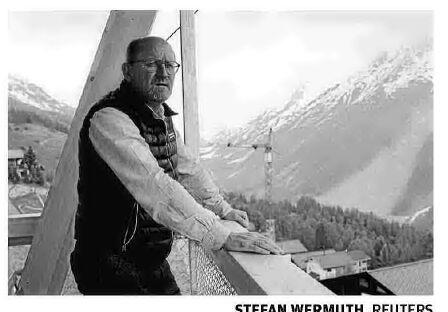
Lukas Kalbermatten stands at the newly built Momentum Lodge in Lauchernalp near Wiler.
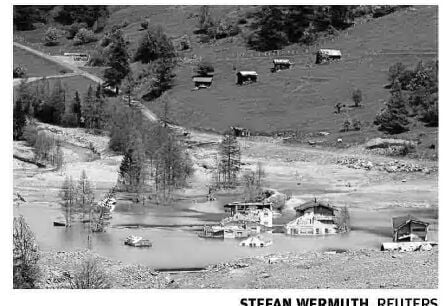
A few remaining houses stand May 20 nearly a year after the collapse of the Birch Glacier in Blatten.

Karin Ritler is opening a new hotel in the Loetschen Valley.
SWITZERLAND
Hotel Momentum stands above Switzerland's Loetschen Valley as a symbol of recovery, a year after a collapsing glacier destroyed the village of Blatten.
Built in just 105 days near the neighboring town of Wiler, the wooden hotel is one of the clearest signs of how displaced residents are rebuilding their lives after the disaster.
"The past is no longer, the future is not here yet, life is here and now," a wooden sign reads in German at the reception — a message that defines the outlook of many who lost their homes.
From the windows, guests can look out across jagged ridges to where Blatten once stood — now a gray stretch of debris and a pool of turquoise water, with the tops of submerged houses still visible.
Authorities evacuated the village's more than 300 residents after rockfall destabilized the Birch glacier above. On May 28, 2025, a cascade of rock, soil and ice roared down the mountainside in a vast cloud of dust, burying much of Blatten.
Experts said the collapse was linked to climate change in the Alps. Thawing permafrost weakens rock once permanently frozen, raising questions about how communities can be safely revived.
Nevertheless, plans aim to rebuild Blatten by about 2030.
In the meantime, former residents like hotel owner Lukas Kalbermatten had to start again.
Kalbermatten lost the Hotel Edelweiss, both his home with his wife and a business run by his family for three generations. After evacuating, he opened the Hotel Momentum with another Blatten hotel owner.
Starting over
Kalbermatten compares the experience to grief. "In the grieving process, there's always that first time, isn't there? For us, it was the first church service, then the kids' first St. Nicholas Day that wasn't spent at home, then the first Christmas," he said. "And now this anniversary is coming up, and I think then we've made it once around, right?"
Hosting guests again brought mixed emotions. "Now you're welcoming them back in a different place and it's difficult," he said. "Some of them are very sad themselves, still almost in shock."
Small details in Momentum nod to Blatten — such as throw blankets recreated to resemble those from the lost village — but parts were left unfinished. The structure is intended as a five-year solution, after which it could be dismantled and reused elsewhere.
It 'will take time'
Officials say progress toward rebuilding is on track. A road began to be rebuilt in April and, if all goes to plan, residents whose homes were not destroyed could begin returning as early as this year. By 2029, key milestones should allow a broader return.
Manfred Ebener, construction project lead of the Blatten 2030 coordination group, said the priority is ensuring the village can endure for future generations, even if not all residents return.
"Rebuilding Blatten will take time before the village can return to a size similar or the same as what it was before," he said. "We realize that some of us may not live to see that happen."
As threats from climate change rise, nearby peaks, like those around Kandersteg, are closely monitored. A few kilometers from Blatten, isolated break-offs from the Oigschtchummun glacier prompted precautionary road closures in May.
Experts say the collapse that destroyed Blatten was unusual. Matthias Huss, head of the Swiss glacier monitoring network, told the media outlet Swissinfo that the Birch glacier collapse was driven by an exceptional build-up of rock, and cautioned against drawing direct parallels.
Moving back?
For Daniel and Karin Ritler, rebuilding meant reshaping their livelihood.
Before the disaster, their work ranged from sheep farming to glamping tents and catering. After their world was upended, they planned a new future.
They will open a new hotel in the Loetschen Valley, saying more beds are needed — not only for tourists, but also for displaced residents. Until April, they still lived in temporary accommodation.
The couple since moved into an apartment in the new hotel, set to open later this year under the name Zeitlos, or "timeless."
Though no official figures are available, Kalbermatten estimates about 80% of Blatten's former residents still live in the valley. Children from the village continue to attend the same schools in Wiler.
The stability of the mountainside can no longer be taken for granted, and the future of Blatten remains uncertain.
"We're not saying we will never go back to Blatten, and we also can't say we will be back in Blatten at this or that time. That will have to unfold," Daniel Ritler said.
For others, the decision is clearer.
"Personally, we will certainly go back," Kalbermatten said. "That's not really up for debate for us."