

Retail robots
Stores are buying them in record numbers, but human jobs still safe
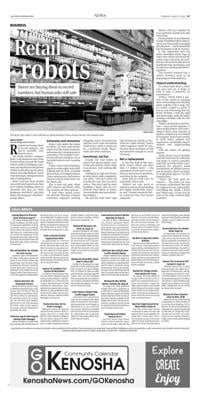
This Brain Corp robot is more efficient at taking inventory than a human worker, the company says.
BUSINESS
Retailers are buying robots in record numbers, and you've probably seen them in stores. San Diego robotics company
Brain Corp deployed more than 50,000 robots around the world with its artificial intelligence software and reported record growth of 68% in sales this year. Its robots work in stores like Walmart, Sam's Club and Target, taking inventory and scrubbing floors.
Brain Corp has been around since 2009 and raised more than $220 million building robots to automate jobs that are "dull, dangerous and dirty," said John Black, the company's chief technology officer.
Autonomy and monotony
Brain Corp builds the brains in robots. Its most well-known robots look like small Zambonis, autonomously cleaning grocery store aisles. The company's newest bot software automizes one of the dullest jobs in retail: counting boxes.
Today, some retail employees spend an entire eight-hour shift walking aisle by aisle, scanning item by item, counting inventory. Those monotonous and tedious tasks are exactly what robots are for, Black said.
The 6-foot-tall pole, fitted with cameras and wheels, often does a better job than a person.
A viral video spread across the internet showing a human warehouse employee working alongside a robot. The livestream captures every time the human clocks in for a shift or clocks out for a bathroom break. Meanwhile, the robot continues.
Functional, not fun
Despite the viral videos of robots that spread online, most of the autonomous robots Brain Corp powers look nothing like people.
Adding faces, legs and dozens of extra joints adds complexity, not value. "The best robots are actually the ones that you don't notice. They don't get the most headlines," Black said. He referenced viral videos of robots uncontrollably dancing and kicking children.
He said the viral robot clips that look fun on TikTok or YouTube are "super sketchy" from a safety engineer's point of view, because these machines are big and powerful enough to cause real harm.
Not a replacement
In the first half of this year, Brain Corp's robots ran more than 5.3 million hours — the equivalent of 600 years of continuous autonomous operation, according to the company.
Some jobs in retail can't be automated, Black said.
"Robots are very good at repetitive, physically demanding and highly predictable tasks," he said. "People remain far better suited for roles that involve judgment."
Robots still can't reliably do even relatively menial tasks like restocking.
Black pointed to an infamous Google DeepMind clip in which a robot was tasked with restocking the chip aisle — and it looked like the Terminator took on Tostitos.
It was impressive how the robot identified which bags of chips were which and found the correct place and price for each. But the robot had no idea how to handle the bags themselves, and it ended up crushing and throwing them.
The recently released Gen 2 robots, however, seem to be improving on their dexterity.
Toward understanding
To understand what a robot can and can't do, it helps to look at how it perceives its environment.
Today's robots build a picture of the world by scanning their surroundings and stitching pixels together into a map. But to a robot, a pixel is a pixel. It has no way of knowing that the pixels forming a wall are rigid and immovable, while the pixels forming a birthday cake are soft and edible.
Weight, permanence and texture — none of that registers. A robot simply detects that something is there, then matches it against categories it was trained to recognize. Brain Corp's robots in retail stores, airports and warehouses can identify objects without ever understanding them.
Still, the robots are getting smarter.
Today, Brain Corp is working with the University of California, San Diego, to create a semantic map that can help robots comprehend the physical world around them. By adding cameras and AI models, robots can begin to understand objects, not just identify them.
"That's the holy grail for robotics — the robot just sees an image, understands the task it's supposed to do, and handles everything else inside a black box," Black said. "I'd say 10 to 20 years to be really commercially available."