

Election pressure
Officials fear more bids to assert control over November's midterms

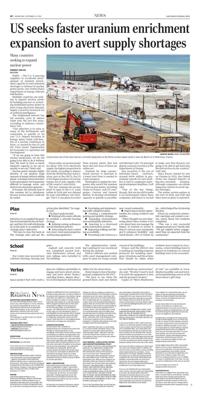
Attorney General Todd blanche holds a news conference sept. 15 in the rose Garden at the White House in Washington.

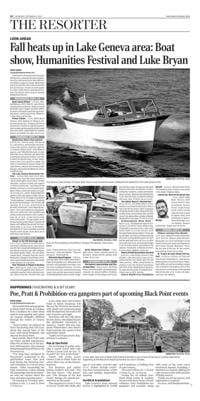
Poll workers, right, assist with voter registration Aug. 11 at the Brookfield Central High school polling station in Brookfield, Wis., during primaries.

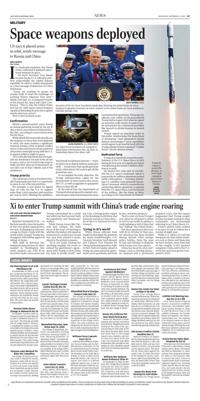
President Donald trump delivers closing remarks sept. 10 at the republican national midterm Convention in Dallas, Texas.

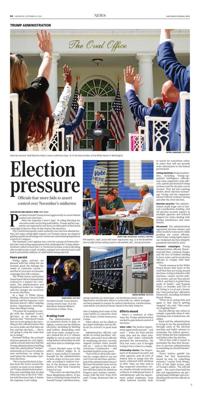
Voting machines are stored sept. 2 at the Bartow County Voter registration and elections offices in Cartersville, Ga., where strategies are being adopted to prepare for political interference, misinformation, cyberattacks and physical threats ahead of the 2026 midterms.
TRUMP ADMINISTRATION
President Donald Trump moved aggressively to assert federal control over elections. After the Supreme Court's Sept. 14 ruling blocking his executive order restricting mail ballots, Trump and his sup-porters are expected to now focus on other parts of that broad campaign in the less than 50 days before the elections.
The Constitution grants states authority over election administration, but some voting rights experts say Trump's moves are aimed at gaining a political advantage over Democrats and retaining Republican control of Congress.
The Supreme Court opinion was a win for a group of Democratic led states and voting organizations that challenged the Trump administration's effort to have the U.S. Postal Service play a role in deciding who would receive a mail-in ballot, saying it was untested and could lead to potentially millions of valid ballots being rejected.
Fears persist
Voting rights activists are pleased with the ruling but are worried about the damage the weeks of confusion caused — and that it's just part of a broader campaign that will continue.
The White House and Justice Department did not immediately respond to a request for comment. The administration and Republican leaders in Congress said the changes are necessary to secure elections.
At a Sept. 15 White House briefing, Attorney General Todd Blanche said the Supreme Court decision doesn't affect ongoing Justice Department investigations into illegal voting.
"Of course we're going to comply with the Supreme Court's decision, as we always do," Blanche said. "That doesn't mean that we're not going to do everything in this administration that we can to make sure that there are free and fair elections. … We're not going to stop the work that we're doing."
Harmeet Dhillon, the assistant attorney general for civil rights, said in a recent interview that the Trump administration is battling what she called judicial "lawfare" nationwide as it races to enforce new restrictions on voting by mail before the November midterm elections.
"We're facing this kind of lawfare from the courts around the country on many of our important Trump administration priorities and something that we deal with every day at the DOJ," Dhillon told Newsmax Sept. 8, before the Supreme Court ruling.
Eroding trust
The administration pushed on numerous fronts to gain, or tighten, control over the midterm elections, including by limiting mail ballots, demanding voter rolls from states, trying to create a federal list of U.S. citizens eligible to vote in each state and using federal citizenship records and other data to challenge voter rolls.
Courts blocked some of the efforts. Federal judges in at least 11 states halted 23 lawsuits brought by the administration to force states to turn over voter rolls, according to Andrew Garber of the Brennan Center for Justice at New York University School of Law.
"The courts are rejecting all of these illegitimate efforts. It has been a stunning losing streak for Donald Trump," said Norm Eisen, who is helping lead some of the court battles as executive chair of the States United Democracy Center.
Other efforts are less likely to face legal challenges and are difficult for activists to push back on.
Administration officials cast doubt on voting machines' reliability, pressured local officials by weakening election-security support systems states usually rely on — such as the Election Assistance Commission — and installed loyalists in key posts.
"Part of this is obviously a pretext for a larger effort to say you can't trust our elections, particularly if the administration doesn't like how November turns out for them," said Ben Hovland, a fellow with the Center for American Progress and a former commissioner with the EAC from 2019 until Trump dismissed him in July.
Efforts mount
Here's a rundown of other ways the Trump administration worked to gain federal control of elections:
Voter rolls: The Justice Department aggressively pressed — and sued — states for their private voter data and for other data. While some states voluntarily provided the information, the DOJ lost every case it brought trying to force states to comply.
Citizenship checks: The Department of Homeland Security and other agencies seek all sorts of federal data to merge into the much-criticized SAVE database at DHS. They say they seek to flag suspected noncitizen voters, despite virtually no historical evidence of widespread fraud. A whistleblower said the department pulled employees from other national security tasks to search for noncitizen voters in states that will not provide voter information to the federal government.
Voting machines: Federal authorities, including Trump-appointed intelligence officials, and some supportive state officials, openly questioned if voting systems used for decades can be trusted. That fed into existing doubts about election technology Trump and his supporters fanned without evidence during and after the 2020 election.
Election security: The administration made huge cuts to federal coordination funding, laid off election security experts in multiple agencies and reduced support for states dealing with foreign interference and cyber threats.
Personnel: The administration appointed election deniers and other loyalists to key posts while pushing out career officials, which many voting rights experts say weakened election integrity guardrails that held in 2020.
Pressure campaigns: Trump administration officials threatened jail time, criminal charges and the loss of federal funding to force states and local election officials to comply with their efforts.
"Surely someone in the White House knows that most of the stuff that they are trying around elections, trying to interfere with elections, cannot survive judicial review, and yet they persist with it, and that is to plant these seeds of doubt," said Hannah Fried, co-founder and CEO of All Voting Is Local and a former top "voter protection" official for Democrats, including President Barack Obama.
"What we're seeing time and again is that they're getting stopped," she said. "The courts are stopping them."
Elected officials also refuse to comply, especially when it risks violating state or federal law, she added.
Fried said the administration is trying to lay the groundwork through some of the election machine and ballot seizures to normalize the federal government taking election equipment and ballots after the election.
"All of that stuff is meant to normalize the idea that disruption in election administration is something we should tolerate," she said.
"Every lawless gambit has failed, but that desperation means he may try something extreme," Lauren Groh-Wargo, CEO of Fair Fight Action, said of Trump's efforts. "He will fail again — the courts have held the line and organizations are preparing legal challenges and coordinating with election officials to be ready."