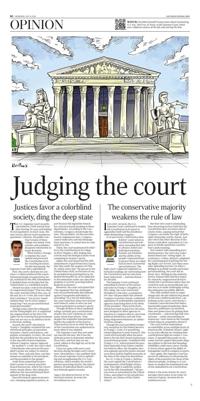

Judging the court
Justices favor a colorblind society, ding the deep state
CHRIS TALGO
The U.S. Supreme Court recently concluded its 236th annual term after hearing 74 cases and holding 58 oral arguments. In most cases, the nine justices did not reach unanimous agreement. Likewise, the public reaction to many of these rulings was mixed. Even scholars and academics disagreed vehemently on many decisions.
What matters, though, is whether the court upheld and preserved the Constitution in its far-reaching decisions. On this benchmark, the Supreme Court did a splendid job.
First, the court's decision in Louisiana v. Callais reinforced the constitutional principle of equal justice for all, enshrined in the 14th Amendment. It doubled down on the idea that the United States is a colorblind society.
Should race play a role in the drawing of congressional maps? That was what the court wrestled with in this case. In the end, by a 6-3 vote, the court ruled that Louisiana's "use of race-based redistricting" for its 2022 congressional map "was an unconstitutional racial gerrymander."
Though some claim this ruling gutted the Voting Rights Act, it supported the original intent of the 1965 civil rights law by ensuring that government does not use race as an arbitrary factor in decision-making.
Second, the court's decision in Trump v. Slaughter sustained the constitutional principles of separation of powers, checks and balances, and popular sovereignty. In short, the court held that the president has the power to fire executive branch employees without Congress' express approval.
By another 6-3 vote, the court ruled, "Subordinates who exercise the president's power are subject to removal by him. Then, and only then, can they remain accountable to the president, and the president to the people."
Aside from cementing the president's power to remove executive branch bureaucrats, which the Constitution clearly allows, this ruling also addresses the unconstitutional development of the deep state.
Executive branch agencies possess vast, sweeping regulatory powers, in part because the legislative branch has outsourced policymaking to these departments. According to the Constitution, Congress should make the laws. The president, via the executive branch, implements laws. Congress cannot make laws and micromanage their execution. It cannot have its cake and eat it, too.
Third, the court maintained its fidelity to the Constitution in its ruling in West Virginia v. BPJ, finding that schools may ban biological males from competing in women's sports.
Again, the court preserved the 14th Amendment's Equal Protection Clause, this time under the auspices of Title IX, which states that "No person in the United States shall, on the basis of sex, be excluded from participation in, be denied the benefits of, or be subjected to discrimination under any education program or activity receiving Federal financial assistance."
Moreover, the court articulated that "the argument that the challenged laws unconstitutionally discriminate against transgender individuals is unavailing." In a win for federalism, the court ruled that states have the last word when it comes to who can and cannot participate in women's sports.
Though all three of these landmark rulings certainly pass constitutional muster, the court continues to come under attack from leftists. They despise the originalist interpretations held by the majority of the justices. These justices focus on what the text of the Constitution was understood to mean when it was adopted.
The Supreme Court does not make nor execute the laws. But it has the ultimate power to determine whether those laws, and how they are executed, adhere to the high bar set by the Constitution.
I may not agree with every court decision during the high court's latest term. Nevertheless, I am confident that the current Supreme Court is upholding and strengthening the U.S. Constitution, which remains the world's greatest governing charter, the utmost defense of individual liberty and the best bulwark against tyranny.
Talgo is the editorial director at The Heartland Institute. He wrote this forInsidesources.com.
The conservative majority weakens the rule of law
DEVON OMBRES
In its 2025-26 term, the U.S. Supreme Court continued to weaken the Constitution in its quest to aggrandize itself and the presidency while diminishing Congress.
As in past terms, Chief Justice John Roberts' court relied on constitutional and statutory reasoning that fails to advance Americans' individual freedoms. Instead, our freedoms and the ability of the people's representatives to protect them are rolled back in favor of powerful special interests. The high court's supposed originalist or textualist readings are overturning how the Constitution and our laws have been understood — and functioned — for decades.
The Supreme Court continued expanding its theory of the unitary executive in Trump v. Slaughter. In this ruling, the court overturned Humphrey's Executor, a unanimous 90-year-old precedent that allowed Congress to protect Senate-confirmed appointees to multimember regulatory agencies from being fired at the whim of the president. These protections, which have been in place for 140 years, were designed to allow agencies to function as Congress directs, free from political interference and safe from being whipsawed whenever an administration changes.
Though the court provided a temporary exception for the Federal Reserve in Trump v. Cook, it is permitting related litigation to move forward. This could still eventually allow the president to fire the Fed's board of governors on pretextual grounds.Combined with Trump v. U.S., which granted the president immunity from crimes committed while in office, the Slaughter decision expands executive powers beyond even those held by English monarchs at the time of the American Revolution.
By a 6-3 vote in Trump v. Barbara, the court upheld the Constitution's enshrinement of birthright citizenship. This right is explicitly spelled out in the 14th Amendment: "All persons born or naturalized in the United States, and subject to the jurisdiction thereof, are citizens of the United States."
But that vote count is misleading. Four dissenting justices held that the Constitution does not mean what it clearly states, arguing instead that Congress can render the right of birthright citizenship void by statute. Just one vote in the other direction in the future could allow a president or Congress to wholly upend the Constitution's plain meaning.
Not content with expanding presidential powers, the court also undermined Americans' voting rights. In Louisiana v. Callais, Roberts completed his careerlong goal of gutting the Voting Rights Act of 1965. Just three years after upholding Section 2 in Allen v. Milligan to prohibit racially motivated gerrymandering, the court did an about-face. Writing for the majority, Justice Samuel Alito held that majority-minority congressional districts violate the Constitution unless they are created in such an extraordinarily narrow way as to make challenging voting discrimination incredibly difficult.
This shift enabled states to supercharge mid-decade redistricting ahead of this year's midterm elections, capitalizing on the court's 2019 Rucho v.Common Cause decision that immunized political gerrymandering. More than ever, politicians can entrench their own power bases by picking their constituents — and ensuring their own victories — rather than battling for Americans' votes based on the strength of their ideas in competitive districts.
The court further undermined accountability across multiple facets of American life. It limited citizens' right to sue state officials for violating their constitutional rights in Landor v. Louisiana. It upended thousands of consumer lawsuits against Monsanto alleging a failure to disclose that Roundup weedkiller could cause cancer. Finally, it struck a blow against the ability of transgender youth to compete in sports.
Once again, this Supreme Court has proven its adherence to advancing the rights of the powerful over those of the American people. In doing so, it continues to weaken the fundamental rule of law embedded in our Constitution.
Ombres is the senior director for courts and legal reform policy at the Center for American Progress. He wrote this for Insidesources.com.