

'No man left behind'
82 years later, D-Day soldier laid to rest in Nebraska

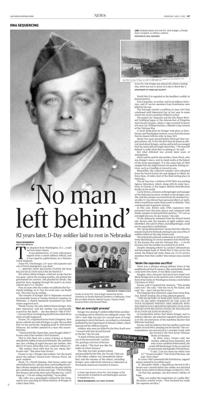
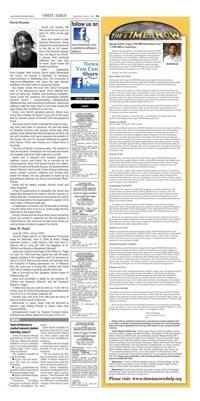
Left: undated photo of army Pvt. Orie Krieger, a Purple Heart recipient, in military uniform.

Army Pvt. Orie Krieger was aboard this infantry landing ship, which was lost in action on d-day in World War II.

Family of army Pvt. Orie Krieger attend the burial ceremony at Omaha national Cemetery in Nebraska. From left are Mark Panecki, Wendy Fasano, Thomas Ploch, Suzanne Ploch and Hannah Ploch.

A street sign honors army Pvt. Orie Krieger at the intersection of Hawthorne and Washington avenues in Hawthorne, N.J.
DNA SEQUENCING
The dispatch from Washington, D.C., could not have been clearer.
It was delivered Dec. 17, 1944, with utmost regards from a senior military official, and it was typed in capital letters on a Western Union telegram.
Army Pvt. Orie Krieger, a 33-year-old carpenter and son of Dutch immigrants, was dead.
"… REPORT NOW RECEIVED STATES HE WAS KILLED IN ACTION SIX JUNE IN FRANCE."
His widow, Marie Krieger, could not accept that he was gone, and in the ensuing months, she probed the government for answers. She pleaded for details. She pried for facts, begging through the mail to an Army colonel and a U.S. senator.
Now, 82 years after the soldier was killed in the Normandy landings on D-Day, his loved ones can finally rest. The story has its ending.
The remains of Krieger and 15 shipmates received an honorable burial at Omaha National Cemetery in Nebraska. A shared memorial monument has their names engraved on it.
Wendy Fasano, the only child of Marie Krieger, who later remarried, said her mother was emotionally scarred by the death — she described it "like PTSD" — because there was lingering doubt in her mind about what actually happened.
Fasano, 70, a registered nurse from Livingston, New Jersey, said she was told of Krieger as a girl. She recalled that on one particular shopping jaunt to downtown Paterson, her mother pointed to a man who resembled him.
"I kind of felt like I knew him, even though I didn't," Fasano said of her mother's first husband.
That is why there was a sense of peace as Fasano attended the military funeral in Nebraska. She said there was also a feeling of regret because her mother, who died at 90 years old in May 2011, could not witness it.
"My mother lived with that for her whole life," Fasano said. "She never had closure."
Fasano is not a Krieger descendant, but she heard about the military funeral from Thomas Ploch, his great-nephew.
Ploch, 70, a North Haledon, New Jersey, native and retired pharmacist, said questions surrounding the soldier's demise weighed on his family for decades until he got a random phone call nine years ago. "The first thing that the guy said on the other end of the line was, 'Don't hang up — I'm not selling anything,'" he recalled.
The caller was a genealogist retained by the Army, and he was searching for blood relatives of Krieger to collect their DNA.
'Not an overnight process'
Krieger was among 25 soldiers killed when an infantry landing craft in which he was riding hit a mine. The 158½-foot ship was part of a second wave of troops preparing to storm the beach, according to a statement published by the Department of Veterans Affairs, which announced the military funeral.
Soldiers who were not killed by the blast itself were "covered with fuel oil and burned in the fire," the VA said.
"A sheet of flame and steel shot out of the forward hold," said the VA, quoting a survivor of the horrific ordeal. "The heat was like the midst of a blast furnace."
The ship was later pushed ashore and grounded by the tide, the VA said. Only one of the fallen soldiers was immediately identified, and the remains of the others, including Krieger, were collectively interred as unknowns at Normandy American Cemetery in France.
World War II is regarded as the deadliest conflict in human history.
Paul Chepurko, an author and local military historian, said 47 service members from Hawthorne were killed in the war.
The borough started a tradition in June 2011 that continued until Memorial Day of last year to name streets for service members killed in action.
The project by Chepurko and the late Mayor Richard Goldberg began at the intersection of Kingston and Lincoln avenues, where a sign is posted in honor of Lance Cpl. William Dutches, a Marine Corps veteran of the Vietnam War.
A street dedication for Krieger took place at Hawthorne and Washington avenues, across from the home that he shared with his wife, in June 2015.
About two years passed before Ploch got that surprise phone call. It was the first time he heard an official word about Krieger, and he said he felt encouraged that the Army did not forget about him. "'No man left behind' is really what they're aiming at," he said.
But what followed was several more years of anticipation.
Ploch said he and his late mother, Doris Ploch, who was Krieger's niece, sent in cheek swabs at the behest of the Army genealogist. It is the same type of DNA sample that one might harvest for genetic testing services, such as 23andMe or Ancestry.com.
Meanwhile, the collective remains were exhumed from the French burial site and shipped to Offutt Air Force Base, 14 miles west of the final resting place in Nebraska.
The air base has a Defense POW/MIA Accounting Agency laboratory, which, along with its sister locations in Hawaii, is the largest skeletal identification facility in the world.
Carrie Brown, a forensic anthropologist and manager of the Nebraska location, worked on the Krieger case. She said the remains recovered from his doomed vessel after D-Day did not have personal effects or teeth, which would have made them easier to identify. They contained only fragments of bone.
In this case, Brown said, DNA sequences were extracted from the bone pieces and compared with family samples to find potential matches. "It's not an overnight process, by any means," she said.
Of the unknowns exhumed from the French burial site, Brown said, the remains of eight soldiers were identified. She said 16 others, including Krieger, could not be separated as individuals.
The "group determination" means that the collective remains buried in Nebraska belong to any one of the 25 soldiers killed on the ship, Brown said.
The federal lab achieved a milestone in 2025 by positively identifying 231 service members from World War II, the Korean War and the Vietnam War — a 34.3% increase over the number accounted for in 2024.
Despite sweeping efforts to conduct exhumations and investigate leads at World War II sites across the world, the federal lab states there are 71,732 service members from that conflict who remain unaccounted for.
'Made the supreme sacrifice'
There was a whisper among military wives in the neighborhood that if a hearse-like automobile should creep down the street, it was likely a bad omen.
Imagine, then, the panic that must have swept over Marie Krieger just as she spotted such a vehicle stop in front of her home on Washington Avenue a week before Christmas in 1944.
Fasano said it haunted her memory. "The people came out," she said, "and she ran in the house, and said, 'No — don't tell me this is true.'"
The telegram that afternoon came from Army Brig. Gen. Robert Dunlop, the acting adjutant general.
"THE SECRETARY OF WAR ASKS THAT I ASSURE YOU OF HIS DEEP SYMPATHY IN THE LOSS OF YOUR HUSBAND PRIVATE ORIE KRIEGER WHO WAS PREVIOUSLY REPORTED MISSING IN ACTION REPORT NOW RECEIVED STATES HE WAS KILLED IN ACTION SIX JUNE IN FRANCE."
In handwritten letters that Marie Krieger sent to military officials, she asked for repeated clarifications as to the circumstances of the maritime disaster that killed her husband.
Fasano said she believes that her mother wrote two copies of each letter, keeping one for herself. The correspondence was preserved in a wooden trunk until she moved to the New Jersey Veterans Home at Paramus.
In latter years, Fasano said, her mother suffered from dementia. But even as her condition deteriorated, she could still find Krieger in the second row of a panoramic photograph of his platoon.
"I said, 'Can you show me where Orie is?'" Fasano recalled. "Out of all of the men, she said, 'that's him'."
In a close-knit community like Hawthorne, support always seemed to be within reach.
H. Alexander Smith, a Republican elected to fill a Senate seat a month before the soldier was declared dead, wrote a letter to Marie Krieger on March 9, 1945.
On that day, perhaps, she discovered a flicker of hope.
"May you realize the inspiration of a noble life," the junior senator wrote. "Your husband has made the supreme sacrifice."