

The long battle against PFAS
Private well owners may never know their water is contaminated

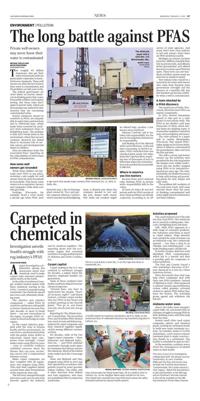
The Ahlstrom paper mill is seen Dec. 5 in Rhinelander, Wis.

A sign warns that nearby water contains PFAS chemicals Oct. 21, 2025, in Stella, Wis.
ENVIRONMENT | POLLUTION
The roughly 40 million Americans who get their water from private wells are particularly vulnerable to harmful forever chemicals. These well owners are often the last to know their water is contaminated, and the problem can take years to fix.
The federal government set strict limits on forever chemicals in drinking water that comes from public utilities and requires testing. But those rules don't apply to private wells, which can leave people near industrial sites unaware they are consuming contaminated water.
Forever chemicals, known to scientists as PFAS, are uniquely able to repel stains and moisture and to withstand heat, which made them essential for products from waterproof shoes to firefighting foam. The problem is they don't break down in the environment, where they are now common. Research has linked them to increased risk of certain cancers and developmental delays in children.
Here are takeaways from The Associated Press' reporting on the vulnerabilities of well owners to PFAS contamination.
How some well owners get stranded
While water utilities can typically treat PFAS in one place, restoring a safe supply for well owners must be done household by household. That leaves some owners out as regulators, lawyers and companies strike deals over who gets help.
Peshtigo, Wisconsin, for example, faced a crisis nearly a decade ago when PFAS were detected near a fire technology plant owned by Tyco and parent company Johnson Controls, which manufactured firefighting foam. A dispute over where the company needed to test and dig new, deeper wells meant that while one resident might be off ered help, another a few houses away would not.
Johnson Controls said it has taken full responsibility for the area its investigation showed was its responsibility.
And finding all of the aff ected wells can be laborious, costly and time consuming. In North Carolina, PFAS stretched from one chemical plant nearly 100 miles down the Cape Fear River, requiring tens of thousands of tests to determine where the contamination ends and find the households it aff ected.
Where in America you live matters
Because there aren't national rules limiting PFAS in private wells, responsibility falls to the states.
At least 20 states do not test private wells for PFAS outside of areas where problems are already suspected, according to an AP survey of state agencies. And many don't have clear policies to tell well owners when there are PFAS problems nearby.
Michigan, in contrast, has been proactive. Millions of people there rely on private wells, and officials tested groundwater and off ered free tests to owners near PFAS hot spots. These tests can cost hundreds of dollars, money many are reluctant or unable to spend.
New federal rules would be a nonstarter for many well owners who value their freedom from government oversight and the absence of a monthly bill. But that freedom can become a liability when a well is contaminated.
A town shocked by a PFAS discovery
The small town of Stella, Wisconsin, illustrates how PFAS can upend a community.
In 2022, Kristen Hanneman agreed to take part in a state project to test private wells. The PFAS in her family's well were thousands of times above federal limits for drinking water. It stunned her neighbors and led to years of investigation and worry.
The state pointed to a paper mill in nearby Rhinelander, Wisconsin, that spread PFASladen sludge on local farm fields, which it believes contaminated the groundwater, lakes and even the fish and deer.
The mill's current and former owners say the activities were permitted by the state long before the dangers were widely understood and the facility stopped using PFAS in its manufacturing process years ago. The state, meanwhile, has limited resources to help with testing and providing grants for new, deeper and safer wells.
The problem left residents of the rural town stuck, with some worried about what the years of drinking contaminated well water might mean for themselves and their children.