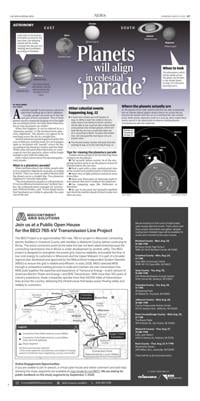


Planets will align in celestial 'parade'


A celestial "parade" is set to put on a show for spectators looking up to catch a glimpse.
Usually, people can look up at the sky and spot at least one planet. Two or three planets are also commonly hanging out in the night sky, according to NASA. But what about when four, five or even six planets are visible?
When that happens, it can be referred to as a "planetary parade," or the technical term, planetary alignment. The planets can appear to be marching across the sky in a straight line.
Another planetary parade happened earlier this year, in February. And this week, it's set to happen again as six planets will "parade" across the sky, according to the Planetary Society and Star Walk. While some will need either binoculars or a telescope to view the spectacle, others will be bright enough to spot with the naked eye.
Here's what to know about the upcoming planetary parade.
What is a planetary parade?
When multiple planets are visible, people refer to it as a planetary alignment or parade, according to NASA. They can create an optical illusion that the planets are in a straight line. True planetary alignment is virtually impossible.
"The term planetary parade is a colloquial term. It's not an official astronomical one," Andrew Fazekas, the communications manager for Astronomers Without Borders, said. "It just simply means that the planets are visible in, generally, the same area of the sky."
Tips for viewing the planetary parade
■ Fazekas advises people to do the following when trying to see the planets:
■ Get up early , before sunrise. Be at the star-gazing location ready to see the planets at least 45 minutes before the sun rises.
■ Find a spot with a clear, unobstructed view of the eastern and southern parts of the horizon.
■ Steer clear of light pollution and move away from cities.
■ Have your binoculars or telescope ready to view planets that aren't visible to the naked eye.
■ Use stargazing apps like Stellarium or SkySafari.
■ Be sure to also pack any mosquito repellent and check the weather ahead of time to make sure skies are clear.
Other celestial events happening Aug. 12
■ A total solar eclipse also will happen on Aug. 12. While it won't be visible in the U.S., some states from Alaska to North Carolina will be able to see a partial solar eclipse while using special solar eclipse glasses, which will look like the sun has a small bite taken out of it, according to NASA. To watch the eclipse live, visit nasa.gov/live starting at 1:15 p.m. Eastern time.
■ The Perseid meteor shower will peak from the evening of Aug. 12 to the morning of Aug. 13.
Where the planets actually are
As the planets of our solar system orbit the sun, they occasionally line up. Planets always appear along a line or arc across the sky because the planets orbit the sun in a relatively flat, disc-shaped plane. While planet alignment itself isn't unusual, what makes these events special is the opportunity to observe multiple planets simultaneously with the naked eye.
When to look
The phenomena, which will be visible across the globe, can be seen in the United States on Aug. 12 in the early morning hours.