
LEAVING HIS MARK
President focuses on reshaping America's cultural, historic sites
Trump
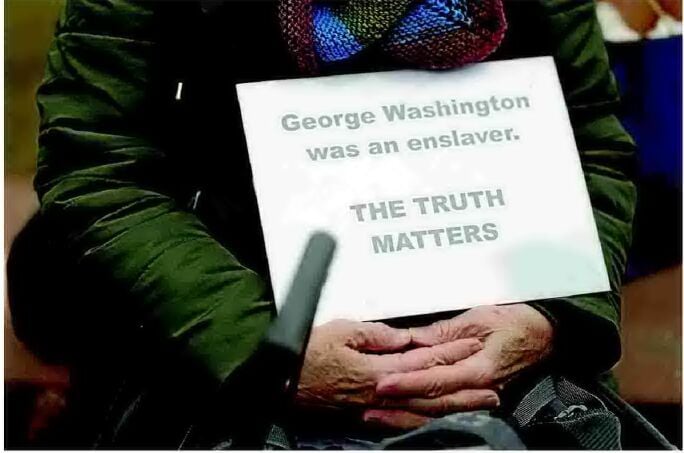
A person holds a sign Feb. 19 after National Park Service workers reinstalled a slavery exhibit at the President's House in Philadelphia.
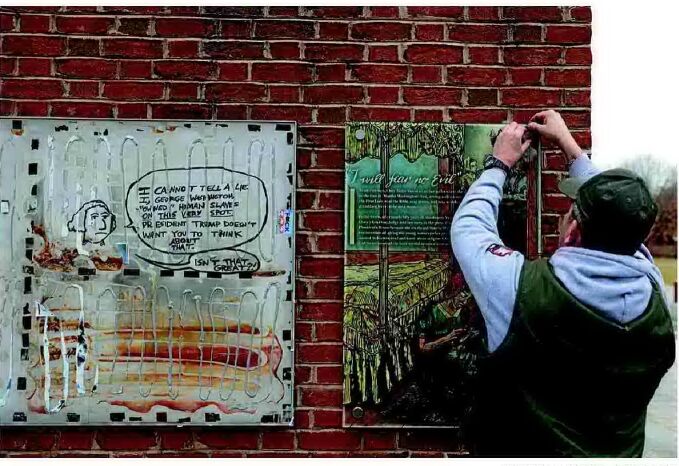
A worker from the National Park Service reinstalls a slavery exhibit Feb. 19 at a historic site in Philadelphia following a U.S. judge's order.

A newly installed statue of Italian explorer Christopher Columbus stands March 23 outside the Eisenhower Executive Office Building near the White House in Washington.

A worker stands on a lift Dec. 19 under U.S. President Donald Trump's name that was added to the facade of the John F. Kennedy Memorial Center for the Performing Arts in Washington, D.C.
TRUMP ADMINISTRATION
President Donald Trump has targeted U.S. cultural and historical institutions to remove what he calls "anti-American" ideology. His declarations and executive orders led to the dismantling of slavery exhibits, the restoration of controversial statues and other moves that civil rights advocates say could reverse decades of social progress.
Ideology, history
Trump signed a March 2025 executive order targeting what he said was the spread of "anti-American ideology" at the Smithsonian Institution and calling for the ideology's removal from the vast museum and research complex, a premier exhibition space for U.S. history and culture.
The order also directed the Interior Department to restore federal parks, monuments and memorials that were "removed or changed in the last years to perpetuate a false revision of history."
In August, Trump decried in a social media post what he said was an excessive focus on "how bad slavery was." In a January interview with the New York Times, when asked about policies that followed the Civil Rights Act of 1964, Trump said civil rights protections hurt white people.
Racial justice group Black Lives Matter said Trump's remarks showed he wants to deny the atrocities of slavery.
Parks' signs
The U.S. Interior Department said all national parks' interpretive signs — the plaques and panels that explain sites and events — were under review as the Trump administration attempted to reshape public spaces and museums.
U.S. National Park Service staff removed an exhibit Jan. 22 from a Philadelphia historic site where George Washington once lived and which included a reference to Washington's ownership of enslaved people. In February, a U.S. federal judge ordered the NPS to reinstall the exhibit.
The Washington Post reported that U.S. officials also ordered national parks to remove dozens of signs and displays related to slavery and the mistreatment of Native Americans by settlers.
Civil rights groups say such moves undermine the acknowledgment of critical phases of American history. "Stripping enslaved people's stories from museum exhibits, monuments, and digital archives is not neutrality — it is erasure," the NAACP said.
Statues reinstalled
The NPS said last August it would reinstall a statue of Confederate General Albert Pike that was toppled and vandalized in 2020 during racial justice protests after police murdered George Floyd, an unarmed Black man, in Minneapolis.
The Trump administration said March 18 that it will display in Washington a statue of Caesar Rodney, a signer of the Declaration of Independence and an enslaver, that was taken down in Delaware in 2020 amid racial justice protests.
On March 22, Trump said the White House installed on its grounds a statue of Italian explorer Christopher Columbus; it is reconstruction of one protesters dumped into Baltimore's harbor in 2020. Activists say heroic portrayals of Columbus downplay or ignore his cruelty toward Indigenous people of the Americas.
Smithsonian pressured
Trump harshly criticized the Smithsonian in a social media post last year, saying it would face the same process as colleges and universities whose funding came under threat for policies that displeased the Trump administration.
The 180-year-old Smithsonian, which includes 21 museums and galleries and the National Zoo, receives most of its budget from the U.S. Congress but is independent of the government in decision-making.
The White House launched an internal review of some Smithsonian museums last year, saying it would assess the tone and historical framing of exhibition materials.
Kennedy Center
Trump named himself chairman of the Kennedy Center and filled its board with allies last year.
In December, the institution's board voted to rename it the Donald J. Trump and the John F. Kennedy Memorial Center for the Performing Arts. Trump previously criticized the institution as too liberal.
Many groups and artists withdrew from the center, citing the Republican leader's takeover. Democrats, noting the center's name was established by Congress, said Trump's rebranding has no force of law. John F. Kennedy's family denounced the renaming as undermining the slain president's legacy.
Trump said Feb. 1 he plans to close the center for two years for reconstruction starting in July.
Other entities
The Trump administration announced last April that the Environmental Protection Agency would close a one-room museum at its headquarters on the agency's history, citing cost cuts.
Last May, Trump attacked historian Kim Sajet, director of the National Portrait Gallery in Washington, calling her partisan. She announced the following month that she would step down. Late last year, the White House fired several members of the National Council on the Humanities.
Trump also withdrew the U.S. from dozens of global and U.N. entities, including cultural and refugee agencies.